Lipids (OCR A-Level Biology A): Revision Notes
📚Revision Notes
Lipids
Introduction to lipids
Lipids are a diverse group of macromolecules that differ from carbohydrates and proteins in several important ways. Unlike carbohydrates and proteins, lipids are not polymers because they are not constructed from many repeating monomer units. Instead, they consist of smaller molecules combined in specific ways.
Note
The key distinction between lipids and other macromolecules lies in their structure: while carbohydrates and proteins are polymers built from repeating monomers, lipids are constructed from a small number of different molecules joined together in specific ways.
The lipid family includes triglycerides (fats and oils), phospholipids, waxes, and steroids such as cholesterol. All lipids share certain chemical characteristics:
- They contain the elements carbon (), hydrogen (), and oxygen ()
- The proportion of oxygen is much lower compared to carbohydrates
- They dissolve in organic solvents (such as ethanol) but not in water
- They are described as hydrophobic (water-repelling)
Biological roles of lipids
Lipids perform numerous functions in living organisms. Their unique chemical properties make them suited to specific biological roles.
Energy source and storage: Lipids have a high energy yield when respired, making them an efficient energy source. Plants store lipids as lipid droplets, while animals accumulate them as fat in specialised adipose tissue. This energy storage does not affect cellular water potential because lipids are insoluble in water.
Insulation: Fat acts as thermal insulation beneath the skin of mammals, reducing heat loss. It also provides electrical insulation around certain nerve cells in both vertebrates and some invertebrates. In plants, lipids form the waxy cuticle that covers leaves and stems, preventing water loss.
Structural components: All biological membranes are constructed from lipids, particularly phospholipids. These molecules create the membrane's characteristic barrier properties.
Hormone production: Steroid hormones (such as testosterone, oestrogen, and progesterone) are lipid-based molecules derived from cholesterol.
Additional functions: When oxidised during respiration, triglycerides release hydrogen molecules that combine with oxygen to form metabolic water. Desert animals rely on this water source for survival. Fat also aids buoyancy in aquatic animals such as whales and provides physical protection around vital organs.
Triglycerides
Structure and formation
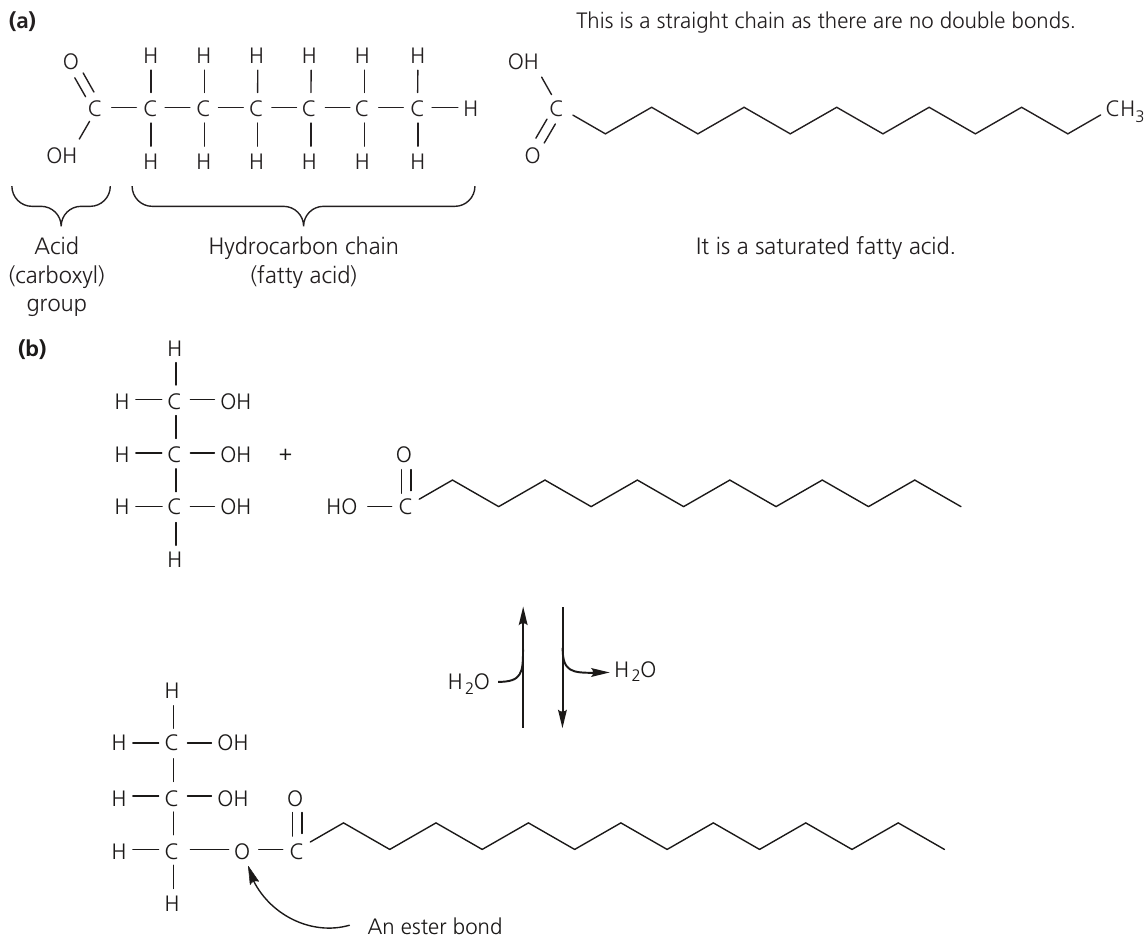
Triglycerides encompass both fats and oils. They form through condensation reactions between two types of molecules: glycerol and fatty acids. The chemical bond created is called an ester bond (or ester link).
Glycerol
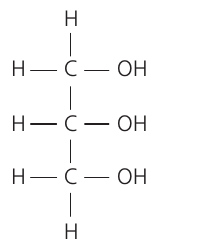
Glycerol is a small alcohol molecule containing just three carbon atoms. Its structure features three hydroxyl () groups, with one attached to each carbon atom. The remaining positions on the carbon atoms are occupied by hydrogen atoms.
Fatty acids
Fatty acids are larger molecules consisting of a long hydrocarbon chain with a carboxyl group () at one end. The carboxyl end reacts with the hydroxyl groups of glycerol during ester bond formation. At the opposite end, a methyl group () makes the entire chain hydrophobic.

The hydrocarbon chain length varies between different fatty acids, but typically contains between and carbon atoms. This hydrocarbon chain gives triglycerides their hydrophobic properties because the electrical charges are evenly distributed along the chain, preventing hydrogen bond formation with water molecules.
Formation of ester bonds
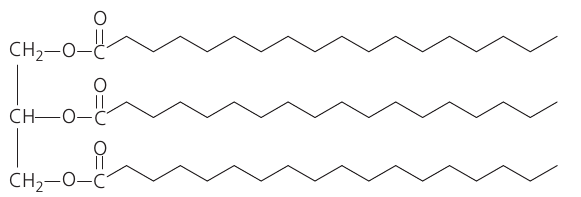
Because glycerol has three hydroxyl groups, three fatty acid molecules can bond to each glycerol molecule through three separate condensation reactions. This process releases three water molecules and forms three ester bonds, creating a complete triglyceride.
Important
Triglycerides are NOT polymers
While a triglyceride is a large molecule due to its long hydrocarbon chains, it is not a polymer. This is because it consists of only four smaller molecules (one glycerol and three fatty acids) that are not similar to each other. Remember: polymers are made from many repeating similar monomer units.
Saturated and unsaturated fatty acids
Saturated fatty acids
A saturated fatty acid contains only single bonds between all carbon atoms in its hydrocarbon chain. Each carbon atom in the chain bonds to two hydrogen atoms (except at the ends). When combined with glycerol, these form saturated fats. Saturated fatty acids are typically found in animal sources, such as stearic acid and butyric acid.
Unsaturated fatty acids
An unsaturated fatty acid contains at least one double bond () in its hydrocarbon chain. This is called a mono-unsaturated fatty acid. The presence of double bonds means fewer positions exist for hydrogen atoms to bond to carbon, resulting in fewer hydrogen atoms in the chain.
When multiple double bonds are present, the molecule becomes a poly-unsaturated fatty acid. These are typically found in plant sources, such as oleic acid.
Note
Saturation and hydrogen atoms:
The terms "saturated" and "unsaturated" refer to hydrogen atoms. A saturated fatty acid is "saturated" with hydrogen atoms - it contains the maximum number possible. An unsaturated fatty acid has fewer hydrogen atoms because double bonds between carbon atoms reduce the available bonding positions for hydrogen.
Structural consequences of unsaturation
The double bond in an unsaturated fatty acid creates a kink in the hydrocarbon chain at that position. This prevents the chains from lying straight and parallel to each other. Instead, the molecules push apart, making unsaturated fats less solid and more fluid at room temperature.
Phospholipids
Structure
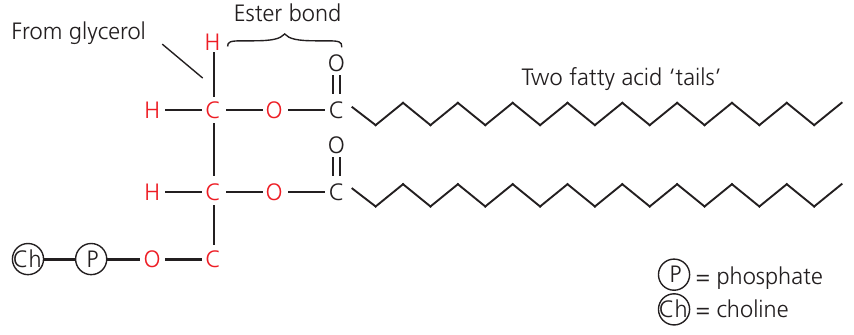
Phospholipids are similar to triglycerides in that they contain a glycerol molecule and fatty acids joined by ester bonds. However, phospholipids have only two fatty acid chains attached to the glycerol. The third hydroxyl group on the glycerol is occupied by a phosphate group, which also bonds through a condensation reaction.
In most phospholipids, the phosphate group attaches to a nitrogen-containing water-soluble molecule such as choline. This creates a phosphate 'head' - the combination of the original glycerol and phosphate group - which forms a hydrophilic (water-attracting) end to the molecule.
The two fatty acid chains form a double 'tail' that remains hydrophobic. These chains face away from water-based environments such as the cytoplasm and extracellular fluid.
Amphipathic nature
The fact that phospholipid molecules possess both hydrophobic and hydrophilic regions makes them amphipathic. This dual nature is crucial for their role in biological membranes.
Important
The importance of amphipathic properties:
The amphipathic nature of phospholipids is what enables them to form biological membranes. The phospholipids arrange themselves to form a barrier that controls which substances can enter and leave cells. The same type of membrane surrounds organelles within cells. This amphipathic property gives cell membranes many of their characteristic features, including selective permeability and the ability to self-assemble into bilayers.
Comparison with triglycerides
| Feature | Triglyceride | Phospholipid |
|---|---|---|
| Structure | One glycerol molecule and three fatty acids | One glycerol molecule, two fatty acids, and one phosphate group |
| Function | Energy source and energy store; insulation layer under skin or around nerves; protective layer around organs; waxy layer on plant leaves | Amphipathic molecule (has both hydrophobic and hydrophilic parts); acts as a barrier to many ions and molecules; basis of cell membranes; forms glycolipids used in cell signalling when carbohydrate chains attach |
Cholesterol
Cholesterol is a molecule structurally similar to phospholipids, possessing both hydrophobic and hydrophilic regions. It plays a vital role in the membranes of all eukaryotic cells. In vertebrates, cholesterol is synthesised in the liver and transported throughout the body via the bloodstream.
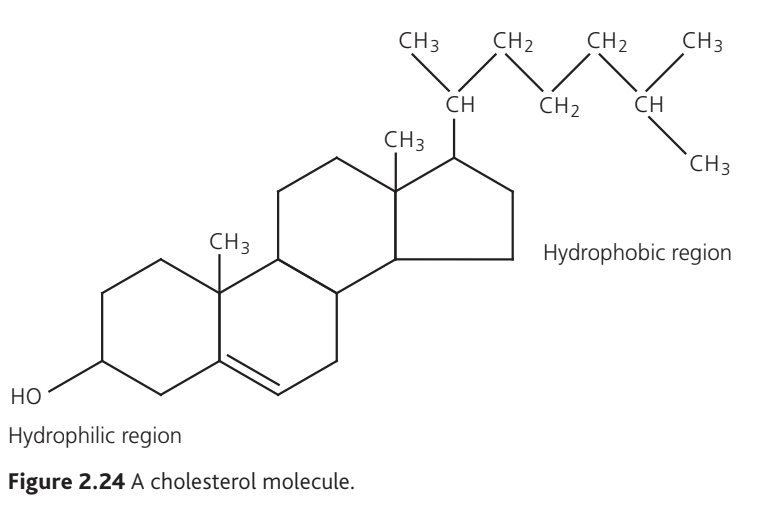
Beyond its importance in maintaining membrane structure, cholesterol serves as the precursor molecule for steroid-based hormones, including testosterone, oestrogen, and progesterone. The presence of cholesterol in membranes is one distinguishing feature between eukaryotic and prokaryotic cells.
Summary
Key Points to Remember:
-
Lipids are macromolecules composed of carbon, hydrogen, and oxygen (with low oxygen proportions). They are hydrophobic and dissolve in organic solvents but not in water.
-
Triglycerides form from one glycerol molecule and three fatty acids joined by ester bonds through condensation reactions, serving as efficient energy stores and insulation.
-
Saturated fatty acids contain only single bonds between carbon atoms, while unsaturated fatty acids have one or more double bonds that create kinks in the chain, affecting physical properties.
-
Phospholipids consist of glycerol, two fatty acids, and a phosphate group, creating an amphipathic molecule with both hydrophobic tails and a hydrophilic head essential for membrane formation.
-
Cholesterol is a steroid lipid with both hydrophobic and hydrophilic regions, vital for eukaryotic cell membranes and the synthesis of steroid hormones.