Water, Hydrogen, and Carbon (OCR A-Level Biology A): Revision Notes
📚Revision Notes
Water, Hydrogen, and Carbon
Constituents of cells
Approximately of all living organisms consist of just four elements: carbon, hydrogen, oxygen, and nitrogen. These elements combine with a small number of additional elements to form all the molecules found within living cells.
The resulting molecules are termed biological molecules, which include:
- Water, which constitutes a substantial proportion of living cells
- Carbon-based molecules combined with hydrogen and oxygen (e.g. carbohydrates and triglycerides)
- Carbon-based molecules containing nitrogen alongside carbon, hydrogen, and oxygen (e.g. proteins and nucleic acids)
Note
These four elements make up the vast majority of all living matter because they can form stable covalent bonds and create the complex molecules necessary for life.
Water and hydrogen bonding
Water is essential for life. The human body comprises approximately water, whilst certain plants and animals may contain up to water by mass.
Structure of water
A water molecule (H₂O) forms when two hydrogen atoms bond covalently with one oxygen atom. A covalent bond is a strong chemical bond created by sharing electrons between atoms.
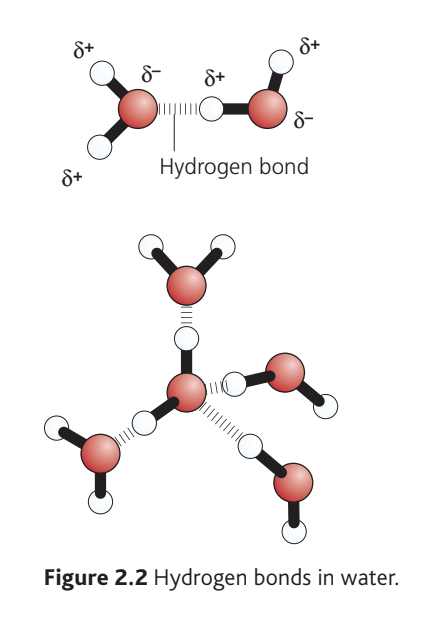
The oxygen atom draws electrons away from the hydrogen atoms, creating an uneven distribution of charge within the molecule. This forms a polar molecule – one with regions of negative and positive charge. The oxygen carries a slight negative charge (δ⁻), whilst each hydrogen carries a slight positive charge (δ⁺). Overall, the molecule remains electrically neutral.
Important
Understanding Polarity
The uneven distribution of charge in water molecules is crucial to understanding all of water's unique properties. The oxygen end is slightly negative (δ⁻) while the hydrogen ends are slightly positive (δ⁺). This polarity enables water to form hydrogen bonds and dissolve other polar substances.
Hydrogen bonds
Water molecules attract one another through weak interactions called hydrogen bonds. These form between the slightly positive hydrogen of one water molecule and the slightly negative oxygen of an adjacent molecule.
This attraction causes water molecules to flow together as a liquid and to be drawn towards charged particles or charged surfaces. Other similar molecules behave differently due to their distinct properties. For instance, hydrogen sulfide (H₂S) exists as a gas at 0\,^{\circ}\mathrm{C} because of its very low boiling point, whereas water remains liquid at this temperature – accounting for many of water's unique characteristics.
Note
Hydrogen bonds are much weaker than covalent bonds, but they occur in such large numbers that they significantly influence water's properties. Each water molecule can form up to four hydrogen bonds with surrounding water molecules.
Unique properties of water
Thermal properties
Hydrogen bonds between water molecules continuously form and break, permitting the molecules to flow freely.
Water exists as a liquid between and , providing an ideal habitat for living organisms. Water functions as an efficient coolant due to its high specific heat capacity – it absorbs considerable heat energy relative to its mass.
Water molecules cannot readily escape unless heat energy is supplied to weaken the hydrogen bonds. At , water transforms into a gas called water vapour.
As water molecules cool, they lose kinetic energy and the hydrogen bonds become harder to break. The molecules form a more rigid structure – a solid (ice). At , solid water is less dense than liquid water and therefore floats on its surface. This creates an insulating layer that maintains a more constant temperature in the water beneath, allowing organisms to survive below the ice.
Important
Ice is Less Dense Than Water
This is unusual – most substances are denser in solid form than liquid form. When water freezes, the hydrogen bonds arrange water molecules in a crystalline structure with spaces between them, making ice less dense. This property is crucial for aquatic life survival during winter, as the ice layer insulates the water below.
Water as a solvent
Water molecules (the solvent) surround solute molecules and maintain them in solution – for example, in salt or sugar solutions. A solution consists of a liquid (the solvent) containing dissolved solids, liquids, or gases (solutes).
The dissolved solute reacts more readily when in solution and can participate in metabolic processes. Because water is polar, other polar molecules dissolve readily in water.
Carbon-containing molecules with charged ionised groups – such as carboxyl groups (–COO⁻) or amino groups (–NH₃⁺) – dissolve easily by forming hydrogen bonds with water's hydroxyl groups (–OH).
Ionic substances like sodium chloride (NaCl) release positively charged ions (cations) or negatively charged ions (anions), such as Na⁺ and Cl⁻. Water molecules form clusters around these ions, keeping them dissolved.
Non-polar substances cannot dissolve in water and are repelled by it. They are termed hydrophobic (water-repelling), such as oils. This property is important in the phospholipid bilayer of cell membranes.
Note
Water's ability to dissolve polar and ionic substances while repelling non-polar substances is fundamental to cellular organization. The hydrophobic effect drives the formation of cell membranes, where non-polar fatty acid tails cluster together away from water.
The role of water in living things
The thermostable properties of water and its capacity to act as a solvent perform vital roles in living organisms. These properties enable chemical reactions to occur within cells and allow molecules to dissolve in the cytosol.
Water serves as an ideal transport medium because it dissolves polar molecules and ions, which can then be transported efficiently around living organisms – for example, in the blood transport system of many animals.
Hydrogen bonds cause water molecules to be attracted to each other (cohesion) and to surfaces (adhesion). Cohesion is a property where water molecules are attracted to each other by hydrogen bonding, allowing them to move together. Adhesion is a property where water molecules are attracted to surfaces such as cell walls, vessels, or tubes.
The hydrogen bonds pull water molecules towards each other, causing them to stick together. At the surface, these bonds pull molecules inward, creating surface tension – a force that stretches the surface. This effect is visible in spherical water droplets on glass or waxy leaves. Some insects exploit this surface tension to move across water surfaces.
Due to cohesion and adhesion combined, water can move up narrow tubes (such as a straw or a xylem vessel in plant vascular tissue). Water also functions as a coolant for plants as it moves through the transpiration stream, and provides suitable habitats for organisms in both freshwater and saltwater environments.
Example
Worked Example: Cohesion and Adhesion in Action
Consider water moving up a xylem vessel in a tall tree:
Step 1: Water molecules at the top evaporate from leaves (transpiration)
Step 2: Cohesion between water molecules creates a continuous column of water
Step 3: Adhesion to the vessel walls prevents the column from breaking
Result: Water is pulled up from the roots to heights of over 100 meters in some trees, purely through these physical properties – no energy required from the plant!
An abundance of carbon
In living organisms, the most common element by mass is oxygen, followed by carbon.
Carbon as a building block
Atoms share electrons to achieve a complete outer shell, making them stable. Carbon makes an excellent building block because it is a small atom with four pairs of electrons in its outer shell. These electron pairs repel each other, pushing the atom into a tetrahedral shape.
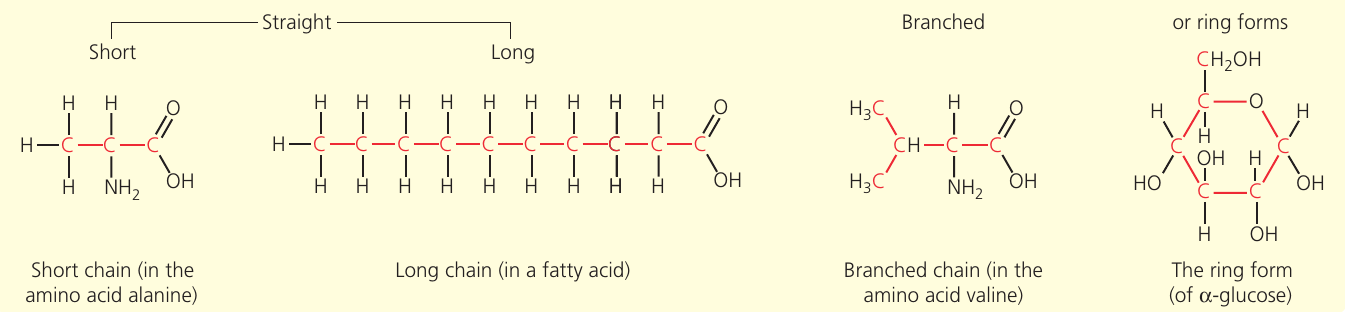
These four electron pairs can be shared with other atoms to form covalent bonds, enabling atoms to join and create organic molecules. Carbon's four bond sites form stable, strong covalent bonds capable of building larger molecules.
Important
Why Carbon is Special
Carbon's four bonding sites allow it to form an almost infinite variety of molecules. No other element can match carbon's versatility in forming stable, complex molecules. This is why carbon is the foundation of all known life – it's called the "element of life."
Carbon atoms can bond to other carbon atoms, forming:
- Short chains (e.g. in the amino acid alanine)
- Long chains (e.g. in fatty acids)
- Branched chains (e.g. in the amino acid valine)
- Ring shapes (e.g. in α-glucose)
Carbon also forms covalent bonds with oxygen, hydrogen, and other atoms such as nitrogen and sulfur, creating numerous different large molecules.
Sometimes carbon forms two bonds with another atom, called a double bond. In hydrocarbon chains, two carbons may share two bonds (C=C). In glucose, one oxygen atom forms a double bond with an adjacent carbon atom (C=O).
Note
The ability of carbon to form single, double, and even triple bonds with other atoms greatly increases the diversity of possible organic molecules. This bonding flexibility is essential for creating the complex molecules needed for life.
Building large molecules from small – monomers and polymers
Monomers and polymers
A monomer is a single small molecule that can form covalent bonds with other similar small molecules to build a larger molecule. These bonds form through a condensation reaction.
A dimer consists of two monomers joined by a condensation reaction.
A polymer is a large molecule constructed from many similar monomers joined by covalent bonds to form a chain or branched chain. Each bond forms via a condensation reaction.
| Biological molecules | Monomers | Polymers |
|---|---|---|
| Carbohydrates | Monosaccharides (e.g. glucose, fructose, ribose, triose) | Polysaccharides (e.g. starch/amylose, glycogen, cellulose) |
| Proteins | Amino acids (e.g. glycine, valine, alanine) | Polypeptides (e.g. amylase, lysozyme) |
| Nucleic acids | Nucleotides | Polynucleotides (e.g. DNA, RNA) |
Condensation reactions
Each monomer joins to another by forming a specific covalent bond through a chemical reaction called a condensation reaction. In this reaction, one molecule of water (two hydrogen atoms and one oxygen atom) is released.
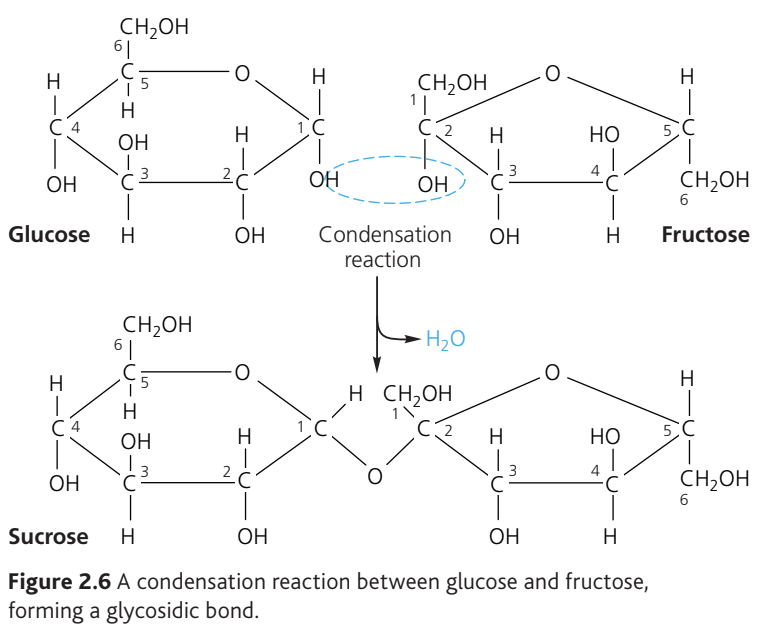
The same reaction repeats each time another monomer is added to form the polymer. Condensation reactions (also termed dehydration reactions) are involved in forming many macromolecules, including triglycerides.
Important
The Condensation Reaction Process
A condensation reaction is a chemical reaction where two molecules join with a covalent bond, forming a larger molecule and releasing one water molecule.
This is how all biological polymers are built – whether carbohydrates, proteins, or nucleic acids. Each time a monomer is added to a growing chain, one water molecule (H₂O) is released.
Hydrolysis reactions
A hydrolysis reaction is the chemical reaction that splits molecules joined by covalent bonds. In hydrolysis, a water molecule must be added to break the covalent bond, releasing the smaller molecules.
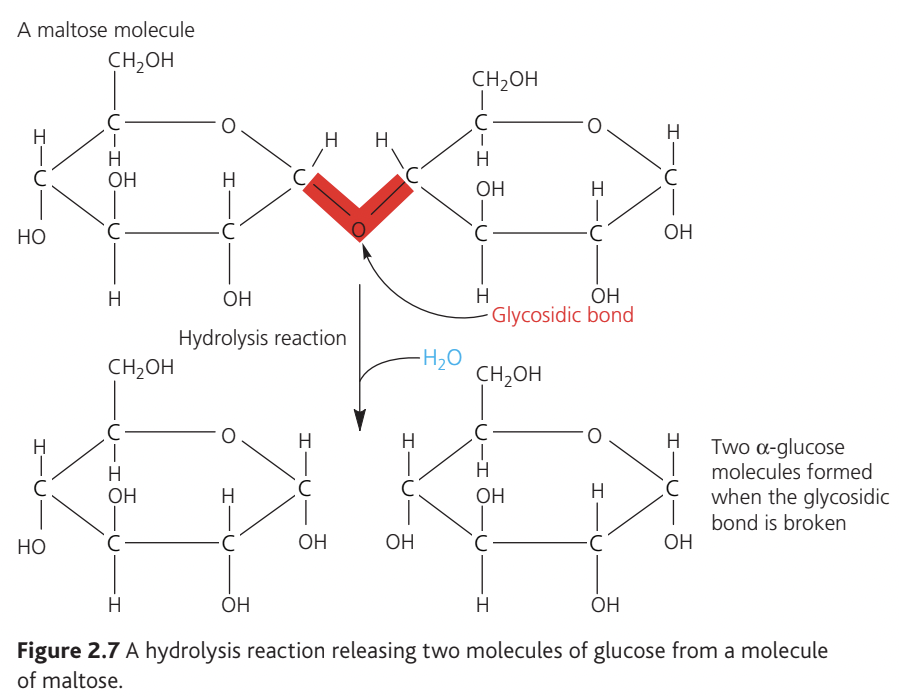
Hydrolysis occurs when breaking down disaccharides such as maltose, sucrose, and lactose. In maltose, two glucose molecules are released. In sucrose, one glucose and one fructose are released. In lactose, one glucose and one galactose are released.
Example
Worked Example: Breaking Down a Disaccharide
Consider the hydrolysis of sucrose (table sugar):
Step 1: Start with sucrose molecule (C₁₂H₂₂O₁₁)
Step 2: Add one water molecule (H₂O) to break the bond
Step 3: The glycosidic bond breaks
Products: One glucose molecule (C₆H₁₂O₆) + one fructose molecule (C₆H₁₂O₆)
This reaction occurs during digestion when enzymes break down the sugar you eat into simpler sugars your cells can use.
Note
Condensation and hydrolysis are opposite reactions. Condensation builds polymers by removing water; hydrolysis breaks polymers apart by adding water. These reactions are fundamental to metabolism – building up molecules when needed and breaking them down when energy or raw materials are required.
Stabilisation of polymers
Polymers are often very large molecules, stabilised by numerous hydrogen bonds. These bonds help molecules maintain their final shape. Shape is crucial to molecular function, so hydrogen bonds (alongside other bonds) are important in maintaining polymer function.
Summary
Key Points to Remember:
- Water is a polar molecule due to uneven charge distribution, with oxygen slightly negative (δ⁻) and hydrogen slightly positive (δ⁺)
- Hydrogen bonds form between water molecules, giving water unique properties: high specific heat capacity, surface tension, cohesion, adhesion, and excellent solvent properties
- Carbon has four bond sites, allowing it to form stable covalent bonds in chains, branches, or rings, making it the ideal building block for biological molecules
- Monomers join through condensation reactions (releasing H₂O) to form polymers; polymers break down through hydrolysis reactions (adding H₂O)
- Approximately of living things consist of just four elements: carbon, hydrogen, oxygen, and nitrogen
- The polarity of water enables it to dissolve ionic and polar substances while repelling non-polar substances – essential for cellular organization
- Carbon's versatility in forming different structures (chains, branches, rings) and bond types (single, double, triple) makes it uniquely suited as the foundation of all biological molecules