Cloning in Animals (OCR A-Level Biology A): Revision Notes
📚Revision Notes
Cloning in Animals
Animal cloning produces genetically identical organisms through both natural and artificial methods. While less common than in plants, several animal species can reproduce asexually or be artificially cloned for agricultural, medical, and conservation purposes.
Natural cloning
Animals reproduce asexually less frequently than plants, particularly those with complex body structures. However, some species have evolved natural cloning mechanisms.
Note
While asexual reproduction is common in plants and simple organisms, it remains relatively rare in animals due to their complex developmental requirements and body organization.
Parthenogenesis
Parthenogenesis is a form of asexual reproduction where offspring develop from unfertilised eggs. Female aphids demonstrate this process during the growing season by producing diploid eggs through mitosis rather than meiosis. These eggs develop inside the mother's body without fertilisation by sperm, containing only maternal genetic material. The eggs hatch internally and emerge as miniature versions of adult aphids. All offspring produced this way form a clone – a group of genetically identical individuals sharing the same genome.
Important
Key concept: A clone is a group of genetically identical individuals that share exactly the same genome. In parthenogenesis, all offspring are clones because they contain only the mother's DNA without any genetic contribution from a male.
Identical twins
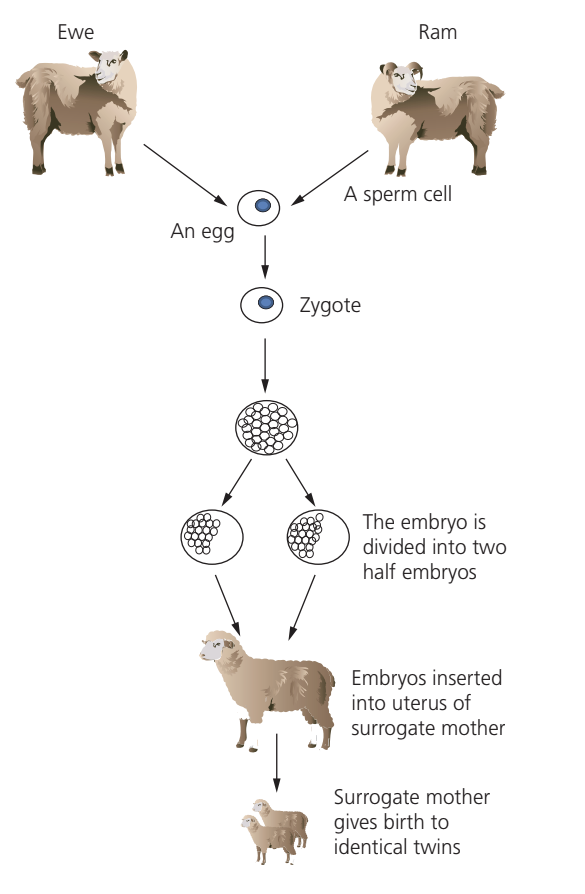
Embryos formed through sexual reproduction can naturally divide into two separate embryos during early development. The resulting identical twins are genetically identical because they originate from the same fertilised egg (the fusion of one sperm and one egg). These twins represent clones of each other, not of their parents, and are always the same sex since they share identical genetic information.

In contrast, non-identical twins develop from two separately fertilised eggs. They are no more genetically similar than ordinary siblings and may be the same sex or different sexes.
Artificial cloning
Scientists have developed techniques to clone animals artificially for agricultural and medical applications.
Embryo twinning
Embryo twinning (also called embryo splitting or embryo cloning) replicates the natural process that produces identical twins. Early-stage embryos are divided into two or more groups of cells in the laboratory. Each group is cultured separately to develop into a complete embryo with identical DNA to its siblings.
After several days of development, these embryos are implanted into the uterus of one or more surrogate mothers who carry them to full term. This technique typically uses embryos from elite female animals whose valuable genetics can be preserved without subjecting them to the physical demands of pregnancy. The female may instead produce additional embryos through in vitro fertilisation.
Note
Embryo cloning has been routine practice for livestock breeding (cattle, pigs, sheep) since the 1980s. However, this method cannot predict the exact productivity of offspring since they result from sexual reproduction involving meiosis and fertilisation, which introduce genetic variation.
Reproductive cloning
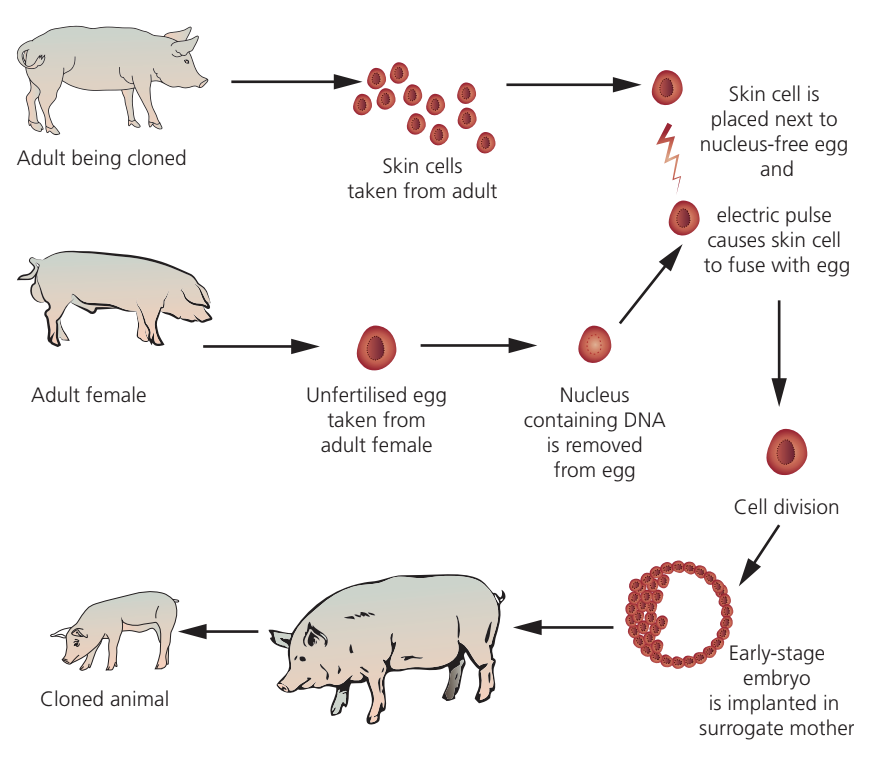
Reproductive cloning creates an organism that is genetically identical to an adult donor animal. This technique uses somatic cell nuclear transfer (SCNT), a process significantly different from embryo twinning.
The SCNT process
SCNT involves several precise steps:
Example
The SCNT Process: Creating a Clone from an Adult Animal
Step 1: An unfertilised egg is removed from a female animal
Step 2: The nucleus is extracted from this egg, creating an enucleated egg
Step 3: A somatic cell (body cell) is taken from the adult animal to be cloned – typically from skin, gut lining, or udder tissue
Step 4: The nucleus from the somatic cell is transferred into the enucleated egg using one of two methods:
- Direct injection of the extracted nucleus using a fine needle
- Electrical pulse that causes the entire somatic cell to fuse with the enucleated egg
Step 5: The egg containing the donor nucleus is stimulated to divide through electrical pulses
Step 6: Once a small embryo has formed through cell division, it is implanted into a surrogate mother
Step 7: The surrogate carries the embryo to full term
John Gurdon produced the first cloned animal from an adult in using the South African clawed toad (Xenopus laevis). He removed nuclei from toad eggs and replaced them with nuclei from gut lining cells. The first cloned livestock animal was Dolly the sheep, born in at the Roslin Institute near Edinburgh. Dolly represented the successful outcome of the th cloning attempt, highlighting the technical challenges of SCNT.
Important
Success rates in cloning: Dolly the sheep was born after 277 unsuccessful attempts, demonstrating that reproductive cloning remains technically challenging with very low success rates even with modern technology.
Many mammal species have since been cloned from somatic cells, including cats, deer, dogs, horses, mules, cattle, rabbits, and rats.
Interspecific SCNT
Interspecific SCNT (iSCNT) uses eggs from a different species than the donor animal. This technique has applications in preserving rare livestock breeds and endangered species where insufficient females of the target species are available to act as surrogates. In iSCNT, embryos are implanted into domesticated animals of a related species.
Example
Case Study: The Pyrenean Ibex Cloning Attempt
The Pyrenean ibex (a wild goat species) became extinct in . Researchers attempted to clone the last surviving individual in using stored cells and domestic goat eggs.
Process: Various species served as surrogate mothers, and one clone was born.
Outcome: The clone survived only a few hours due to severe lung defects.
Possible cause: Frozen storage may have damaged the DNA, contributing to this failure.
This case highlights both the potential and limitations of using cloning for species conservation.
Therapeutic cloning
Therapeutic cloning follows the same initial stages as reproductive cloning through SCNT. However, once the embryo forms with nuclei from an adult's somatic cells, its cells are harvested and subdivided rather than implanted for full development. These stem cells can differentiate into any cell type, offering potential treatments for replacing damaged or worn tissues in patients. Researchers aim to use patient-matched stem cells to treat degenerative conditions like Alzheimer's disease or to generate organs for transplantation.
Important
Critical difference: While reproductive cloning creates a complete organism, therapeutic cloning produces stem cells for medical treatment. The embryo is not implanted into a surrogate mother but is instead used as a source of stem cells.
Since stem cells derived this way are genetically identical to the patient, they avoid immune rejection. However, no stem cell therapy based on SCNT-derived cells currently exists for clinical use.
Uses of animal cloning
Animal cloning provides several practical applications:
Agricultural production
Cloning enables mass production of animals with desirable characteristics. Unlike conventional breeding through sexual reproduction, cloning guarantees that offspring inherit specific productive traits such as high milk yield in dairy cattle. Elite animals can be replicated without the genetic variation introduced by meiosis and fertilisation.
Medical and pharmaceutical research
Reproductive cloning produces genetically engineered livestock that synthesise human proteins in their milk or tissues. Laboratory animals created through cloning eliminate genetic variability in drug testing and medical research, providing more reliable experimental results. This standardisation parallels the value of identical twins in human medical studies.
Conservation
SCNT offers a tool for preserving endangered species and rare livestock breeds, though technical and ethical challenges remain significant. Success rates vary considerably between species and individual attempts.
Arguments for and against artificial cloning
Challenges and limitations
Important
Low success rates characterise reproductive cloning attempts. Dolly the sheep resulted from the th attempt, and Japanese researchers cloned eight calves from one cow but only four survived. Many cloning attempts fail at various stages from nuclear transfer through pregnancy to the first months after birth.
Large offspring syndrome (LOS) affects many cloned animals that survive to birth. These individuals are abnormally large with disproportionately sized organs, causing breathing difficulties and circulatory problems. Scientists cannot reliably predict which clones will develop LOS.
Even clones without LOS may develop organ malformations affecting the liver, kidneys, or brain, along with impaired immune systems causing health problems throughout life. Research suggests the cloning process interferes with precise gene regulation during embryonic development, leading to these abnormalities.
Note
iSCNT complications include mitochondrial DNA mismatch. Animals produced through interspecific SCNT have nuclear DNA from the donor species but mitochondrial DNA from the egg donor species, making them incomplete clones. Several wild cattle species were cloned shortly after Dolly, but calves died soon after birth.
Ethical considerations
Embryo twinning generates minimal controversy as it extends a natural process and rarely involves human embryo experimentation or destruction. Few ethical objections arise compared to other cloning methods.
Reproductive cloning raises significant concerns:
- High failure rates and animal suffering during unsuccessful attempts
- Risks to both surrogate mothers and clones during pregnancy
- Resource investment for uncertain outcomes, particularly for endangered species
- Cloned endangered animals often live only in zoos and ex situ conservation facilities rather than wild populations
- Questions about interference with natural reproduction
Important
Therapeutic cloning destroys pre-embryos to harvest stem cells, raising ethical debate about embryo status and rights. The technique offers potential medical benefits but involves destroying early-stage human embryos, which some consider morally unacceptable.
Genetic diversity concerns
Widespread cloning of elite animals reduces genetic variation within populations, potentially increasing susceptibility to diseases and environmental changes. A genetically uniform population lacks the diversity needed to adapt to new pathogens or altered conditions.
Remember!
Summary
Key Points to Remember:
-
Parthenogenesis is natural asexual reproduction where unfertilised eggs develop into offspring (e.g., aphids produce diploid eggs through mitosis)
-
Embryo twinning splits early embryos to create genetically identical individuals that are clones of each other but not their parents
-
SCNT (somatic cell nuclear transfer) transfers a nucleus from an adult somatic cell into an enucleated egg to clone the adult organism
-
Reproductive cloning creates a new organism genetically identical to the donor, while therapeutic cloning produces stem cells for medical treatment
-
Cloning faces significant challenges including:
- Low success rates (Dolly was the th attempt)
- Large offspring syndrome
- Organ abnormalities
- Ethical concerns about embryo use and animal welfare