Factors Affecting the Evolution of a Species (OCR A-Level Biology A): Revision Notes
📚Revision Notes
Factors Affecting the Evolution of a Species
Population dynamics and selection pressures
Organisms within a population naturally reproduce, and without limiting factors, population numbers would increase exponentially. However, several factors restrict this growth. Selection pressures are factors that provide certain individuals in a population with a greater chance of survival compared to others. These pressures include both biotic factors (predation, competition for resources, disease) and abiotic factors (availability of space, minerals, water supply).
Environmental resistance refers to the combined effect of biotic and abiotic factors that prevent unlimited population growth. When environmental resistance acts on a population, not all individuals can survive because the environment has finite resources.
Note
The carrying capacity represents the maximum population size that a particular habitat can sustainably support over time. Once a population reaches this threshold, resources become insufficient for all individuals, leading to mortality among some members before they can reproduce.
Within any population, variation exists between individuals. Some organisms possess adaptations that make them better suited to their environment, allowing them to compete more effectively for resources. These individuals demonstrate a higher relative survival rate and are more likely to pass their advantageous alleles to subsequent generations. This differential survival forms the basis of natural selection.
Stabilising selection
Stabilising selection operates when selection acts against the extreme phenotypes in a population, removing individuals at both ends of the distribution while maintaining those near the mean. This type of selection preserves the population's characteristics over time rather than causing change.
Example
Example: Human Birth Weight
A 1973 study demonstrated that both very small and very large babies experience higher mortality rates compared to babies of intermediate weight. Extremely low birth weight babies often face physiological challenges, while exceptionally large babies may encounter complications during delivery. As a result, birth weight remains relatively stable within a narrow range around the mean value.
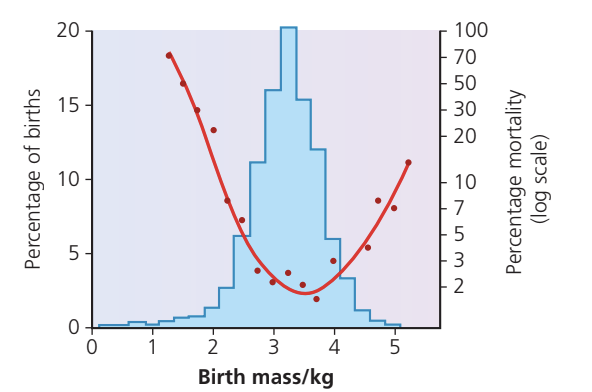
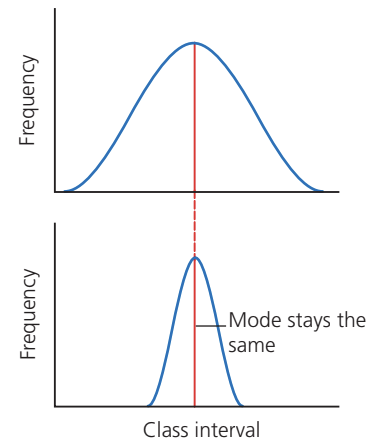
When a new, extreme phenotype emerges in a population under stabilising selection, it confers no selective advantage. Natural selection therefore removes these extremes from the population, maintaining the norm. The mode (most common value) of the distribution remains constant over generations.
Directional selection
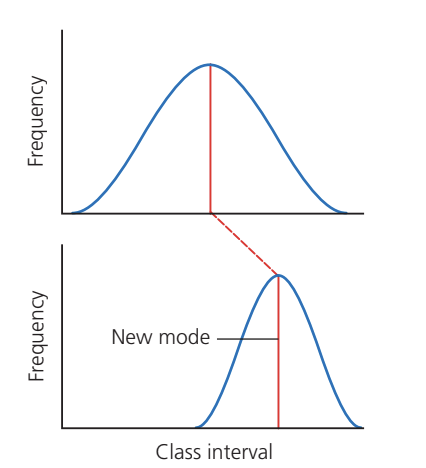
Directional selection occurs when environmental conditions change, favouring individuals with characteristics better suited to the new environment. Unlike stabilising selection, directional selection causes the population to change over time by favouring one extreme of the phenotype range.
Individuals possessing advantageous features have a competitive advantage—they are more likely to survive to reproductive age and produce offspring. Consequently, the alleles coding for these beneficial traits increase in frequency within the population across generations. The population's characteristics shift in one direction, with an increasing proportion of individuals displaying the advantageous feature.
Darwin's finches: a case study
Example
Worked Example: Directional Selection in Ground Finches
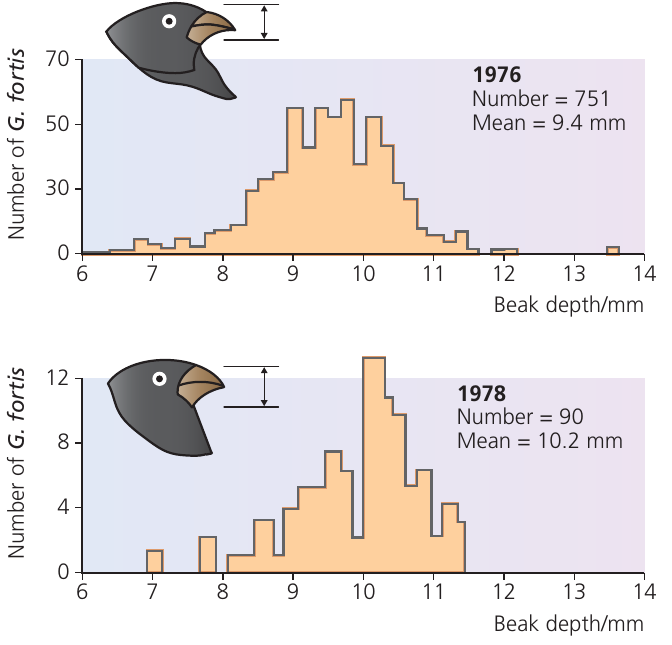
Ground finches (Geospiza fortis) on Daphne Major island in the Galápagos archipelago provide a classic demonstration of directional selection in action. During the 1970s, a severe drought devastated the island's plant populations. Many seed-producing plants died, leaving primarily hardy, large-seeded species.
This environmental change created strong selection pressure. Finches with smaller beaks could not crack the large, tough seeds and faced starvation. However, individuals possessing a genetic mutation for slightly larger beak size could access this food source and survived the drought.
The data clearly show this evolutionary shift:
- In 1976 (before the drought): individuals, mean beak depth = mm
- In 1978 (after the drought): individuals, mean beak depth = mm
The population experienced both a dramatic reduction in size and a measurable shift toward larger beak dimensions.
Important
Natural selection is the mechanism underlying evolution. It describes the survival to reproductive age of organisms with characteristics best suited to their environment, increasing the probability that their alleles will be transmitted to future generations.
Genetic drift
Genetic drift refers to random changes in allele frequency within a population that occur independently of natural selection. Whether particular alleles are passed to the next generation may be entirely due to chance rather than conferring any adaptive advantage.
Important
Genetic drift has its greatest impact in small populations. When a population is small, the alleles that happen to be passed on—purely by chance—can cause substantial changes in allele frequencies. In large populations, random sampling effects average out, so genetic drift has minimal impact.
In extreme cases, genetic drift may result in the complete elimination of an allele from a population within just one or two generations. This reduces genetic variation within the population, which can increase extinction risk or potentially contribute to the formation of new species through reproductive isolation.
Genetic bottleneck
A genetic bottleneck (or population bottleneck) occurs when a population's size is sharply and severely reduced due to environmental catastrophes (volcanic eruptions, earthquakes, floods, droughts), disease outbreaks, or human activities such as overhunting.
Following such an event, all subsequent generations descend from the small number of survivors. The gene pool available from these few individuals is extremely limited compared to the original population, resulting in dramatically reduced genetic diversity at each gene locus. Allele frequencies in the post-bottleneck population will differ substantially from those in the original population.
Examples of genetic bottlenecks
Note
Hawaiian goose (Nēnē): The Hawaiian goose (Branta sandvicensis) evolved after the Canada goose arrived on Hawaii approximately 500,000 years ago. Geographic isolation on the Hawaiian islands created a genetic bottleneck. Mitochondrial DNA analysis reveals that modern Nēnē populations are closely related to the giant Canada goose and dusky Canada goose but possess extremely limited genetic diversity.
Northern elephant seal: Mirounga angustirostris represents a classic example of a human-caused genetic bottleneck. Intensive hunting reduced the population to merely 30 individuals by 1890. Although the population has since recovered to hundreds of thousands of individuals, genetic analysis shows the species still carries very limited genetic variation—a legacy of that near-extinction event.
Giant panda: Genomic studies of giant pandas reveal evidence of a severe genetic bottleneck that occurred approximately 43,000 years ago. This ancient population crash continues to affect the species' genetic diversity today.
Genetic drift very commonly follows genetic bottlenecks, as the small surviving population experiences random changes in allele frequencies, further reducing genetic diversity.
Founder effect
The founder effect occurs when a small population colonises a new geographical area, such as a newly formed volcanic island. Until mutations generate new alleles in this population, only the alleles present in the original colonising individuals can occur in subsequent generations.
This small founding population may have allele frequencies quite different from the original source population, and genetic diversity is necessarily reduced. The founder effect therefore creates populations with distinct genetic characteristics compared to related populations elsewhere.
Experimental evidence
Example
Worked Example: Testing the Founder Effect with Anolis Lizards
Researchers tested the founder effect hypothesis using the brown anolis lizard (Anolis sagrei). They randomly selected male and female lizards from one large population and released small groups onto seven previously uninhabited small islands in the Bahamas.
Results: Over time, all seven island populations evolved similar adaptations suited to life on small islands (demonstrating convergent evolution). However, they retained the genetic differences inherited from their specific founder groups, supporting the founder effect model.
Human genetic diseases and the founder effect
Note
Huntington's disease in Tasmania: This neurodegenerative condition is caused by a dominant allele coding for an abnormally long huntingtin protein. The extended protein accumulates in brain tissue, causing neuronal death. Tasmania has twice the incidence of Huntington's disease compared to the rest of Australia, traced to a single individual with the disease who settled in Tasmania and passed the mutant allele to descendants.
Tibial muscular dystrophy in Finland: This condition results from a mutant allele of the TTN gene, which codes for the skeletal muscle protein titin. It affects approximately 10 in every 100,000 people in Finland—a much higher frequency than in other populations. This elevated incidence stems from a mutation present in the founder population that colonised Finland and gave rise to the modern Finnish population.
Eye defects in Pacific island populations: On a small island in the western Pacific, a disproportionately high number of individuals suffer from an inherited eye defect. This pattern arose because a recessive mutant allele was present in just one of the original colonising individuals. As the small population interbred, the recessive condition appeared at higher frequencies than would occur in larger populations.
Remember!
Summary
Key Points to Remember:
- Selection pressures (biotic and abiotic factors) limit population growth by reducing survival rates of less well-adapted individuals.
- Stabilising selection removes extreme phenotypes, maintaining population characteristics around the mean value over time (e.g. human birth weight).
- Directional selection favours one extreme phenotype when environmental conditions change, causing the population to evolve (e.g. larger beak size in drought-affected finches).
- Genetic drift causes random changes in allele frequencies, having the greatest impact in small populations and potentially eliminating alleles entirely.
- Genetic bottlenecks and the founder effect both drastically reduce genetic diversity—bottlenecks through population crashes, founder effects through colonisation by small groups—with long-lasting consequences for genetic variation.