Using the Hardy–Weinberg Principle (OCR A-Level Biology A): Revision Notes
📚Revision Notes
Using the Hardy–Weinberg Principle
Introduction
The Hardy-Weinberg principle, developed by G.H. Hardy and Wilhelm Weinberg, provides a mathematical model for predicting allele frequencies in populations across multiple generations. This principle relies on understanding the gene pool – the complete collection of alleles for a particular gene within an entire population.
Note
The Hardy-Weinberg principle is fundamental to population genetics, providing a baseline model for understanding how genetic variation is maintained or changes over time. It serves as a null hypothesis for detecting evolutionary change.
The gene pool
The gene pool represents all the alleles for a particular gene present in a whole population. When analyzing genetic variation, we examine how frequently different alleles occur within this pool. Understanding the gene pool allows us to calculate both allele frequencies (how common each allele is) and genotype frequencies (how common each genetic combination is).
Note
Definition: Gene Pool
All the alleles for a particular gene in the whole population.
Hardy-Weinberg equations
Allele frequency equation
When a gene has two alleles at a locus, the frequencies of these alleles must sum to (representing 100% of the population). This relationship is expressed as:
Where:
- = frequency of the dominant allele
- = frequency of the recessive allele
- = the whole population
Genotype frequency equation
The frequencies of all possible genotypes in a population must also sum to . This is represented by:
Where:
- = frequency of the homozygous dominant genotype
- = frequency of the heterozygous genotype
- = frequency of the homozygous recessive genotype
Note
Why 2pq?
The term includes a factor of because heterozygotes can form in two ways: receiving the dominant allele from either parent (mother or father). This accounts for both possible combinations.
Important
Exam tip: Both equations are always provided in exam questions. Determine whether you are given information about allele frequencies (use ) or genotype frequencies (use ).
Worked example: cystic fibrosis
Example
Worked Example: Calculating Allele and Carrier Frequencies
Cystic fibrosis is an inherited condition caused by a recessive allele, resulting in excess thick mucus that makes breathing and digestion difficult. This example demonstrates how to calculate allele frequencies from phenotype data.
Given information:
- Incidence: in individuals affected
- Inheritance pattern: recessive allele (requires homozygous recessive genotype)
- Two alleles: (dominant, normal) and (recessive, cystic fibrosis)
Step 1: Calculate (frequency of affected individuals)
Since affected individuals must be homozygous recessive (), we can determine:
Step 2: Calculate (frequency of recessive allele)
To find the frequency of the recessive allele:
Step 3: Calculate (frequency of dominant allele)
Using :
Results:
- Frequency of (recessive allele) = 0.02 or 2%
- Frequency of (dominant allele) = 0.98 or 98%
Step 4: Calculate carrier frequency
Carriers are heterozygous individuals () who do not show symptoms but can pass the allele to offspring. Their frequency is represented by :
Final Answer: Approximately 4% of the population are carriers of the cystic fibrosis allele.
Assumptions of the Hardy-Weinberg principle
The Hardy-Weinberg principle predicts that allele frequencies remain constant across generations only when five specific conditions are met:
-
No migration – No individuals enter (immigration) or leave (emigration) the population, preventing introduction or removal of alleles
-
No gene mutation – No new alleles arise or existing alleles change, keeping the gene pool stable
-
Large, random breeding population – The population is sufficiently large that all individuals can breed freely and randomly with equal reproductive success, eliminating sampling errors and mate preference
-
No selection – All genotypes have equal survival and reproductive rates, meaning no allele confers advantage or disadvantage
-
No genetic drift – Random changes in allele frequencies due to chance events do not occur (this typically requires a large population)
Important
Common Pitfall
In reality, no natural population perfectly meets all five assumptions. The Hardy-Weinberg principle provides an idealized model. Deviations from Hardy-Weinberg equilibrium indicate that evolutionary forces are acting on the population, making it a powerful tool for detecting natural selection, migration, or other evolutionary processes.
Hardy-Weinberg equilibrium
When a population meets all five assumptions, it is said to be in Hardy-Weinberg equilibrium for that gene locus. At equilibrium, allele frequencies remain constant from one generation to the next.
Note
Testing for Equilibrium
Populations can be tested for Hardy-Weinberg equilibrium by observing allele frequencies across multiple generations. If frequencies remain stable and match predicted values, the population is likely at equilibrium. Deviations from expected frequencies suggest one or more assumptions are violated, indicating evolutionary forces are acting on the population.
Application: the MN blood group system
The MN blood group system provides a useful example of Hardy-Weinberg calculations with codominant alleles. Unlike the ABO system, this system has two codominant alleles ( and ) at the L gene locus.
Population data
In a sample population:
- 36% are homozygous (blood type MM)
- 48% are heterozygous (blood type MN)
- 16% are homozygous (blood type NN)
Example
Worked Example: Calculating Allele Frequencies from Genotype Data
In a population of individuals, there are total alleles (each person carries two):
Step 1: Count alleles
- From individuals:
- From individuals:
- Total alleles:
Step 2: Calculate frequency of allele
Step 3: Count alleles
Number of alleles:
Step 4: Calculate frequency of allele
Verification: ✓
Practical modeling activity
The Hardy-Weinberg principle can be modeled using colored beads representing different alleles. For the MN system, red beads represent alleles and yellow beads represent alleles. The beads are placed in an opaque container (the gene pool), and pairs are randomly selected to simulate reproduction over multiple generations.
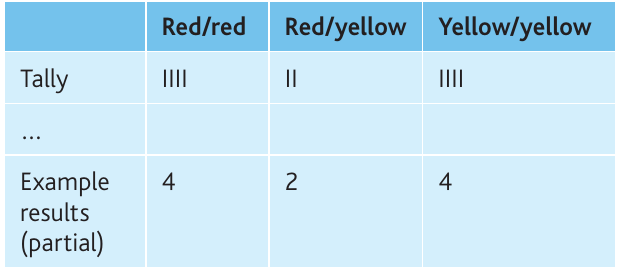
This hands-on activity demonstrates how random mating maintains allele frequencies when Hardy-Weinberg assumptions are met. By removing certain phenotypes between generations, students can observe how selection pressure alters allele frequencies over time.
Remember!
Summary
Key Points to Remember:
-
The Hardy-Weinberg principle uses two equations: for allele frequencies and for genotype frequencies
-
The gene pool contains all alleles for a gene in a population; allele frequencies describe how common each variant is
-
To calculate carrier frequency for recessive conditions, use after determining from the frequency of affected individuals ()
-
Five assumptions must be met for Hardy-Weinberg equilibrium: no migration, no mutation, large random breeding population, no selection, and no genetic drift
-
When populations are in equilibrium, allele frequencies remain constant across generations; deviations indicate evolutionary change is occurring