Effects of Humans on the Environment (OCR A-Level Biology A): Revision Notes
📚Revision Notes
Effects of Humans on the Environment
Introduction
Human activities have significant impacts on ecosystems, particularly those that are sensitive to environmental changes. This topic examines two key areas:
- The effects of human activities on plant and animal populations in sensitive ecosystems and methods to control these impacts
- Managing conflicts between species preservation and conservation alongside the demands of growing human populations
The following table identifies several environmentally sensitive regions worldwide, their conservation importance, and the threats they face:
| Region | Specific Interest | Threats |
|---|---|---|
| Galápagos Islands, Eastern Pacific Ocean | Many endemic species including those studied by Charles Darwin | Invasive species, overpopulation with humans, tourism pressure |
| Antarctica | Very productive marine environment supporting huge biodiversity | Climate change, overexploitation, tourism and scientific research development |
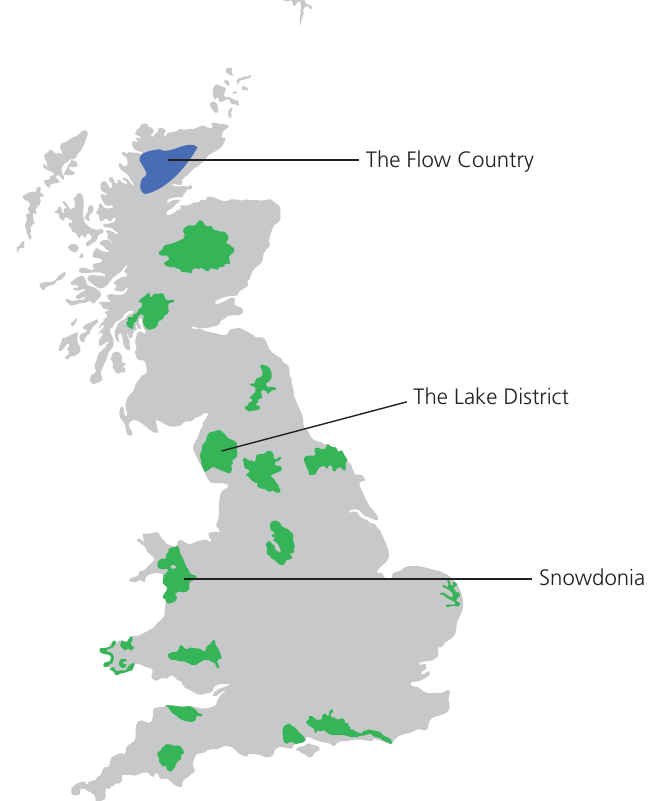
| Snowdonia National Park, Wales | Maintaining scenic beauty of mountainous area | Invasive plant species |
| Lake District, North-West England | Maintaining access for visitors | Environmental damage from visitor pressure |
| Flow Country, Northern Scotland | Peat bogs as carbon sinks, rare ecosystems | Development and forestry |
| Masai Mara National Reserve, Kenya | Populations of large mammals in savanna ecosystem | Increase in local human population and tourism |
| Terai Region, Nepal | Several flagship species of conservation | Poaching, habitat fragmentation |
Examples of environmentally sensitive areas
Antarctica
Antarctica is a continent covering million km² with many outlying islands including South Georgia, the South Orkneys, and the South Shetland Islands. The entire region is protected by the Antarctic Treaty, which reserves the continent for peace and science.
Terrestrial and marine ecosystems
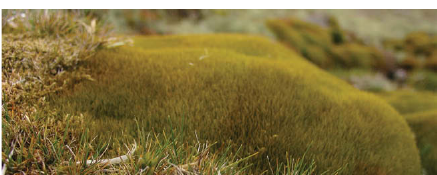
On land, productivity is very low. Plant life is restricted to ice-free areas and consists of low-growing mosses, lichens, and liverworts.
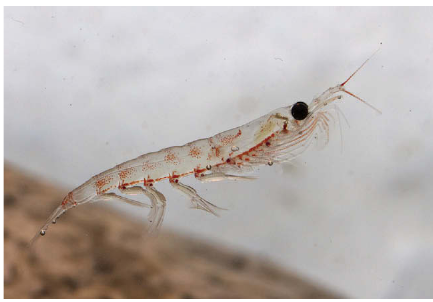
In contrast, marine ecosystems show huge productivity. During summer months, phytoplankton utilize the high mineral concentrations in Antarctic waters. These phytoplankton are consumed by krill - small crustaceans that grow to mm in length and form the main food source for many predators including penguins and marine mammals.
Note
The Role of Krill in Antarctic Ecosystems:
Krill occupy a critical position in Antarctic food webs. They feed on phytoplankton and in turn provide food for numerous species including whales, seals, penguins, and other seabirds. This makes krill populations essential for the health of the entire Antarctic marine ecosystem.
Human impacts on Antarctic ecosystems
Important
Three Main Human Impacts on Antarctica:
Human activity affects Antarctic ecosystems in three primary ways:
1. Global warming effects: The Antarctic Peninsula has warmed by over in the last years, with far-reaching consequences for both terrestrial and marine ecosystems.
2. Sea ice reduction: Seas around the Peninsula have warmed significantly, causing a 40% decline in sea ice area over the past years, which directly impacts the marine food web.
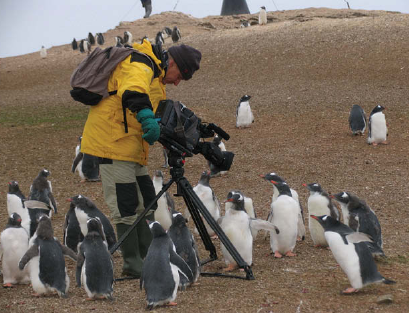
3. Introduction of alien species: Visitors to Antarctica (tourists, researchers, and film crews) have introduced non-native plant and animal species, particularly from the Arctic, which are becoming established as temperatures warm.
Consequences of warming temperatures:
- Certain lichens, mosses, and liverworts have expanded their geographical range into previously too-cold areas
- Primary productivity has increased due to warmer temperatures and increased snow-free areas
Sea ice reduction impacts the marine ecosystem:
Young krill graze phytoplankton from the underside of winter sea ice. Reductions in sea ice have led to:
- Decreased phytoplankton availability for krill
- Population declines in Adélie penguins and chinstrap penguins
- Loss of breeding grounds for Adélie penguins when sea ice melts too early
- Declines in emperor penguin populations, with some colonies disappearing completely
Note
Tourist numbers have increased dramatically, from approximately visitors in – to over in –. This trend could have significant impacts on the Antarctic environment in the future, including disturbance to wildlife and introduction of more alien species.
Conservation measures
The Convention on the Conservation of Antarctic Marine Living Resources (CCAMLR) came into force in as part of the Antarctic Treaty System. It was established primarily to prevent overfishing of krill, which could seriously affect populations of krill-dependent species.
CCAMLR pioneered the ecosystem approach to fisheries regulation. This approach does not focus solely on the population dynamics of harvested species but also seeks to minimize harm to the entire ecosystem. Conservation does not exclude harvesting, provided catches remain sustainable.
The Protocol on Environmental Protection to the Antarctic Treaty (in force since ) establishes clear environmental regulations for all Antarctic activities, including:
- Designation of specially protected areas
- Creation of exclusion zones where scientific bases and tourist activities are prohibited
Snowdonia National Park
Snowdonia National Park in Wales covers just over km². A major conservation problem is the invasive species Rhododendron ponticum, which forms large bushes or shrubs.
Characteristics and spread
Rhododendrons were introduced as horticultural plants and to provide cover for pheasants approximately years ago. Since escaping cultivation, they have become established over hectares in Snowdonia.
Key characteristics that make R. ponticum an effective colonizer:
- Produces vast numbers of seeds (a single large bush can produce million tiny seeds annually)
- Seeds are tiny and easily dispersed
- Requires moist conditions for germination
- Can grow to heights of m or more
- Has dense evergreen leaves creating deep shade beneath
- Long-lived plants that can reproduce vegetatively through adventitious roots
The rate of spread has been exponential, and the species has not yet reached its carrying capacity in Snowdonia.
Ecological impacts
Important
Severe Ecological Damage from R. ponticum:
The invasive species has devastating consequences for native ecosystems:
- Dense evergreen canopy makes ground underneath so dark that few plants survive
- Kills local vegetation wherever it colonizes
- Does not support many other species as leaves are poisonous to most invertebrates and mammals
- Leaves decompose very slowly, accumulating and damaging soils and freshwater bodies
- Hosts the plant pathogen Phytophthora ramorum, which threatens conifers (especially Japanese larch)
- Makes otherwise suitable habitats unsuitable for grazing animals as it is unpalatable and toxic
Control methods
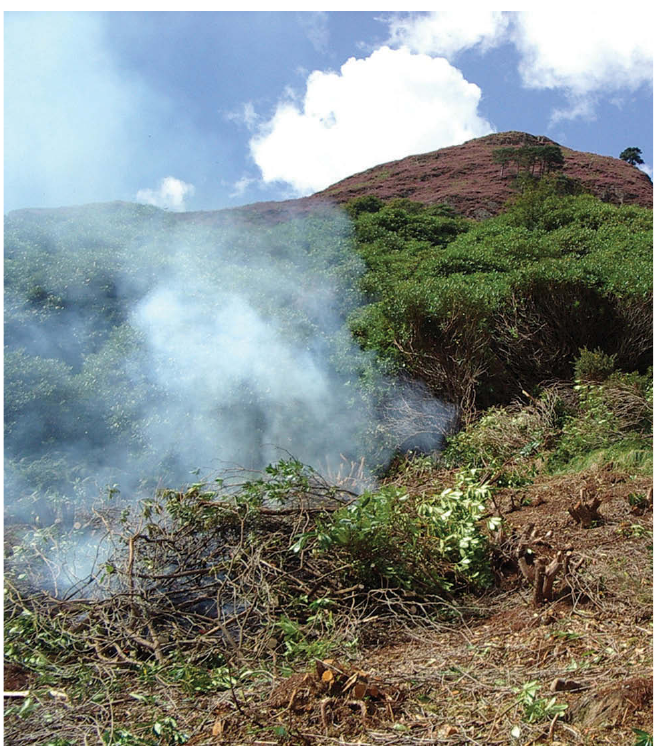
Controlling R. ponticum requires sustained effort over many years. The approach varies depending on the scale of infestation.
Example
Control Programme for R. ponticum:
For scattered bushes:
- Stem injection method: Drill holes into each stem and apply herbicides directly to kill individual plants
For larger infestations:
Phase 1: Cut down and burn or chip the bushes to remove above-ground biomass
Phase 2: Approximately months after cutting, spray regrowth with herbicides (this step is essential to prevent vigorous regrowth from the root system)
Phase 3: Continue monitoring and treatment over a minimum of years for the initial management
Long-term: Maintain ongoing management for a minimum of additional years to prevent re-establishment
Note
Partnership Approach to Conservation:
The Snowdonia National Park Authority, National Trust, Gwynedd Council, and Natural Resources Wales formed the Snowdonia Rhododendron Partnership. This partnership works with private landowners, concentrating control efforts in the Nant Gwynant/Beddgelert area. This collaborative approach ensures resources are used effectively and control efforts are coordinated across land ownership boundaries.
Managing conflicts between conservation and human needs
The Flow Country
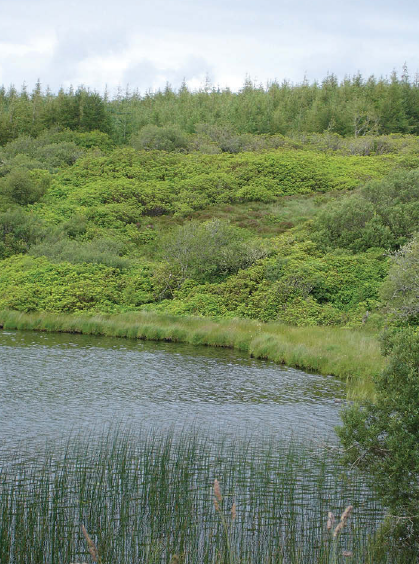
The Flow Country is an expanse of blanket bog extending over km² in Caithness and Sutherland, northern Scotland.
Ecosystem characteristics
A blanket bog forms in areas with:
- High rainfall and high humidity
- Poorly drained soil
- Continuous water flow that leaches out bases, maintaining acidic conditions
- Low nutrient availability
- Limited detritivores and decomposers
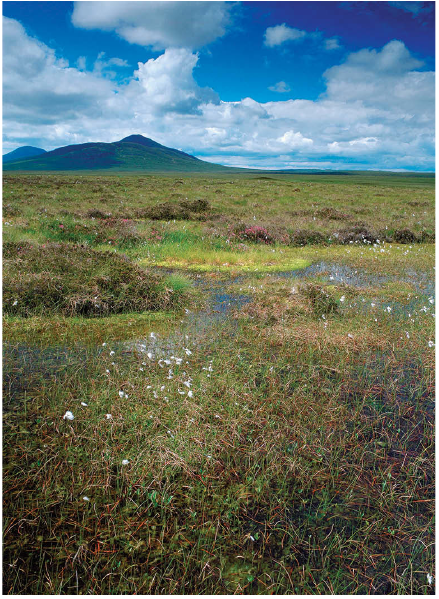
The climax community consists of low-growing heather and, in very wet areas, Sphagnum moss. Vegetation includes:
- Cross-leaved heath (Erica tetralix)
- Ling (Calluna vulgaris)
- Sphagnum papillosum
- Deergrass (Trichophorum cespitosum)
- Bog myrtle (Myrica gale)
- Hare's-tail cottongrass (Eriophorum vaginatum)
Note
The region is particularly important for:
- Large continuous areas of Sphagnum carpets and hummocks (including S. fuscum, S. imbricatum, and S. pulchrum)
- Numerous pools of water and small lochs (lakes)
These features make the Flow Country one of the most significant blanket bog systems in the world.
Importance as a carbon sink
The Flow Country is the largest peat mass in the UK and three times larger than any similar area in Britain or Ireland. Dead plant material does not decay in the waterlogged, acidic conditions, so carbon compounds are not respired to carbon dioxide as would occur in aerated soils.
The peat in the Flow Country stores 400 million tonnes of carbon, making it a major carbon sink - a reservoir that removes carbon dioxide from the atmosphere and stores it long-term.
Threats and conservation
Important
Major Threats to the Flow Country:
Drainage to 'improve' ground for cultivation: When land is drained, it dries out and natural vegetation dies. The exposed peat begins to decompose, releasing stored carbon back into the atmosphere as carbon dioxide.
Afforestation (planting trees): Between and , tens of thousands of hectares were planted with non-native conifer trees, driven by inappropriate forestry grants and tax breaks. This destroyed large areas of blanket bog and released stored carbon.
Conservation measures:
- Tax breaks were eventually removed to stop further afforestation
- The Royal Society for the Protection of Birds (RSPB) and other organizations took steps to protect the area from future development
- Some land has been restored by removing trees and blocking drains to re-establish waterlogged conditions
- The RSPB established the Forsinard Flows nature reserve
- Other areas are designated as Sites of Special Scientific Interest (SSSIs)
The Terai region, Nepal
The Terai region lies along the southern edge of Nepal below the Himalayan foothills and extends into northern India. The natural vegetation consists of savanna, marshy grasslands, and forest. The region has experienced large-scale deforestation over the past years.
Flagship species
The Terai is one of only two places in the world where three large mammal species coexist:
- Bengal tiger (Panthera tigris tigris) - IUCN status: Endangered
- One-horned rhinoceros (Rhinoceros unicornis) - IUCN status: Vulnerable
- Indian elephant (Elephas maximus) - IUCN status: Endangered
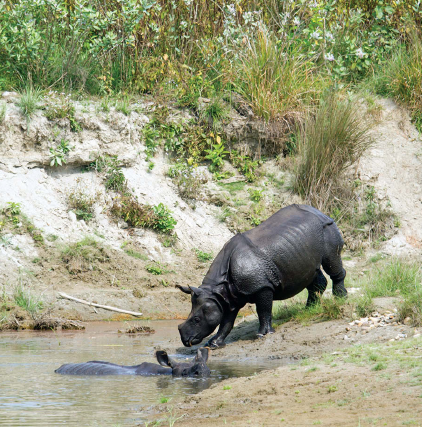
These three flagship species - charismatic species used to promote conservation - are protected by reserves and parks across India and Nepal, forming the Terai Arc Landscape.
Note
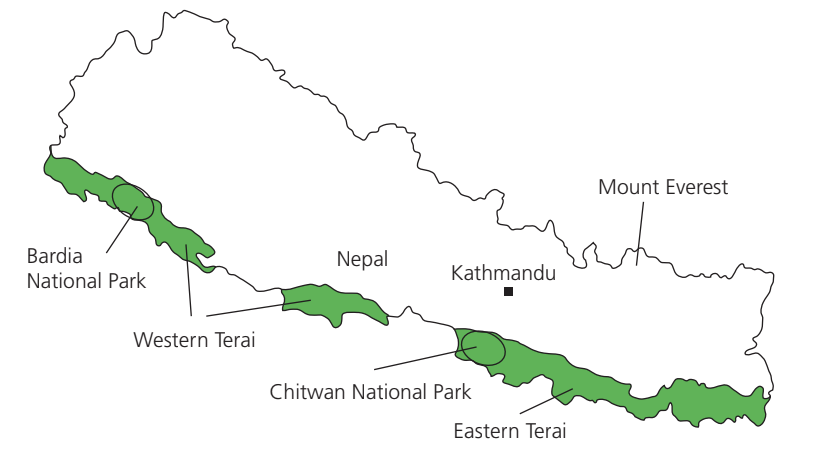
The two main national parks in the Terai region of Nepal are:
- Bardia National Park (western Terai)
- Chitwan National Park (eastern Terai)
Together with Banke National Park, the coherent protected area of km² represents the Tiger Conservation Unit (TCU) Bardia-Banke, extending over km² of alluvial grasslands and subtropical moist deciduous forests.
Conservation challenges
Important
Poaching Threats:
All three flagship species have been heavily poached:
- Rhino and tiger body parts are used in traditional medicine in Asia (particularly China and Vietnam)
- Elephant tusks are used in the ivory trade (flourishing in Thailand and Southeast Asia)
Thanks to efforts by the Nepalese government and army patrols in national parks, poaching has decreased in Nepal.
Population monitoring:
In –, intensive sampling using transects and camera traps estimated the tiger population to be individual adults ( males, females, and of undetermined sex). Chitwan National Park alone contains approximately tigers and has the world's second-largest concentration of one-horned rhinos.
Ecosystem approach to conservation
In situ conservation (conserving species in their natural habitat) requires maintaining fully functioning ecosystems. This is particularly challenging for large predators like Bengal tigers because:
- They require large hunting areas to obtain sufficient energy
- Top predators are naturally rare, even without human interference
- Removal of large predators decreases biodiversity at all trophic levels
Conflicts with human populations:
Conserving large areas for wildlife conflicts with human needs, as local populations use:
- Forests as fuel sources
- Savanna for grazing livestock

Example
Requirements for Effective Wildlife Corridors:
Wildlife corridors connect parks and reserves into a network of protected areas. Few protected areas are large enough to support viable populations of large mammals alone, so corridors allow tigers and other large mammals the space they need to maintain healthy populations.
Essential characteristics:
- Sufficient width: Must be broad enough for animals to use without threat from human activities
- Ongoing maintenance: Need continuous protection from human interference and encroachment
- Network connectivity: Should connect multiple protected areas to create a functional network that supports genetic diversity and population viability
Summary
Key Points to Remember:
-
Sustainable forestry methods like strip felling and coppicing maintain biodiversity while allowing timber production. Trees act as carbon sinks, storing atmospheric carbon as wood.
-
Antarctica faces three main threats: global warming (reducing sea ice and affecting krill populations), ozone thinning, and direct exploitation through tourism and harvesting. International treaties like CCAMLR protect the ecosystem using an ecosystem approach.
-
Invasive species like Rhododendron ponticum in Snowdonia can devastate native ecosystems. Control requires sustained multi-year efforts including cutting, herbicide treatment, and partnership working.
-
Blanket bogs like the Flow Country are major carbon sinks storing millions of tonnes of carbon. They are threatened by drainage and afforestation but protected through designation as SSSIs and active restoration.
-
Large predator conservation requires an ecosystem approach with large protected areas and wildlife corridors. This creates conflicts with human populations but is essential for maintaining biodiversity at all trophic levels.