Acids, Bases and pH (OCR A-Level Chemistry A): Revision Notes
📚Revision Notes
Brønsted–Lowry Acids and Bases
Introduction to acid-base models
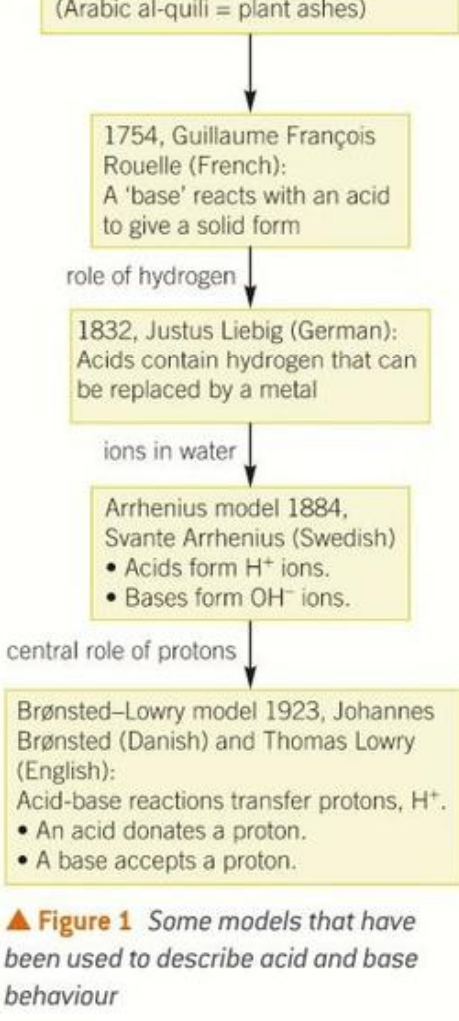
Understanding acids and bases has evolved significantly over time. Early scientists recognised that acids taste sour and bases (or alkalis) come from plant ashes. As chemistry developed, several key models emerged to explain acid-base behaviour.
The Arrhenius model (1884) was an important early theory that described:
- Acids dissociate and release ions in aqueous solution
- Alkalis dissociate and release ions in aqueous solution
- Neutralisation occurs when ions react with ions to form water
However, this model was limited to aqueous solutions only. The Brønsted-Lowry model, developed in 1923, extended this understanding by emphasising the central role of proton transfer between chemical species.
Note
The Brønsted-Lowry model represents a significant advancement because it can explain acid-base behaviour in non-aqueous solvents and provides a more unified understanding of proton transfer reactions across different chemical systems.
Brønsted–Lowry definitions
The Brønsted-Lowry model provides a more comprehensive way to understand acid-base reactions by focusing on what happens to protons (hydrogen ions) during chemical reactions.
What is a Brønsted–Lowry acid?
A Brønsted–Lowry acid is a species that donates a proton () to another species.
When an acid dissolves in water, it releases protons. For example, hydrochloric acid dissociates as follows:
In this reaction, HCl is acting as an acid because it donates a proton.
What is a Brønsted–Lowry base?
A Brønsted–Lowry base is a species that accepts a proton () from another species.
Bases receive protons during reactions. Common examples include hydroxide ions () and ammonia (). When a base accepts a proton, it forms a new species.
Important
An important feature of the Brønsted-Lowry model is that it works in any solvent, not just water, making it more versatile than the Arrhenius model. This means you can have acid-base reactions in solvents like liquid ammonia, ethanol, or even in the gas phase.
Conjugate acid-base pairs
One of the most important concepts in Brønsted-Lowry theory is the idea of conjugate acid-base pairs. These pairs are intimately connected through proton transfer.
Understanding conjugate pairs
A conjugate acid-base pair consists of two species that differ by one proton (). The two species can be interconverted by transferring a single proton between them.
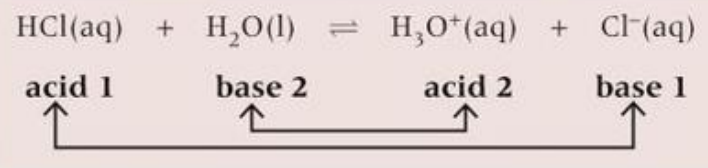
Let's examine the dissociation of hydrochloric acid:
Although this equation shows an equilibrium, HCl is a strong acid, so the position of equilibrium lies far to the right. We can often use a single arrow to show the reaction goes essentially to completion:
In this reaction:
- In the forward direction: HCl releases a proton to form its conjugate base,
- In the reverse direction: accepts a proton to form its conjugate acid, HCl
HCl and therefore form a conjugate acid-base pair.
Examples of conjugate acid-base pairs
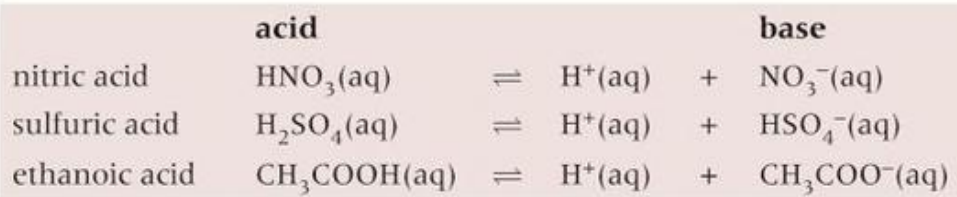
Different acids form different conjugate bases when they donate a proton. Here are some common examples:
Note
Notice that:
- Nitric acid () and the nitrate ion () form a conjugate pair
- Sulfuric acid () and the hydrogensulfate ion () form a conjugate pair
- Ethanoic acid () and the ethanoate ion () form a conjugate pair
Each conjugate base is simply the acid with one fewer hydrogen ion.
Identifying acid-base pairs in equilibria
Many acid-base reactions involve two conjugate acid-base pairs because both the forward and reverse reactions involve proton transfer.
Consider the reaction between hydrochloric acid and hydroxide ions:
We can label the species as follows:
- Acid 1: HCl (donates a proton)
- Base 2: (accepts a proton)
- Acid 2: (formed when base 2 accepts the proton)
- Base 1: (formed when acid 1 donates the proton)
The two conjugate acid-base pairs are:
- HCl and (acid 1 - base 1)
- and (acid 2 - base 2)
Important
Exam tip: When identifying conjugate acid-base pairs in equations, look for species that differ by exactly one ion. The acid in the pair always has one more hydrogen than the base. Label them clearly using numbers (1 and 2) or draw arrows to show the connections.
The hydronium ion, (aq)
In aqueous solutions, acid dissociation requires water to be present because protons must be transferred to a base. Water itself can act as a Brønsted-Lowry base by accepting protons.
When hydrochloric acid dissolves in water, the following equilibrium is established:
In this reaction:
- HCl acts as an acid (donates a proton)
- acts as a base (accepts a proton)
- is formed (the conjugate acid of water)
- is formed (the conjugate base of HCl)
The species is called the hydronium ion (or sometimes the oxonium ion). This is the actual acidic species present in all aqueous acid solutions. The hydronium ion is the active acid ingredient that gives acidic solutions their characteristic properties.
Simplification in equations
Although (aq) is the correct representation of the acidic species in water, it is common practice to use the simplified form (aq) in equations. This simplification makes equations easier to write and understand.
Note
For example, neutralisation can be written as:
or more simply:
Just remember that (aq) really represents the hydronium ion, (aq).
Monobasic, dibasic, and tribasic acids
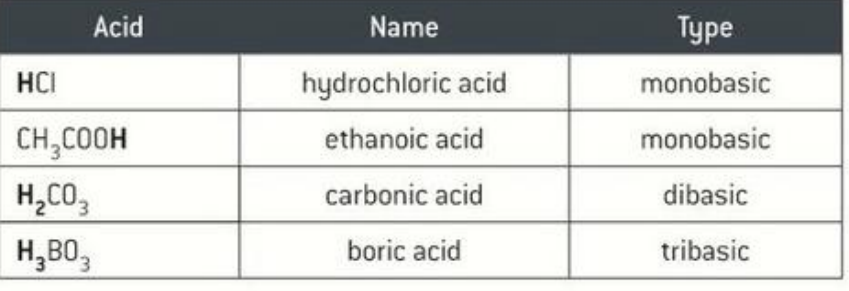
Acids differ in the number of hydrogen ions they can donate per molecule. This property is described using the terms monobasic, dibasic, and tribasic.
Definitions
The terms refer to the total number of hydrogen ions in the acid molecule that can be replaced per molecule during an acid-base reaction. Typically, these hydrogen ions are replaced by metal ions or ammonium ions () when the acid reacts to form a salt.
- Monobasic acid: Can donate one proton per molecule
- Dibasic acid: Can donate two protons per molecule
- Tribasic acid: Can donate three protons per molecule
The number of hydrogen atoms in the formula gives you a clue about the type of acid, though you must only count hydrogen atoms that can be released as ions.
Important notes about basicity
Important
For organic acids: The hydrogen atoms in the carbon chain cannot be replaced. Only the hydrogen atom in the carboxylic acid group (-COOH) can be donated as a proton. Therefore, ethanoic acid () is monobasic even though it contains four hydrogen atoms in total.
Examples of acid reactions based on basicity
The basicity of an acid determines the stoichiometry of its reactions with bases. Consider neutralisation reactions with sodium hydroxide:
Monobasic acid ():
One mole of monobasic acid reacts with one mole of NaOH.
Dibasic acid ():
One mole of dibasic acid reacts with two moles of NaOH.
Tribasic acid ():
One mole of tribasic acid reacts with three moles of NaOH.
Note
This pattern is crucial for calculations involving neutralisation reactions and titrations. Understanding basicity allows you to predict the correct molar ratios in acid-base reactions.
The role of in acid reactions
The hydrogen ion (or more accurately, the hydronium ion) is the active species in all acid reactions. Understanding this allows us to write generalised ionic equations that apply to any acid.
Reactions of acids with metals
Dilute acids react with reactive metals to produce salts and hydrogen gas:
For example, magnesium reacts with dilute hydrochloric acid:
Full equation:
Ionic equation:
Notice that in the ionic equation, we've cancelled the spectator ions (in this case, ). The ionic equation shows that ions are the active species from the acid.
The same ionic equation applies for the reaction of magnesium with dilute sulfuric acid:
Full equation:
Ionic equation:
This demonstrates that any dilute acid will react with magnesium in the same way because is the reactive species.
Note
Spectator ions are ions that do not participate in the reaction. They appear unchanged on both sides of the full equation and can be omitted from the ionic equation.
Redox reactions between acids and metals
Some metals undergo redox reactions with dilute acids. For example, zinc reacts with any dilute acid:
In this reaction:
- Zinc is oxidised (loses electrons):
- Hydrogen ions are reduced (gain electrons):
Reactions of acids with metal oxides
Metal oxides and hydroxides are bases that neutralise acids to form a salt and water only:
For example, magnesium oxide reacts with any dilute acid:
Note
This ionic equation is the same regardless of which acid is used (hydrochloric, sulfuric, nitric, etc.). This universality demonstrates that is the active species in all these reactions.
Reactions of acids with carbonates
Carbonates are bases that react with acids to produce a salt, water, and carbon dioxide:
For solid copper(II) carbonate reacting with any acid:
For aqueous carbonates, the spectator ions cancel out to give a simpler ionic equation:
Important
Note: When writing ionic equations for solid carbonates, always include the full formula (e.g., ) because the carbonate changes state during the reaction from solid to aqueous/gaseous products.
Reactions of acids with alkalis
Alkalis are soluble bases. When an acid reacts with an alkali, both species are in solution, so we can write a very simple ionic equation:
The ionic equation for neutralisation of (aq) ions by (aq) ions is:
Note
This equation is universal for all neutralisation reactions between acids and alkalis in aqueous solution. It shows that neutralisation is simply the combination of hydrogen ions and hydroxide ions to form water.
Writing full equations from ionic equations
While ionic equations are useful for showing the essential chemistry, you must also be able to write full balanced equations. To do this:
- Start with the ionic equation
- Add back the spectator ions to balance the charges
- Ensure all atoms are balanced
Example
Worked Example: Converting Ionic to Full Equations
For the reaction between sulfuric acid and sodium hydroxide:
Ionic equation:
Full equation:
Notice that sulfuric acid provides 2 ions (it's dibasic), so we need 2 NaOH molecules for complete neutralisation.
Volume calculations in neutralisation
Understanding the basicity of acids is essential for stoichiometric calculations.
Example
Worked Example: Calculating Volumes in Neutralisation
Question: What volume of NaOH(aq) is required to completely neutralise of of each of these acids: HNO₃, H₂SO₄, and H₃PO₄?
Solution:
For monobasic HNO₃:
One mole of HNO₃ reacts with one mole of NaOH, so equal volumes are needed:
Volume of NaOH = 25.0 cm³
For dibasic H₂SO₄:
One mole of H₂SO₄ reacts with two moles of NaOH, so twice the volume is needed:
Volume of NaOH = 50.0 cm³
For tribasic H₃PO₄:
One mole of H₃PO₄ reacts with three moles of NaOH, so three times the volume is needed:
Volume of NaOH = 75.0 cm³
Summary
Key Points to Remember:
-
A Brønsted–Lowry acid is a proton () donor, while a Brønsted–Lowry base is a proton acceptor
-
A conjugate acid-base pair consists of two species that differ by exactly one proton; they can be interconverted by proton transfer
-
The hydronium ion () is the actual acidic species in aqueous solution, though we often simplify this to (aq) in equations
-
Monobasic acids donate one proton per molecule, dibasic acids donate two, and tribasic acids donate three; this affects the stoichiometry of their reactions
-
The ion is the active species in all acid reactions, which means you can write the same ionic equation for any acid reacting with the same reagent
-
When writing ionic equations, remember to cancel spectator ions and focus on the species that actually participate in the reaction