The Acid Dissociation Constant Ka (OCR A-Level Chemistry A): Revision Notes
📚Revision Notes
The Acid Dissociation Constant Ka
Introduction to strong and weak acids
Understanding how acids behave in water is fundamental to physical chemistry. When we talk about acid strength, we're referring to how readily an acid releases hydrogen ions (protons) in aqueous solution.
Strong acids undergo complete dissociation in water. This means that virtually every acid molecule breaks apart to form ions. Hydrochloric acid is a classic example:
Notice the forward arrow—this reaction goes essentially to completion.
Weak acids, in contrast, only partially dissociate in water. They establish a dynamic equilibrium between the intact acid molecules and the ions formed. Ethanoic acid demonstrates this behaviour:
Note
The equilibrium arrows (⇌) indicate that significant amounts of both reactants and products exist in solution simultaneously. This is the key difference between weak and strong acids—weak acids never fully dissociate, no matter how dilute the solution.
Most acids you'll encounter at A-Level are weak acids, making it essential to quantify just how weak they are.
What is the acid dissociation constant Ka?
The acid dissociation constant, represented as , provides a numerical measure of the extent to which a weak acid dissociates in solution. It's a specialized version of the equilibrium constant , adapted specifically for acid-base equilibria.
General form of acid dissociation
For any weak acid (which we can represent generically as HA), the dissociation in water follows this pattern:
Here, HA represents the undissociated acid molecule, and A⁻ represents the conjugate base formed when the acid loses its proton.
The Ka expression
Following the principles of equilibrium constants, we write the expression by placing product concentrations in the numerator and reactant concentrations in the denominator:
The square brackets represent equilibrium concentrations measured in mol dm⁻³.
Example
Specific Example: Ethanoic Acid
For ethanoic acid dissociation:
The Ka expression becomes:
Units of Ka
The units derive from the concentration terms in the expression. Because we have two concentration terms in the numerator and one in the denominator:
Note
Since the general form always involves divided by , the units for will always be mol dm⁻³, regardless of which weak acid you're studying.
Interpreting Ka values
The magnitude of tells us about acid strength. When Ka is large, the equilibrium position lies further to the right, meaning more dissociation has occurred—indicating a stronger acid. Conversely, a small Ka value reveals that the equilibrium heavily favours the undissociated acid, characterizing a weaker acid.
Important
Temperature Dependence
Like all equilibrium constants, changes with temperature. Standard values are typically reported at 298 K (25°C) to allow fair comparisons between different acids.
The pKa scale
Why we need pKa
Working directly with values presents a practical challenge. Weak acids have very small values—often expressed in scientific notation with negative exponents—making them cumbersome to compare. The solution mirrors the approach used for hydrogen ion concentrations: apply a logarithmic scale.
The value transforms using a negative logarithm:
This relationship parallels the pH scale, where .
Note
Think of it this way: pKa is to Ka as pH is to [H⁺]. Both use the same logarithmic transformation to make unwieldy numbers more manageable.
Converting between Ka and pKa
To reverse the calculation and find from :
These transformations prove invaluable for exam calculations and comparing acid strengths.
Worked example: converting from Ka to pKa
Example
Worked Example: Ka to pKa Conversion
Question: What is the value of a weak acid with mol dm⁻³?
Solution:
Using the relationship :
Exam tip: Always give pKa values to two decimal places unless otherwise instructed.
Worked example: converting from pKa to Ka
Example
Worked Example: pKa to Ka Conversion
Question: What is the value of a weak acid with ?
Solution:
Using the relationship :
Exam tip: Give Ka values to two decimal places in the scientific notation, or as directed in the question.
Advantages of pKa values
The scale offers several benefits over raw values. Firstly, values typically fall within a manageable range of approximately 0 to 14 for common weak acids, avoiding unwieldy scientific notation. Secondly, comparing relative acid strengths becomes more intuitive—though remember the inverse relationship.
Important
The Inverse Relationship
As values have a negative power of ten within them, and have an inverse relationship. Since negative indices make smaller numbers:
- A smaller pKa indicates a larger Ka and therefore a stronger acid
- A larger pKa indicates a smaller Ka and therefore a weaker acid
Comparing acid strengths using Ka and pKa
Interpreting the values
Understanding the relationship between these constants and acid strength is crucial:
- Stronger acids have larger Ka values and smaller pKa values
- Weaker acids have smaller Ka values and larger pKa values
Let's examine some specific examples:
| Acid | Formula | / mol dm⁻³ | Relative strength | |
|---|---|---|---|---|
| Nitrous acid | HNO₂ | 3.39 | Strongest | |
| Methanoic acid | HCOOH | 3.75 | ↑ | |
| Ethanoic acid | CH₃COOH | 4.75 | ↓ | |
| Chloric(I) acid | HClO | 7.53 | Weakest |
Note
Reading the Table
This table reveals important patterns. Nitrous acid, with the largest Ka value of mol dm⁻³, dissociates most extensively and is therefore the strongest acid in this group. Its corresponding of 3.39 is the smallest value.
At the other extreme, chloric(I) acid has a of only mol dm⁻³, making it the weakest acid, reflected in its largest pKa of 7.53.
Important
Exam Technique: Check Your Values!
When comparing acid strengths in exams, always check whether you're given or values, as they follow opposite trends. A common mistake is treating them the same way.
Biological significance
Values of prove particularly useful when studying biological systems, where the behaviour of weak acids influences countless processes from enzyme activity to cellular pH regulation. The convenient scale allows biochemists to quickly assess which acids will dominate ionization at physiological pH (around 7.4).
Polybasic weak acids
Dibasic acids: stepwise dissociation
Some acids contain more than one ionizable hydrogen atom. Dibasic acids possess two protons that can dissociate, and this happens in sequential steps, each with its own equilibrium constant.
Sulfurous acid () provides an excellent example. This weak dibasic acid dissociates in two stages:

In the first dissociation step, one proton leaves the molecule, forming the hydrogensulfite ion (). This occurs relatively easily, with a value of 1.92, indicating moderate acid strength.
The second dissociation step removes the remaining proton from to form the sulfite ion (). This second ionization is considerably more difficult, as evidenced by the of 7.18—substantially larger than the first.
Note
Why is the second dissociation weaker? Removing a positively charged proton from an already negatively charged ion requires more energy, making the second dissociation weaker. You're fighting against electrostatic attraction!
Important
General Principle for Polybasic Acids
For polybasic acids, each successive dissociation becomes progressively weaker. The values decrease (and values increase) with each step.
This pattern holds true for all polybasic acids, whether dibasic or tribasic.
Organic acids in wine
Wine chemistry beautifully illustrates weak acid behaviour in a real-world context. The characteristic tartness of wine derives largely from organic acids naturally present in grapes.
Malic and tartaric acids
These dibasic acids represent the primary acids found in wine grapes:
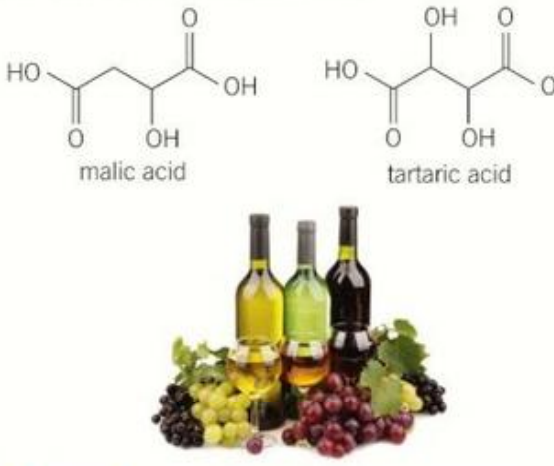
Both acids contain two carboxyl groups (COOH), which can each donate a proton. When these acids ionize, the hydrogen ions dissociate specifically from the COOH groups, not from the hydroxyl (OH) groups also present in the molecules. This selectivity occurs because the COOH group is far more acidic than the OH group.
The first dissociation of malic acid occurs at the carboxylic acid group:

This initial proton loss has a of 3.40, indicating that malic acid is reasonably acidic—though still weak compared to strong mineral acids.
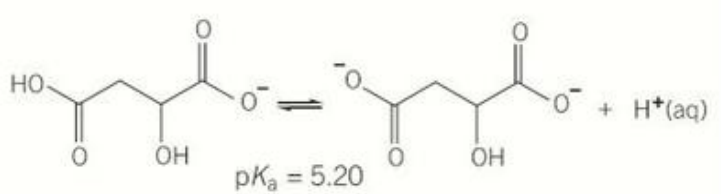
The second carboxylic acid group then dissociates in a separate equilibrium:
Note
Notice that the second value is 5.20, significantly higher than the first. This confirms our earlier principle: removing the second proton from an already negatively charged species requires more energy, resulting in weaker acidity for the second dissociation.
Important
Functional Group Acidity
The alcohol groups (OH) in malic acid do not dissociate under normal conditions because they're much less acidic than the carboxylic acid groups. This exemplifies functional group acidity—different groups within the same molecule can have vastly different acidic strengths.
Only the COOH groups contribute to the acid dissociation; the OH groups remain intact.
Tribasic acids
Citric acid takes this concept further as a tribasic acid containing three carboxylic acid groups:
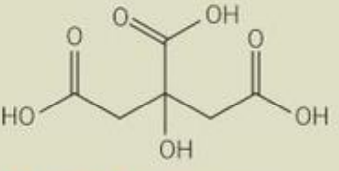
Citric acid undergoes three successive dissociations, each progressively weaker than the last. You can write equilibrium expressions for each of the three ionization steps, with each having its own distinct and value.
Note
Exam Application
Questions may ask you to:
- Write stepwise dissociation equations for polybasic acids
- Calculate expressions for each step
- Explain why successive dissociations become weaker
Always remember that each dissociation is treated as a separate equilibrium with its own constant.
Exam tips and common mistakes
Key calculation skills
- Converting between Ka and pKa: Practice these transformations until they become automatic. Remember: and
- Unit awareness: always has units of mol dm⁻³, but has no units (it's a logarithm)
- Significant figures: Typically give values to 2 decimal places and values to 2 significant figures in standard form
Important
Common Pitfalls to Avoid
Mistake 1: Confusing the trends—remember that stronger acids have larger Ka but smaller pKa values (inverse relationship)
Mistake 2: Writing concentration terms incorrectly in expressions—always put products (including and ) in the numerator
Mistake 3: Forgetting that polybasic acids dissociate in steps—each dissociation has its own equilibrium and value
Mistake 4: Using the wrong base for logarithms—the relationship uses base 10 logarithms (log₁₀), not natural logarithms (ln)
Exam technique
- Always write out the dissociation equation before writing the expression
- Check you're using the correct temperature (usually 298 K)
- When comparing acids, clearly state which is stronger and explain using both and values
- For polybasic acids, identify which dissociation step you're considering
- Show all working when converting between and —partial marks are available for method
Summary
Key Points to Remember:
-
Strong acids completely dissociate in water (HCl → H⁺ + Cl⁻), while weak acids only partially dissociate and establish an equilibrium (CH₃COOH ⇌ H⁺ + CH₃COO⁻)
-
The Ka expression is with units of mol dm⁻³, and measures the extent of acid dissociation
-
pKa provides a more convenient scale: and , making comparisons easier
-
Interpreting acid strength: Larger Ka = stronger acid (more dissociation); Smaller pKa = stronger acid (inverse relationship)
-
Polybasic acids dissociate in steps: each successive ionization is weaker (higher ) because removing a proton from a negatively charged ion is more difficult