Lattice Enthalpy (OCR A-Level Chemistry A): Revision Notes
📚Revision Notes
Lattice Enthalpy
Introduction to lattice enthalpy
Ionic compounds in their solid state exhibit remarkable stability, characterized by their strong ionic bonds and typically high melting points. This stability originates from the powerful electrostatic forces of attraction between oppositely charged ions arranged in the ionic lattice structure. Understanding and quantifying this stability is essential in physical chemistry.
Lattice enthalpy provides a quantitative measure of the strength of ionic bonding within a giant ionic lattice. Specifically, it is defined as the enthalpy change that occurs when one mole of an ionic compound forms from its constituent gaseous ions under standard conditions.
For example, the formation of solid potassium chloride from gaseous ions can be represented as:
This process involves bringing separate gaseous ions together to form the ionic lattice structure. Since ionic bond formation releases energy, lattice enthalpy is always exothermic, meaning the enthalpy change will always be negative.
Note
The negative sign in lattice enthalpy values indicates that energy is released when gaseous ions come together to form the solid ionic lattice. The more negative the value, the stronger the ionic bonding and the more stable the compound.
The Born-Haber cycle
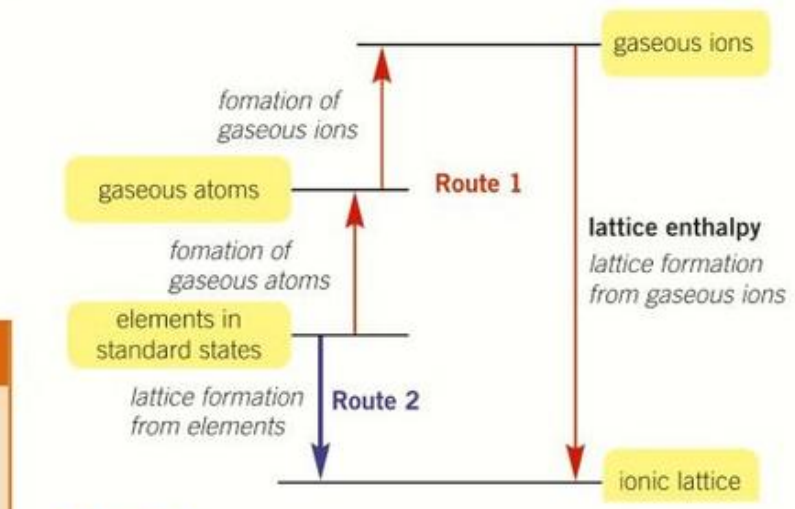
Lattice enthalpy cannot be measured directly through experiment. Instead, we must calculate it indirectly using an energy cycle approach. This indirect determination employs a special type of thermochemical cycle called a Born-Haber cycle.
The Born-Haber cycle demonstrates two different pathways (routes) for converting elements in their standard states into an ionic lattice:
- Route 1 (indirect pathway): Elements → Gaseous atoms → Gaseous ions → Ionic lattice
- Route 2 (direct pathway): Elements → Ionic lattice
According to Hess's Law, the total enthalpy change is independent of the route taken. Since Route 2 involves just one step (the enthalpy change of formation), and Route 1 involves multiple steps with known enthalpy values, we can calculate the unknown lattice enthalpy.
Note
Application of Hess's Law
The key principle is that the total enthalpy change for Route 1 must equal the enthalpy change for Route 2. This allows us to set up an equation:
Route 1 enthalpy changes + Lattice enthalpy = Route 2 enthalpy change
Rearranging this equation lets us solve for the unknown lattice enthalpy.
Route 1: The indirect pathway
Route 1 requires three distinct stages:
Formation of gaseous atoms:
- Converting elements from their standard states into gaseous atoms
- This change is endothermic because it involves breaking bonds
Formation of gaseous ions:
- Converting gaseous atoms into positive and negative gaseous ions
- Overall, this change is endothermic (though electron affinity contributes an exothermic component)
Lattice formation:
- Bringing gaseous ions together to form the solid ionic lattice
- This is the lattice enthalpy and is exothermic
Route 2: The direct pathway
Route 2 converts elements in their standard states directly to the ionic lattice through a single step - the enthalpy change of formation (). This process is typically exothermic.
Key enthalpy changes in Born-Haber cycles
Several specific enthalpy changes appear in Born-Haber cycles. Understanding each definition is crucial for constructing accurate cycles and performing calculations.
Standard enthalpy change of formation ()
This represents the enthalpy change occurring when one mole of a compound forms from its constituent elements under standard conditions, with all reactants and products in their standard states.
For sodium chloride formation:
Important
The compound will always be an ionic compound in its solid lattice form in Born-Haber cycles. Elements must be in their standard states at the start of the equation.
Standard enthalpy change of atomization ()
This is the enthalpy change for forming one mole of gaseous atoms from the element in its standard state under standard conditions.
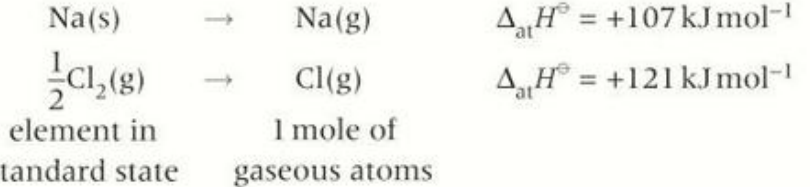
Examples include:
The atomization process is always endothermic because bonds must be broken to produce gaseous atoms. When the element exists as a gas in its standard state (like ), the enthalpy of atomization relates to the bond enthalpy of the bond being broken.
Note
Relationship to Bond Enthalpy
For chlorine gas atomization, the Cl—Cl bond is broken, which has a bond enthalpy of . Since only half a mole of is needed to form one mole of Cl atoms, the atomization enthalpy is (exactly half the bond enthalpy).
First ionization energy ()
The first ionization energy is the enthalpy change required to remove one electron from each atom in one mole of gaseous atoms, forming one mole of gaseous 1+ ions.
For example:
Ionization energies are endothermic because energy must be supplied to overcome the electrostatic attraction between the negatively charged electron and the positively charged nucleus.
First electron affinity ()
Electron affinity represents the opposite of ionization energy. The first electron affinity is the enthalpy change when one electron is added to each atom in one mole of gaseous atoms, forming one mole of gaseous 1− ions.
For example:
First electron affinities are exothermic because the electron being added is attracted towards the positive nucleus.
Important
Important distinction:
- Electron affinity measures the energy to gain electrons
- Ionization energy measures the energy to lose electrons
These are opposite processes with opposite energy changes.
Determining lattice enthalpies: worked examples
By constructing a complete Born-Haber cycle, you can calculate lattice enthalpies using Hess's Law. The following examples demonstrate the systematic approach needed for different types of ionic compounds.
Example
Worked Example: Calculating the lattice enthalpy of sodium chloride
You are provided with the following enthalpy changes:
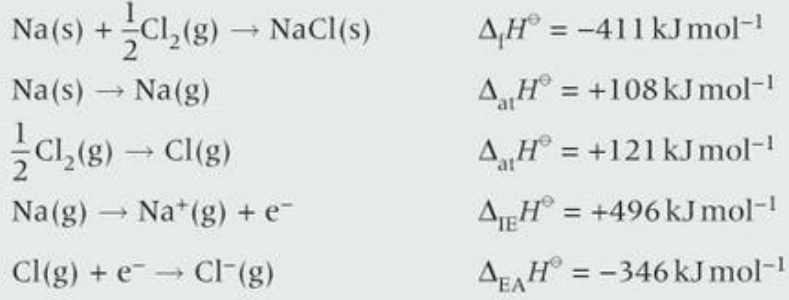
Construct a Born-Haber cycle and calculate the lattice enthalpy of sodium chloride, NaCl.
Step 1: Construct a Born-Haber cycle
The formation of gaseous atoms requires two separate energy changes:
- for sodium atomization
- for chlorine atomization
The formation of gaseous ions requires two separate energy changes:
- for sodium ionization
- for chlorine electron affinity
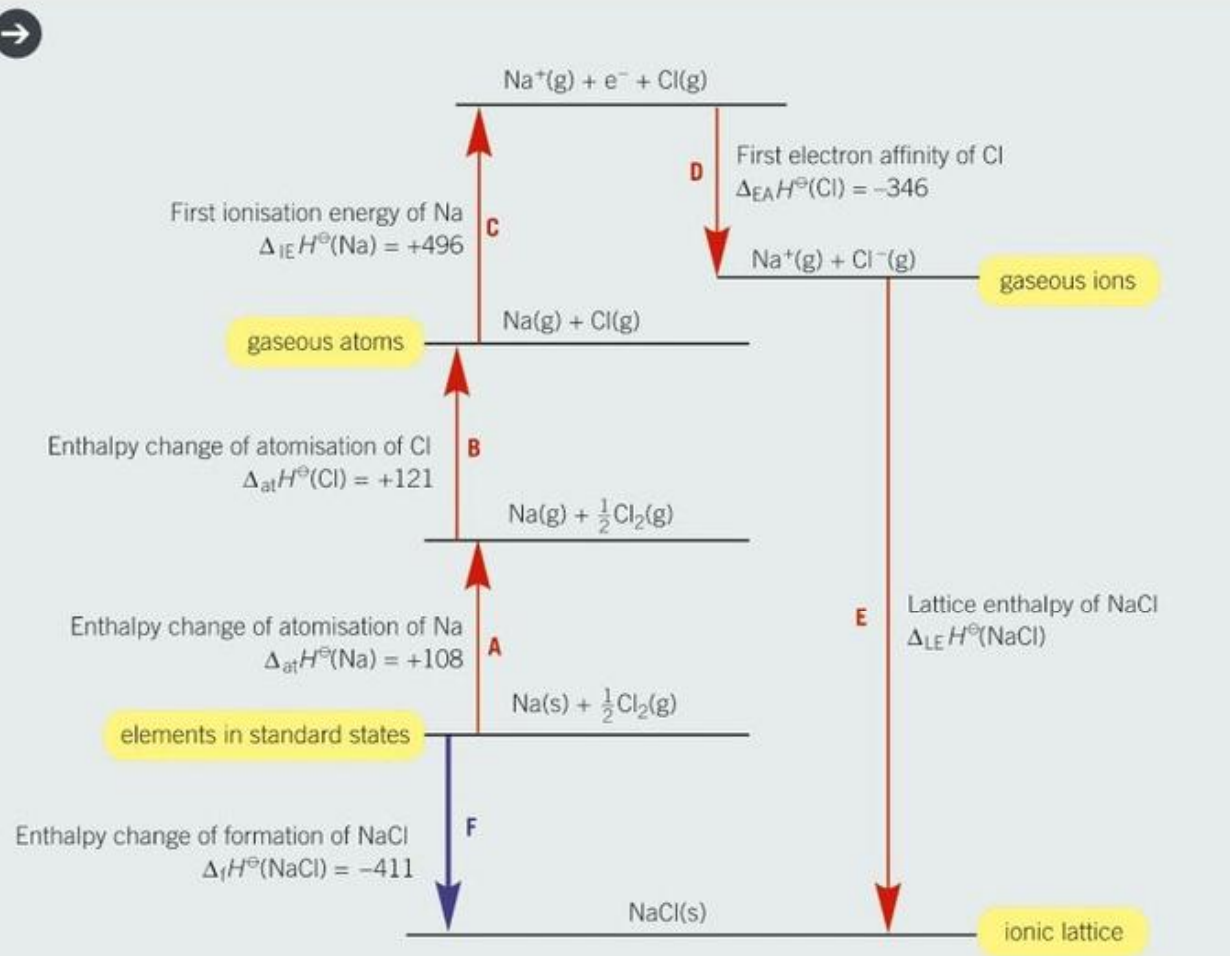
Between each horizontal energy level in the cycle:
- Only one species has changed, matching the specific enthalpy change that occurred
- All species present are balanced
For example, for change A, Na(s) has been atomized to Na(g), while remains unchanged but is included to account for all species present.
Step 2: Calculate the lattice enthalpy of sodium chloride
Using Hess's Law, the enthalpy change via Route 1 equals the enthalpy change via Route 2:
Route 1: , which equals
Route 2:
Using Hess's law:
Substituting values:
Answer: The lattice enthalpy of sodium chloride is -790 kJ mol⁻¹
Example
Worked Example: Calculating the lattice enthalpy of magnesium chloride
This example introduces additional complexity compared to sodium chloride:
-
The magnesium ion has a 2+ charge, so its formation requires both the first and second ionization energies of magnesium: and . This adds another step to the energy cycle.
-
Two chlorine atoms are involved throughout. You must multiply all values involving Cl or Cl⁻ by a factor of 2.
You are provided with the following enthalpy changes (all values in kJ mol⁻¹):

Construct a Born-Haber cycle and calculate the lattice enthalpy of magnesium chloride.
Step 1: Construct a Born-Haber cycle
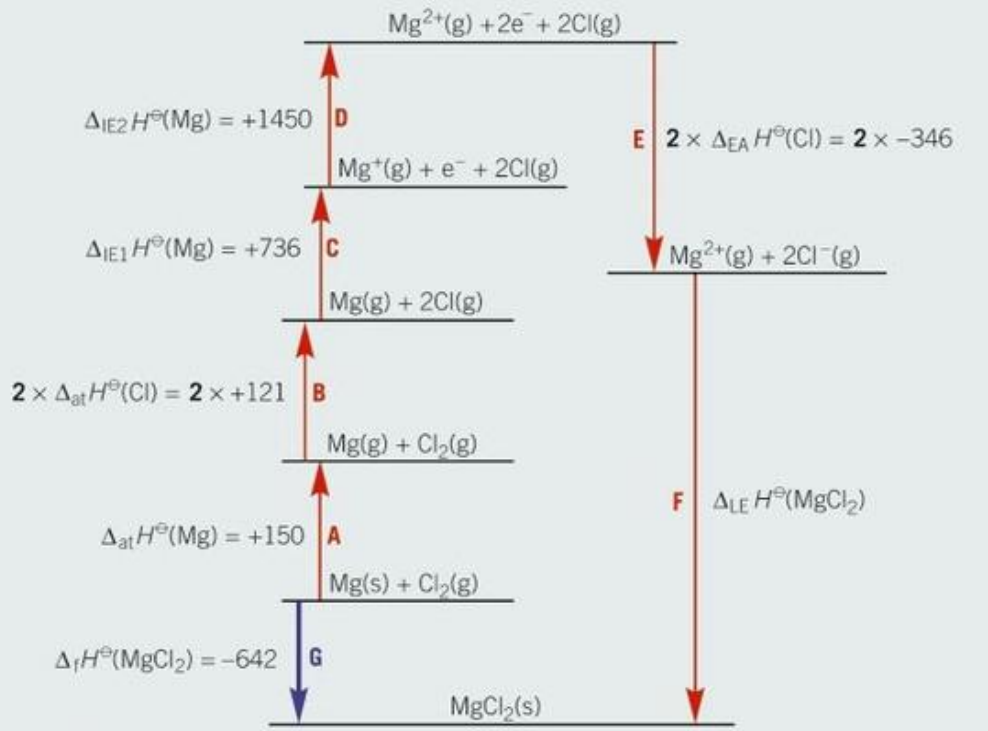
Step 2: Calculate the lattice enthalpy of magnesium chloride
Route 1: , which equals
Route 2:
Using Hess's law:
Substituting values:
Answer: The lattice enthalpy of magnesium chloride is -2528 kJ mol⁻¹
Successive electron affinities
The magnesium chloride example included two ionization energies to account for the formation of . Similarly, when an anion has a charge greater than 1−, such as , successive electron affinities are required. These are handled analogously to successive ionization energies.
The first two electron affinities for oxygen are:
First EA:
Second EA:
Important
Second electron affinities are endothermic.
A second electron is being gained by a negatively charged ion, which repels the incoming electron. Energy must be supplied to force the negatively charged electron onto the negative ion, overcoming this electrostatic repulsion.
This is in contrast to first electron affinities, which are exothermic because the electron is attracted to the neutral atom's nucleus.
A Born-Haber cycle involving would contain both electron affinity energy changes.
Exam tips and common mistakes
Important
Critical Points for Success
-
Signs matter: Always check whether an enthalpy change should be positive or negative:
- Endothermic: Atomization, ionization energy, second (and higher) electron affinities
- Exothermic: Formation, lattice enthalpy, first electron affinity
-
Stoichiometry: When dealing with compounds like , remember to multiply enthalpy values by the appropriate stoichiometric coefficient (e.g., ).
-
Gaseous atoms: Atomization always produces one mole of gaseous atoms. For , only is needed to form 1 mol of Cl(g).
-
Definition recall: You must know the precise definitions for lattice enthalpy, first ionization energy, and enthalpy change of formation. For other enthalpy changes, understanding what they represent is sufficient for constructing cycles and performing calculations.
-
Hess's Law application: Route 1 plus lattice enthalpy equals Route 2. Rearrange to solve for lattice enthalpy.
Summary
Key Points to Remember:
-
Lattice enthalpy measures the strength of ionic bonding and is always exothermic (negative value) as it involves forming ionic bonds from gaseous ions.
-
Born-Haber cycles use Hess's Law to calculate lattice enthalpy indirectly by comparing two routes: Route 1 (via gaseous atoms and ions) and Route 2 (direct formation).
-
Key enthalpy changes include:
- Formation: exothermic
- Atomization: endothermic
- Ionization energy: endothermic
- First electron affinity: exothermic
- Second electron affinity: endothermic
-
Sign conventions are critical: atomization and ionization are always endothermic; first electron affinity and lattice enthalpy are exothermic; second electron affinities are endothermic.
-
Complex ions (like or ) require multiple ionization energies or electron affinities, and stoichiometry must be carefully considered when multiple atoms are involved.