Controlling the Position of Equilibrium (OCR A-Level Chemistry A): Revision Notes
📚Revision Notes
Controlling the Position of Equilibrium
Understanding equilibrium position shifts
When a chemical system at equilibrium experiences a change in conditions, the equilibrium position responds to counteract that change. This is explained by Le Chatelier's principle, which you learned about in earlier topics. But why does this happen? The answer lies in understanding equilibrium constants.
There are three key rules for predicting equilibrium shifts:
- Concentration changes: If the concentration of a species increases, the equilibrium position shifts in the direction that reduces that concentration
- Pressure changes: If pressure increases, the equilibrium position shifts towards the side with fewer gaseous moles
- Temperature changes: If temperature increases, the equilibrium position shifts in the endothermic direction
Note
The reason Le Chatelier's principle works is because the equilibrium constant () controls the relative amounts of reactants and products present at equilibrium.
The meaning of equilibrium constants
The magnitude of an equilibrium constant tells us the extent of a chemical equilibrium. Understanding what different values of mean is crucial:
- indicates an equilibrium halfway between reactants and products
- indicates an equilibrium well in favour of the products
- indicates an equilibrium well in favour of the reactants
The value of gives the exact position of equilibrium. When reactants or products of a reversible reaction are mixed together, the reaction proceeds until the concentrations (or partial pressures) of the equilibrium species match the value of when placed into the equilibrium constant expression.
What changes equilibrium constants?
Important
Here's a crucial point that many students find confusing: at a set temperature, is constant and does not change despite any modifications to concentration, pressure, or the presence of a catalyst.
However, does change if the temperature is changed. Temperature change is the only condition that will cause to change its value.
Effect of temperature on equilibrium constants
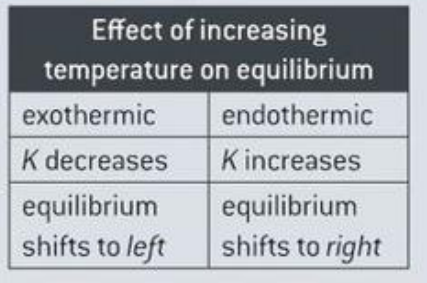
The value of changes when you alter the temperature. Whether gets larger or smaller depends on whether the forward reaction is exothermic or endothermic.
Exothermic reactions
For an exothermic forward reaction (one that gives out energy):
- The equilibrium constant decreases with increasing temperature
- Raising the temperature decreases the equilibrium yield of products
Let's look at a specific example: the sulfur dioxide/oxygen/sulfur trioxide equilibrium.
This is an exothermic reaction. The table below shows how changes with temperature:

As temperature increases from 500 K to 1100 K, decreases dramatically from to atm. The equilibrium position shifts to the left (towards reactants).
Example
Worked Example: Understanding the Temperature Effect on an Exothermic Equilibrium
At equilibrium at 500 K:
Step 1: Identify the initial equilibrium
- At 500 K: atm
- The system is at equilibrium with this value
Step 2: Analyze what happens when temperature increases to 700 K
- decreases from to atm
- The system is no longer in equilibrium
- The ratio is now greater than the new
Step 3: Determine how the system responds
To restore equilibrium with the new, smaller value, the partial pressures must adjust:
- The partial pressure of product SO must decrease
- The partial pressures of reactants SO and O must increase
- The position of equilibrium shifts towards the reactants (to the left)
A new equilibrium is reached where the ratio equals the new value.
Endothermic reactions
For an endothermic forward reaction (one that takes in energy):
- The equilibrium constant increases with increasing temperature
- Raising the temperature increases the equilibrium yield of products
Consider the nitrogen/oxygen/nitrogen monoxide equilibrium:
This is an endothermic reaction. As temperature increases, increases significantly, and the equilibrium position shifts to the right (towards products).
Example
Worked Example: Understanding the Temperature Effect on an Endothermic Equilibrium
At equilibrium at 700 K:
Step 1: Identify the initial equilibrium
- At 700 K: atm
- The system is at equilibrium with this value
Step 2: Analyze what happens when temperature increases to 1100 K
- increases from to atm
- The system is no longer in equilibrium
- The ratio is now less than the new
Step 3: Determine how the system responds
To match the new, larger value:
- The partial pressure of product NO must increase
- The partial pressures of reactants N and O must decrease
- The position of equilibrium shifts towards the products (to the right)
Summary of temperature effects
Effect of concentration changes on equilibrium
Note
The value of an equilibrium constant is unaffected by changes in concentration or pressure. This seems strange at first because you know from Le Chatelier's principle that the equilibrium position can be shifted by changing concentration or pressure. The key is understanding that the equilibrium shift results from the fact that the equilibrium constant does not change.
How concentration changes work
Let's examine a specific equilibrium to understand this properly:
Example
Worked Example: Effect of Concentration Change on Equilibrium Position
At a constant temperature, suppose the equilibrium concentrations are:
Step 1: Calculate the equilibrium constant
Step 2: Analyze what happens if we increase to
Calculate the new ratio:
This ratio is now less than (which remains 16.0), so the system is no longer in equilibrium.
Step 3: Determine the direction of shift
To restore equilibrium and return the ratio to its value of 16.0 mol dm, the concentrations must change:
- The concentration of product NO must increase
- The concentration of reactant NO must decrease
- A new equilibrium is established where is restored to its value
The equilibrium position shifts to the right (towards products).
This is exactly what Le Chatelier's principle predicts! By decreasing [NO], the equilibrium shifts from left to right. But now you understand why: it's because controls the relative concentrations of reactants and products present at equilibrium, and itself doesn't change with concentration changes.
Note
The same principle applies when using for equilibrium constants involving partial pressures instead of concentrations.
Effect of pressure changes on equilibrium
For gaseous equilibria, pressure changes also don't change the value of , but they do shift the equilibrium position.
How pressure changes work
Using the same equilibrium as before:
Example
Worked Example: Effect of Pressure Change on Equilibrium Position
Suppose at constant temperature, the equilibrium partial pressures are:
- atm
- atm
Step 1: Calculate the equilibrium constant
Step 2: Analyze what happens if we double the total pressure
Doubling the total pressure doubles the partial pressures of both species:
- increases to 19.2 atm
- increases to 0.48 atm
Calculate the new ratio:
This ratio is greater than (which remains 384 atm), so the system is no longer in equilibrium.
Step 3: Determine the direction of shift
To return to equilibrium with the value of 384 atm:
- The partial pressure of product NO must decrease
- The partial pressure of reactant NO must increase
- The equilibrium position shifts to the left (towards reactants)
Using Le Chatelier's principle, you'd predict a shift from right to left to the side with fewer gaseous moles - exactly what we've just shown! The shift is directed by the value of being restored.
General rules for pressure effects
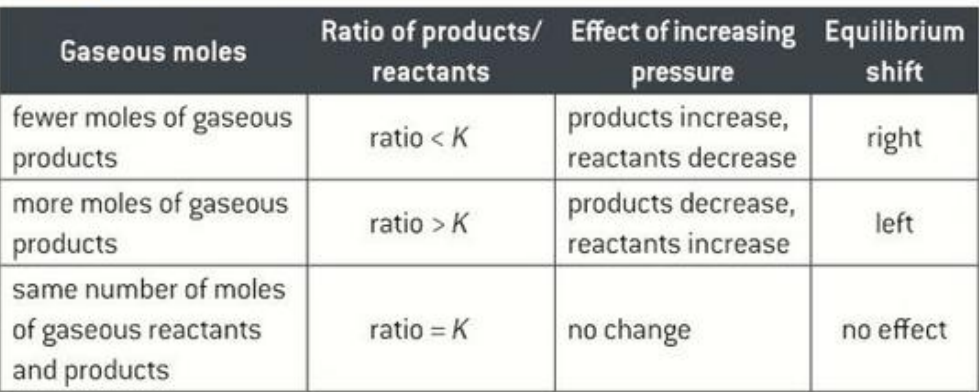
The table below summarizes how increasing pressure affects equilibrium position:
Note
Key Principle for Pressure Effects:
- If there are fewer moles of gaseous products, the ratio is less than , and equilibrium shifts right
- If there are more moles of gaseous products, the ratio is greater than , and equilibrium shifts left
- If there are equal moles on both sides, the ratio equals , and there's no effect
Effect of catalysts on equilibrium constants
Equilibrium constants are unaffected by the presence of a catalyst.
Note
Catalysts affect the rate of a chemical reaction but not the position of equilibrium. Here's what catalysts do:
- They speed up both the forward and reverse reactions by the same factor
- Equilibrium is reached more quickly
- The equilibrium position itself is not changed
This is important to remember: adding a catalyst gets you to equilibrium faster, but doesn't give you more product once equilibrium is established.
Summary
Key Points to Remember:
-
Temperature is the ONLY factor that changes the value of K. Concentration, pressure, and catalysts do not affect itself.
-
For exothermic reactions: Increasing temperature decreases and shifts equilibrium left (towards reactants). Decreasing temperature increases and shifts equilibrium right (towards products).
-
For endothermic reactions: Increasing temperature increases and shifts equilibrium right (towards products). Decreasing temperature decreases and shifts equilibrium left (towards reactants).
-
Le Chatelier's principle works because controls the equilibrium position. When you change concentration or pressure, the system adjusts to restore the value by shifting the equilibrium position.
-
Catalysts speed up the rate of reaching equilibrium but don't change the equilibrium position or the value of .
-
Exam tip: When answering questions about equilibrium shifts, always explain your reasoning in terms of how changes (for temperature) or how the ratio compares to (for concentration/pressure changes).