Concentration–Time Graphs (OCR A-Level Chemistry A): Revision Notes
📚Revision Notes
Concentration–Time Graphs
Introduction to continuous monitoring
When studying chemical reactions, we often need to track how concentrations change over time. This process is called continuous monitoring, where measurements are taken at regular intervals throughout the reaction.
There are several experimental methods available for continuous monitoring:
- Gas collection: Measuring the volume of gas produced over time (useful when a gas is a product)
- Mass loss: Monitoring the decrease in mass as a gas escapes from the reaction mixture
- Colorimetry: Measuring colour intensity changes when a colored reactant or product is involved
Note
Not all reactions produce gases, so we need alternative monitoring methods. When a reaction involves a colour change, we can use a colorimeter to track the progress of the reaction.
Monitoring reactions using colorimetry
How a colorimeter works
A colorimeter (or spectrophotometer) measures the intensity of light passing through a colored solution. The basic principle is that the concentration of a colored species is directly proportional to how much light it absorbs.
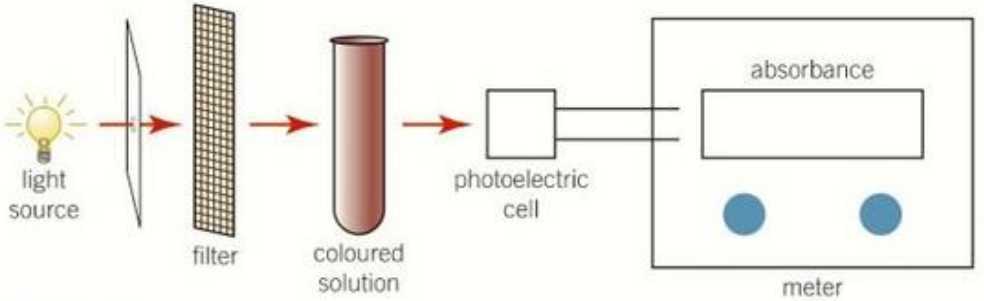
The key components of a colorimeter are:
- Light source: Provides white light
- Filter: Selects a specific wavelength of light (chosen to be the complementary colour to the substance being measured)
- Sample cell: Contains the colored solution
- Photoelectric cell: Detects the light that passes through the sample
- Meter: Displays the absorbance reading
Important
The filter is crucial - it must be set to the complementary colour of the substance being absorbed. For example, if you're monitoring orange/brown iodine, you would use a green/blue filter.
Practical procedure for colorimetry analysis
Let's consider the reaction between propanone and iodine in the presence of an acid catalyst:
The iodine is orange/brown in colour, and as the reaction proceeds, this colour fades as iodine is consumed.
Example
Practical Procedure: Analyzing a Reaction Using Colorimetry
To analyze this reaction using colorimetry:
-
Prepare standard solutions of known concentrations of the colored species (in this case, aqueous iodine, )
-
Select the appropriate filter with the complementary colour to the substance being measured (green/blue filter for orange/brown iodine)
-
Zero the colorimeter using distilled water as a reference
-
Measure absorbance readings for each standard solution
-
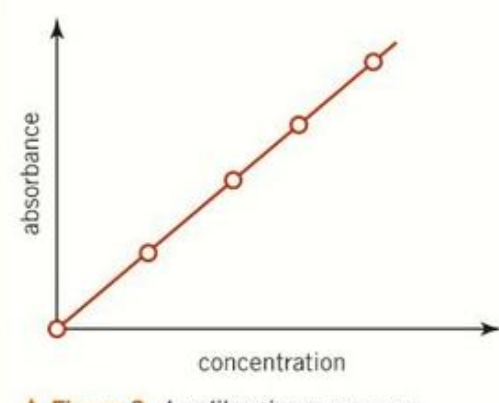
Plot a calibration curve showing absorbance against concentration - this creates a reference graph
-
Carry out the actual reaction, taking absorbance readings at regular time intervals
-
Use the calibration curve to convert each absorbance reading into a concentration value
-
Plot a second graph showing concentration of the colored species against time
From this concentration-time graph, you can determine the order of reaction with respect to the colored species.
Interpreting concentration-time graphs
The shape of a concentration-time graph reveals important information about the reaction order. The gradient at any point on the graph represents the rate of reaction at that moment.
Zero order reactions
A zero order reaction produces a concentration-time graph that is a straight line with a negative gradient.
Note
Key characteristics of zero order reactions:
- The gradient (and therefore the rate) remains constant throughout the reaction
- The reaction rate does not depend on the concentration of the reactant
- The rate equation is: rate
- The value of the gradient equals the rate constant
Zero order reactions are relatively uncommon but can occur in certain catalytic processes where the catalyst surface is saturated.
First order reactions
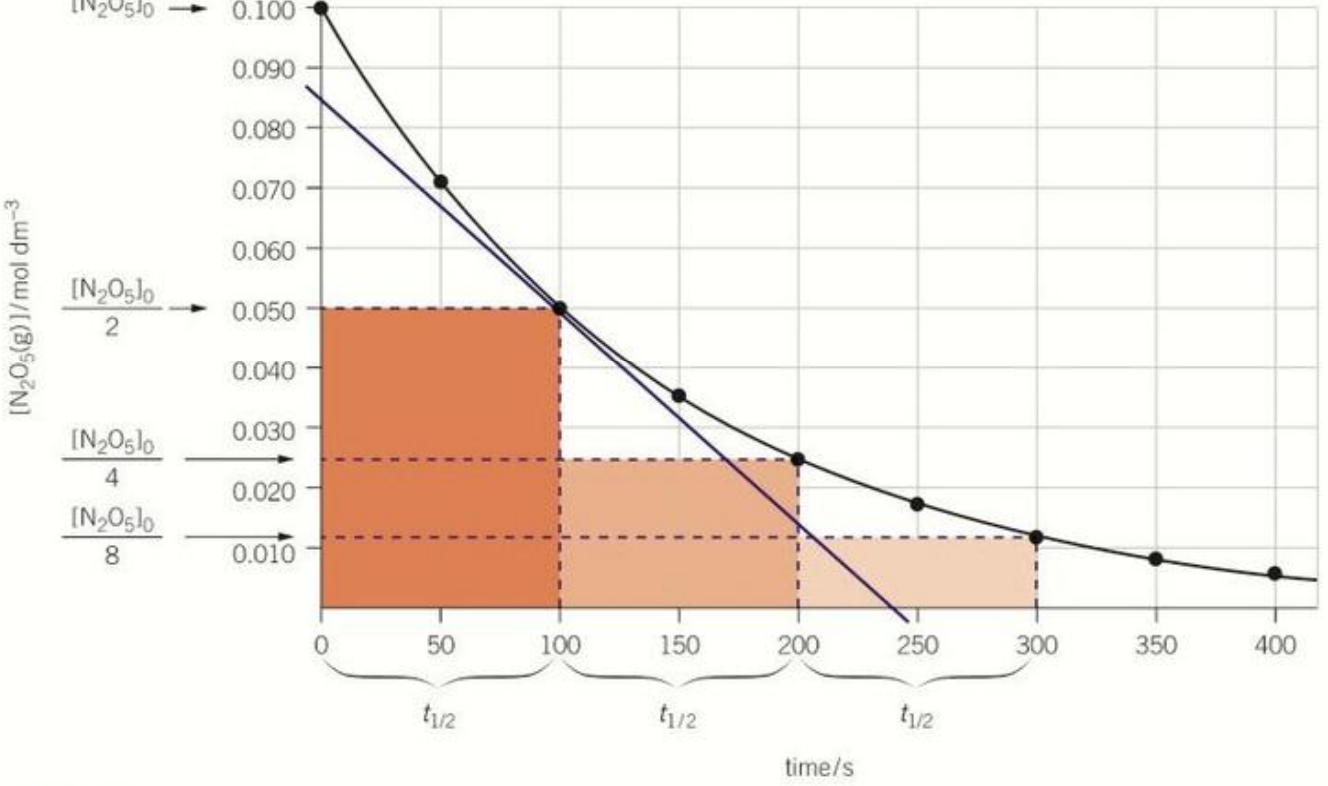
A first order reaction produces a concentration-time graph that is a downward curve with a decreasing gradient over time.
Note
Key characteristics of first order reactions:
- The gradient (rate) decreases as the reaction proceeds
- The reaction rate is directly proportional to the concentration of the reactant
- The rate equation is: rate
- The time taken for the concentration to halve (the half-life) is constant
The curved shape reflects the fact that as reactant is consumed, the concentration decreases, causing the reaction to slow down gradually.
Second order reactions
For completeness, second order reactions also produce a downward curve, but one that is steeper at the start and tails off more gradually than a first order reaction. However, you will not be required to analyze second order concentration-time graphs in detail for this specification.
Half-life and first order reactions
Understanding half-life
The half-life () is defined as the time taken for the concentration of a reactant to decrease to half of its original value.
Important
For first order reactions, the half-life has a special property: it remains constant regardless of the starting concentration. This characteristic is unique to first order kinetics and is often called exponential decay.
Confirming first order kinetics
You can confirm that a reaction is first order by measuring successive half-lives from a concentration-time graph. If all the half-lives are equal (or very similar, accounting for experimental error), the reaction is first order with respect to that reactant.
Example
Worked Example: Confirming First Order Kinetics
Looking at the decomposition of dinitrogen pentoxide:
From the graph, we can identify three successive half-lives:
- First half-life: concentration drops from 0.100 to 0.050 mol dm⁻³ in approximately 100 s
- Second half-life: concentration drops from 0.050 to 0.025 mol dm⁻³ in approximately 100 s
- Third half-life: concentration drops from 0.025 to 0.0125 mol dm⁻³ in approximately 100 s
Since all three half-lives are equal at 100 s, this confirms the reaction is first order with respect to .
The rate equation for this reaction is therefore:
Determining the rate constant k for first order reactions
There are two methods for calculating the rate constant from a concentration-time graph for a first order reaction.
Method 1: Using the gradient (tangent method)
This method involves drawing a tangent to the curve at a specific concentration, then using the gradient to calculate .
Example
Worked Example: Tangent Method
Step-by-step process:
- Draw a tangent to the curve at a chosen concentration value
- Calculate the gradient of the tangent - this gives you the rate at that concentration
- Substitute the rate and concentration values into the rate equation
- Rearrange to find
Calculation:
For the decomposition, if we draw a tangent when mol dm⁻³:
Since rate :
Important
The units of for a first order reaction are always s⁻¹ (or time⁻¹). You can verify this by substituting the units into the rate expression:
Method 2: Using the half-life formula
This is a much simpler and more accurate method that uses the mathematical relationship for first order reactions:
Where:
- = rate constant (s⁻¹)
- (natural logarithm of 2)
- = half-life (s)
Example
Worked Example: Half-Life Formula Method
For the decomposition with s:
Advantages of this method:
- No need to draw tangents, which can be subjective and imprecise
- More accurate as it uses the consistent half-life value
- Quicker to calculate
- You can find the ln button on scientific calculators (often requires pressing a shift or second function key)
Why the half-life method is preferred
Drawing accurate tangents can be difficult, and small variations in where you draw the tangent can lead to different rate values. The half-life method avoids this subjectivity by using a measurable, objective value from the graph. This makes it the preferred method in both practical work and exams.
Summary
Key Points to Remember:
-
Continuous monitoring allows us to track concentration changes throughout a reaction using methods like gas collection, mass loss, or colorimetry
-
Colorimeters measure light absorbance through colored solutions, with absorbance being directly proportional to concentration
-
Zero order reactions give straight-line concentration-time graphs with constant gradient (rate = )
-
First order reactions give curved concentration-time graphs with decreasing gradient (rate = )
-
Half-life is the time for concentration to halve; for first order reactions, it remains constant and confirms first order kinetics
-
Two methods to find k: draw a tangent to find the gradient (rate), or use the much easier formula
-
Units of k for first order reactions are always s⁻¹ (or time⁻¹)