Orders, Rate Equations and Rate Constants (OCR A-Level Chemistry A): Revision Notes
📚Revision Notes
Orders, Rate Equations and Rate Constants
Introduction to reaction rates
Every chemical reaction proceeds at a specific pace, known as the reaction rate. We measure how quickly reactions occur by tracking changes in the amounts of reactants or products as time progresses. This measurement is fundamental to understanding chemical kinetics and predicting how reactions will behave under different conditions.
Note
In practical experiments, chemists can monitor various physical properties that change during a reaction. The rate can be calculated using any measurable quantity, and the units will reflect whatever quantity is being measured divided by time. For example, if you measure the volume of gas produced, the rate would be expressed in volume per unit time.
However, for consistency and to allow comparison between different reactions and experiments, chemists typically express reaction rates in terms of concentration changes. The standard definition becomes:
Concentration is measured in (moles per cubic decimetre), and time can be measured in any convenient unit - seconds, minutes, or hours depending on how fast the reaction proceeds. When time is measured in seconds, the rate has units of .
Note
Square Bracket Notation
An important convention in chemistry is the use of square brackets as shorthand notation. When you see , this means "the concentration of substance A" and has the standard concentration units of . This notation makes equations much more compact and easier to work with.
Understanding order of reaction
The concentration of reactants has a significant influence on how quickly reactions proceed. However, the relationship is not always straightforward - it's not simply that doubling the concentration doubles the rate. Instead, the rate is proportional to the concentration raised to a power, and this power is what we call the order of reaction.
For a reactant A, we can write:
The value of represents the order of reaction with respect to that particular reactant. Different reactants in the same reaction can have different orders, meaning they affect the rate in different ways. The most common orders you'll encounter are zero, first, and second order, though other orders are possible.
Zero order reactions
When a reaction is zero order with respect to a particular reactant, changing the concentration of that reactant has no effect whatsoever on the reaction rate. Mathematically, this is expressed as:
Important
Remember: Any number raised to the power of zero equals 1 (you can verify this on your calculator - try or and you'll always get 1). This means the concentration term effectively disappears from the rate expression, leaving the rate constant and unaffected by changes to .
In practical terms, if you're conducting an experiment and you double, triple, or halve the concentration of a zero order reactant, the rate remains exactly the same. This might seem counterintuitive, but it occurs in certain reaction mechanisms, particularly in catalytic processes where the catalyst surface is saturated.
First order reactions
A reaction is first order with respect to a reactant when the rate depends directly on that reactant's concentration raised to the power of one:
This creates a direct proportional relationship between concentration and rate. Understanding this relationship is crucial for predicting how concentration changes affect the reaction:
- If you double the concentration (multiply by 2), the rate increases by a factor of (it doubles)
- If you triple the concentration (multiply by 3), the rate increases by a factor of (it triples)
- If you halve the concentration (multiply by 0.5), the rate decreases by the same factor
Note
In a first order reaction, any change in concentration produces an equal proportional change in the rate. This makes first order kinetics relatively straightforward to work with and predict.
Second order reactions
When a reaction is second order with respect to a reactant, the rate depends on the concentration squared:
This squared relationship means that concentration changes have a more dramatic effect on the rate compared to first order reactions:
- If you double the concentration, the rate increases by a factor of (it quadruples)
- If you triple the concentration, the rate increases by a factor of (it increases nine-fold)
- If you halve the concentration, the rate decreases by a factor of (it becomes a quarter of the original)
Second order behaviour often arises when two molecules of the same reactant must collide for a reaction to occur, or in more complex mechanisms. The important thing to remember is that the change in rate is the square of the change in concentration.
The rate equation and rate constant
The rate equation provides the complete mathematical relationship between the concentrations of all reactants and the reaction rate. It's the fundamental equation of chemical kinetics and allows us to predict exactly how changes in conditions will affect the reaction.
For a reaction involving two reactants A and B, the general form of the rate equation is:
Let's break down each component of this equation:
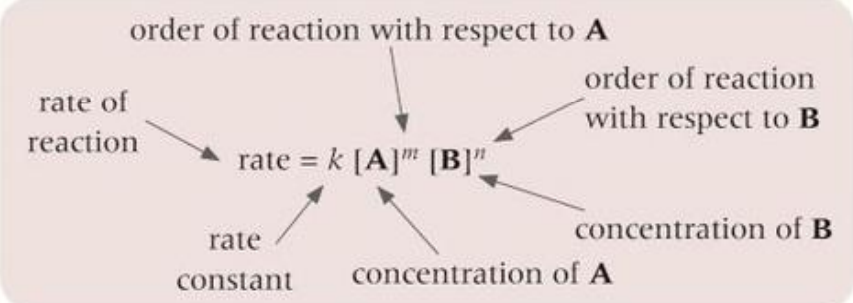
The rate constant, , is the proportionality constant that links concentrations to rate. Think of it as an "exchange rate" that converts concentration into reaction rate. Each reaction has its own unique rate constant at a given temperature. The value of tells you how fast a reaction is intrinsically - a larger k means a faster reaction under the same concentration conditions. Importantly, is constant for a given reaction at a specific temperature, but changes if temperature changes.
Important
Critical Concept: Determining Orders
The exponents and represent the order of reaction with respect to reactants A and B respectively. These values must be determined experimentally - you cannot predict them from the balanced chemical equation. The orders tell you how sensitive the rate is to changes in each reactant's concentration.
Overall order
The overall order of a reaction gives you the combined effect of all reactants on the rate. It's calculated simply by adding together all the individual orders:
For example, if a reaction is first order with respect to A () and second order with respect to B (), the overall order is . This overall order has important implications for the units of the rate constant, as we'll see next.
Writing rate equations - a worked example
Consider a reaction:
Suppose experiments show that A is zero order, B is first order, and C is second order.
Example
Worked Example: Writing a Rate Equation
Step 1: Calculate the overall order:
Step 2: Write the full rate equation:
Step 3: Simplify by removing terms:
- Since , this term can be omitted
- Since , we can write this without the superscript
The simplified rate equation becomes:
This simplification is standard practice - zero order terms are dropped (as they equal 1), and powers of 1 are omitted as they're understood.
Units of the rate constant
Important
Variable Units Alert
The units of the rate constant are not fixed - they depend on the overall order of the reaction. This is different from most other constants you encounter in chemistry. Understanding how to determine these units is essential for exam success and for ensuring your calculations are dimensionally correct.
The units of can be determined using three approaches, but the most reliable method is:
- Rearrange the rate equation to make the subject
- Substitute the units (not numbers) into the expression
- Cancel common units and write the final units on a single line
Remember that rate always has units of and concentration always has units of .
Units for zero order reactions
For a zero order reaction:
Since the rate equals directly:
Units for first order reactions
For a first order reaction:
Rearranging:
Substituting units:
The cancels:
Units for second order reactions
For a second order reaction:
Rearranging:
Note
Understanding Squared Units
Note that , so:
Substituting units:
Cancelling one mol and three dm powers from top and bottom:
The convention is to write positive indices before negative ones, giving the final answer.
Example
Worked Example: Determining Units of k
What are the units of the rate constant in the rate equation below?
Step 1: Rearrange to make the subject:
Step 2: Substitute units and cancel:
Cancelling one mol and three dm powers:
Writing positive indices first:
Determining orders from experimental results
Important
Experimental Determination is Essential
Orders of reaction cannot be determined from the balanced chemical equation - they must be found experimentally. The most common method is called the initial rate method, which involves conducting multiple experiments with different starting concentrations and measuring how fast the reaction proceeds at the very beginning.
The initial rate is the instantaneous rate right at the start of the experiment when . Using the initial rate is important because:
- At the start, the concentrations are accurately known
- The rate hasn't been affected by products building up
- Side reactions are minimised
- It's easier to compare different experiments fairly
By systematically varying one reactant's concentration while keeping others constant, you can determine how that particular reactant affects the rate, revealing its order.
The approach for determining orders
When comparing experiments, look for cases where one concentration changes while others remain constant. Then observe what happens to the rate:
- Zero order: If concentration changes but rate stays the same, it's zero order
- First order: If concentration changes by a factor and rate changes by the same factor, it's first order
- Second order: If concentration changes by a factor and rate changes by the factor squared, it's second order
Example
Worked Example: Determining Rate Equation from Experiments
Nitrogen dioxide reacts with ozone according to the equation:
The following experimental results were obtained:
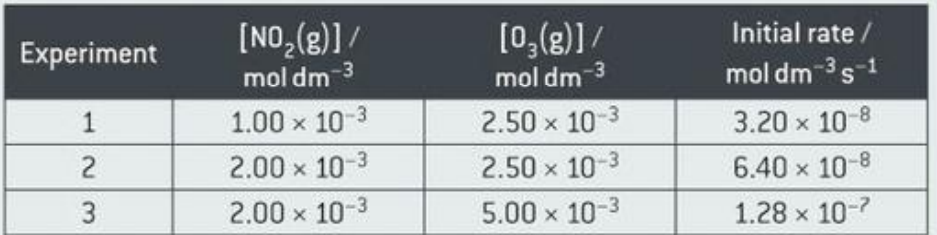
Step 1: Determine the order with respect to each reactant
Comparing Experiments 1 and 2:
- doubles (from to )
- stays the same (remains at )
- The rate doubles (from to )
Since doubling the concentration of NO₂ doubles the rate, the reaction is first order with respect to NO₂.
Comparing Experiments 2 and 3:
- doubles (from to )
- stays the same (remains at )
- The rate doubles (from to )
Since doubling the concentration of O₃ doubles the rate, the reaction is first order with respect to O₃.
Therefore, the overall order is (the reaction is second order overall).
Step 2: Write the rate equation:
Step 3: Calculate the rate constant with units
Rearrange the rate equation:
Substitute values from Experiment 1:
Determine units by substituting and cancelling:
Therefore:
You should get the same value of if you use data from Experiments 2 or 3 - this confirms your orders are correct. Always check your work this way if you have time in an exam.
Key exam tips
Important
Common Mistakes to Avoid
-
Don't assume orders from the balanced equation - The stoichiometric coefficients in the balanced equation have no relationship to the orders of reaction. Orders must be determined experimentally.
-
Units of the rate constant - Remember these change depending on overall order. Always show your working when calculating units to avoid errors.
-
Initial rates - When determining orders experimentally, always use initial rates, not rates measured later in the reaction.
-
Simplifying rate equations - Zero order terms disappear (equal to 1), and first order powers are usually omitted.
-
Comparing experiments - Only compare experiments where one concentration changes and others stay constant.
Note
Essential Calculation Skills
- Be confident rearranging the rate equation to make the subject
- Practice cancelling units systematically
- Know how to use powers:
- Remember that concentration squared means the concentration unit is also squared
Summary
Key Points to Remember
-
Rate of reaction measures how quickly reactants are consumed or products formed, typically expressed as .
-
Order of reaction (with respect to a reactant) is the power to which that reactant's concentration is raised in the rate equation. Common orders are 0, 1, and 2.
-
The rate equation has the form where is the rate constant and and are the orders. Orders must be determined experimentally.
-
The rate constant is specific to each reaction at a given temperature and its units depend on the overall order of the reaction.
-
Overall order equals the sum of all individual orders: overall order = (for two reactants).
-
Initial rate method involves conducting multiple experiments with different concentrations and comparing how the rate changes, allowing you to determine orders of reaction.
Exam Focus Checklist:
- ✓ Can you write a rate equation given the orders?
- ✓ Can you determine the units of for any overall order?
- ✓ Can you work out orders by comparing experimental data?
- ✓ Can you calculate from experimental results?
- ✓ Do you understand the difference between zero, first, and second order behaviour?