Electrode Potentials (OCR A-Level Chemistry A): Revision Notes
📚Revision Notes
Electrode potentials
Introduction to electrochemical cells
An electrochemical cell (also called a voltaic cell or galvanic cell) is a device that transforms chemical energy into electrical energy. This conversion process is the fundamental principle behind modern cells and batteries that power devices such as mobile phones and laptops.
For an electrochemical cell to function, you need chemical reactions that transfer electrons from one species to another. These electron transfer reactions are called redox reactions - reactions where both reduction and oxidation occur simultaneously.
Important
The key requirement is that the chemicals involved in the redox reaction must be kept physically separated in the cell. If they were allowed to mix directly, electrons would flow in an uncontrolled manner, releasing energy as heat rather than useful electrical energy that can do work.
Half-cells
A half-cell is a fundamental component of an electrochemical cell. It contains all the chemical species that appear in one half of a redox equation (a half-equation). When you connect two different half-cells together, you create a complete electrochemical cell that allows controlled electron flow through an external circuit.
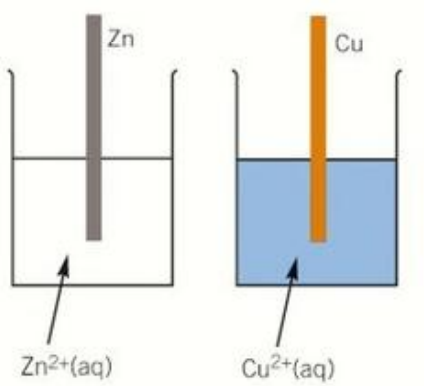
Metal/metal ion half-cells
The most straightforward type of half-cell consists of a metal electrode dipped into a solution of its own aqueous metal ions.
For example, a zinc half-cell comprises:
- A zinc metal rod (the electrode)
- A solution containing Zn²⁺(aq) ions
Note
We represent this half-cell using standard notation with a vertical line showing the phase boundary between the solid metal and the aqueous solution: Zn²⁺(aq)|Zn(s)
Similarly, a copper half-cell would be written as: Cu²⁺(aq)|Cu(s)
At the phase boundary where the metal contacts its ionic solution, a dynamic equilibrium is established. By convention, we always write half-cell equilibria with the forward reaction showing reduction (gain of electrons) and the reverse reaction showing oxidation (loss of electrons):
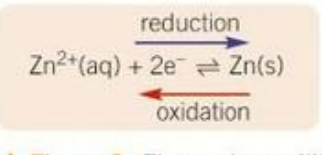
In an isolated half-cell (one that is not connected to another half-cell), there is no net electron transfer into or out of the metal. The system is at equilibrium.
When two half-cells are connected in a complete electrochemical cell, the direction of electron flow depends on the relative tendency of each electrode to release electrons. The metal that releases electrons more readily will undergo oxidation.
Ion/ion half-cells
A different type of half-cell contains ions of the same element in different oxidation states. A common example involves iron ions where both Fe²⁺(aq) and Fe³⁺(aq) are present in the same solution.
The redox equilibrium for this system is:
In this type of half-cell, there is no metal electrode to transport electrons into or out of the solution. Therefore, we use an inert electrode made of platinum.
Note
Platinum is chosen because it:
- Does not react with the solution
- Conducts electrons effectively
- Allows electron transfer to occur at its surface
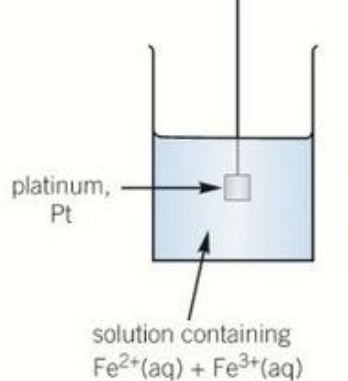
The notation for this half-cell is: Fe³⁺(aq), Fe²⁺(aq)|Pt(s)
Understanding electrode potentials
When you connect two metal/metal ion half-cells in an electrochemical cell, one electrode will have a greater tendency to release electrons than the other. This difference determines which electrode becomes positive and which becomes negative.
In an operating cell:
- The more reactive metal releases electrons more readily and undergoes oxidation - this becomes the negative electrode (anode)
- The less reactive metal gains electrons and undergoes reduction - this becomes the positive electrode (cathode)
Important
Electrons flow through the external wire from the negative electrode to the positive electrode, creating an electric current that can do useful work.
Standard electrode potential
Definition and standard reference
The tendency of a half-cell to be reduced (gain electrons) compared to other half-cells is quantified as its standard electrode potential, given the symbol .
To measure standard electrode potentials, we need a reference point. The chosen standard is the standard hydrogen electrode (SHE), which consists of:
- Hydrogen gas, H₂(g), at a specified pressure
- A solution containing H⁺(aq) ions at a specified concentration
- An inert platinum electrode to allow electron transfer
The half-equation for the standard hydrogen electrode is:

Standard conditions
For electrode potential measurements to be comparable, they must be made under standardised conditions. The standard conditions are:
- Temperature: 298 K (25°C)
- Pressure: 100 kPa (1 bar)
- Concentration: Solutions must have a concentration of exactly 1 mol dm⁻³
Note
The standard electrode potential is defined as: the e.m.f. (electromotive force) of a half-cell connected to a standard hydrogen electrode under standard conditions of 298 K, solution concentrations of 1 mol dm⁻³, and a pressure of 100 kPa.
Important
By definition, the standard electrode potential of the standard hydrogen electrode is exactly 0 V.
The sign (positive or negative) of a standard electrode potential tells you about the half-cell's tendency to gain electrons compared to the hydrogen half-cell.
Measuring standard electrode potentials
To measure the standard electrode potential of a half-cell, you need to construct a complete electrochemical cell and connect the half-cell to a standard hydrogen electrode.
The experimental setup requires:
- A wire connection between the two electrodes to allow controlled electron flow through an external circuit
- A voltmeter to measure the potential difference (e.m.f.) between the two half-cells
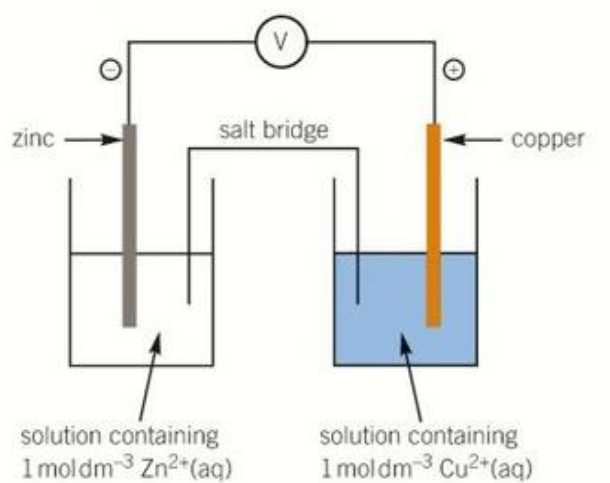
- A salt bridge connecting the two solutions to allow ion movement and complete the circuit
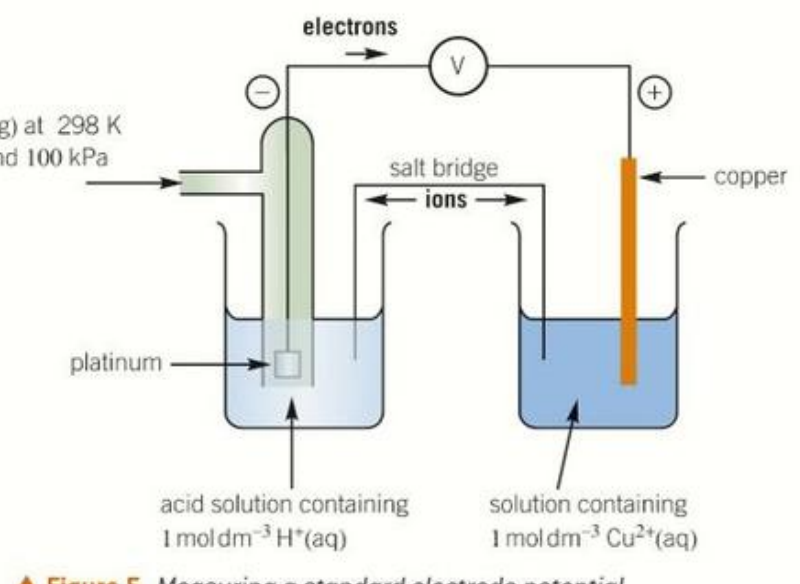
The salt bridge is a crucial component. It typically consists of a strip of filter paper soaked in a concentrated solution of an aqueous electrolyte. A commonly used electrolyte is potassium nitrate, KNO₃(aq).
Important
The salt bridge serves two important functions:
- It allows ions to flow between the two solutions, maintaining electrical neutrality
- It does not react chemically with either solution in the half-cells
Without the salt bridge, the circuit would be incomplete and no electron flow could occur through the external wire.
Setting up a standard measurement
Example
Experimental Procedure: Measuring Standard Electrode Potential
To measure a standard cell potential correctly, you must:
Step 1: Prepare two standard half-cells
- For a metal/metal ion half-cell, the metal ion concentration must be 1 mol dm⁻³
- For an ion/ion half-cell, both metal ions must be present at equal concentrations of 1 mol dm⁻³, with an inert platinum electrode
- For a gas half-cell (like the hydrogen electrode), the gas must be at 100 kPa pressure in contact with a 1 mol dm⁻³ solution, with an inert platinum electrode
- All half-cells must be at a temperature of 298 K
Step 2: Connect the metal electrodes of the half-cells to a voltmeter using wires
Step 3: Prepare a salt bridge by soaking filter paper in a saturated aqueous solution of potassium nitrate, KNO₃
Step 4: Connect the two solutions with the salt bridge
Step 5: Record the standard cell potential from the voltmeter
Standard electrode potential values
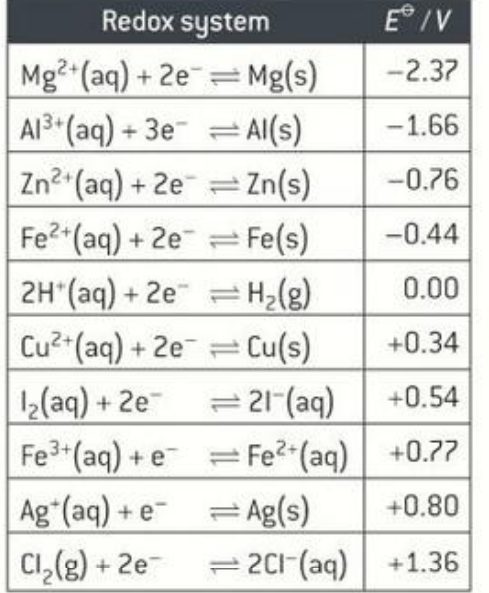
Standard electrode potentials have been measured experimentally for many different redox systems. These values are compiled in data tables for reference in calculations and predictions.
The table below shows examples of standard electrode potentials:
Important
Important conventions:
- The equilibrium is always shown with reduction (electron gain) as the forward reaction
- The redox systems are arranged in order of their standard electrode potential values
- More negative values appear at the top, more positive values at the bottom
Interpreting electrode potential values
The more negative the value:
- The greater the tendency to lose electrons and undergo oxidation
- The less the tendency to gain electrons and undergo reduction
The more positive the value:
- The greater the tendency to gain electrons and undergo reduction
- The less the tendency to lose electrons and undergo oxidation
Note
General trends:
- Metals tend to have negative values - they tend to lose electrons (undergo oxidation)
- Non-metals tend to have positive values - they tend to gain electrons (undergo reduction)
In terms of reactivity:
- The more negative the value, the greater the reactivity of the metal in losing electrons
- The more positive the value, the greater the reactivity of the non-metal in gaining electrons
Predicting cell behaviour
When two half-cells are connected to form a complete cell:
- The half-cell with the more positive value undergoes reduction and becomes the positive electrode (cathode)
- The half-cell with the more negative value undergoes oxidation and becomes the negative electrode (anode)
- Electrons flow from the more negative electrode to the less negative (more positive) electrode
Cell potentials
Standard electrode potentials allow you to predict and calculate the e.m.f. (cell potential) of any electrochemical cell made from two half-cells. The cell potential, , is simply the difference between the two standard electrode potential values.
Calculating cell potentials
The formula for calculating a standard cell potential is:
Important
The positive electrode is the one with the more positive (or less negative) value.
Example
Worked Example: Calculating Cell Potential for a Zinc-Copper Cell
Consider a cell made from Zn²⁺(aq)|Zn(s) and Cu²⁺(aq)|Cu(s) half-cells:
From the data table:
- for Cu²⁺(aq) + 2e⁻ → Cu(s) is +0.34 V
- for Zn²⁺(aq) + 2e⁻ → Zn(s) is -0.76 V
Step 1: Identify which is the positive electrode
- Copper has the more positive value (+0.34 V), so copper is the positive electrode
- Zinc has the more negative value (-0.76 V), so zinc is the negative electrode
Step 2: Apply the formula
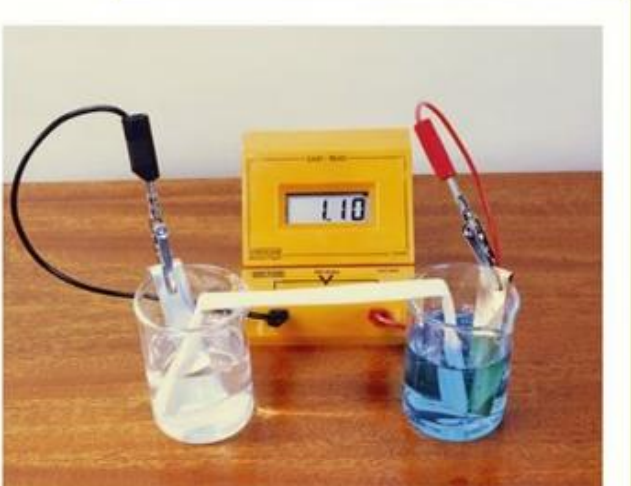
This calculated value matches the experimental measurement shown in the photograph:
Writing overall cell equations
To determine what happens in the cell:
At the positive electrode (copper):
- The half-cell with the more positive undergoes reduction
- Cu²⁺(aq) + 2e⁻ → Cu(s)
- Electrons are gained
At the negative electrode (zinc):
- The half-cell with the more negative undergoes oxidation
- The equilibrium is reversed: Zn(s) → Zn²⁺(aq) + 2e⁻
- Electrons are lost
Overall cell equation: Combine the reduction and oxidation half-equations:
Exam tips
Important
Common mistakes to avoid:
- Forgetting to reverse the equilibrium for the oxidation half-equation when writing cell equations
- Getting confused about which electrode is positive - remember, the more positive value gives the positive electrode
- Not showing state symbols in half-equations
- Forgetting standard conditions: 298 K, 100 kPa, 1 mol dm⁻³
Key exam skills:
- Always write half-cell equilibria with reduction as the forward reaction
- When calculating cell potentials, identify the positive electrode first (more positive )
- Remember: electrons flow from negative to positive electrode in the external circuit
- For ion/ion half-cells, always include the inert platinum electrode in notation
Writing half-equations: When a question asks for the half-equation at the more negative electrode, write the equilibrium the other way round (oxidation) with electrons on the right-hand side.
Remember!
Summary
Key Points to Remember:
-
Standard electrode potential measures a half-cell's tendency to be reduced compared to the standard hydrogen electrode, measured under standard conditions (298 K, 100 kPa, 1 mol dm⁻³)
-
Standard conditions are essential - temperature 298 K, pressure 100 kPa, and solution concentration 1 mol dm⁻³ - for meaningful comparisons of electrode potentials
-
More positive values indicate a greater tendency to gain electrons (undergo reduction), while more negative values indicate a greater tendency to lose electrons (undergo oxidation)
-
Cell potential is calculated using: , where the positive electrode has the more positive (or less negative) value
-
Half-cell equilibria are always written with reduction (electron gain) as the forward reaction, but the oxidation half-equation must be reversed when writing overall cell equations