Manganate(VII) Redox Titrations (OCR A-Level Chemistry A): Revision Notes
📚Revision Notes
Manganate(VII) Redox Titrations
Introduction to manganate(VII) redox titrations
Manganate(VII) redox titrations are quantitative analytical techniques used to determine the concentration of reducing agents in solution. These titrations follow similar procedural steps to acid-base titrations but involve electron transfer rather than proton transfer. The key feature that distinguishes these titrations is that manganate(VII) ions act as the oxidising agent and are themselves reduced during the reaction.
In these titrations, ions (which have a deep purple colour) are reduced to ions (which are very pale pink, appearing almost colourless). For this reduction to occur, the other substance present must be a reducing agent that undergoes oxidation. This makes manganate(VII) titrations particularly useful for analysing substances that can donate electrons.
Important
An important advantage of manganate(VII) titrations is that they are self-indicating. This means no separate indicator chemical is required because the manganate(VII) ions themselves provide a clear visual signal when the end point is reached.
Two common redox titrations using manganate(VII)
This topic focuses on two standard redox titrations that you should be familiar with:
- Potassium manganate(VII) titrations under acidic conditions - Using as the oxidising agent
- Sodium thiosulfate titrations - Using for determining iodine () concentration
Note
Potassium manganate(VII) is also known by its traditional IUPAC name, potassium permanganate. Both names refer to the same compound.
Carrying out a manganate(VII) titration
Procedure
The experimental procedure for a manganate(VII) titration follows these key steps:
Step 1: Prepare the burette
A standard solution of potassium manganate(VII), , is prepared and added to a clean burette. The concentration of this solution must be accurately known (typically around 0.0200 mol dm⁻³).
Step 2: Prepare the analyte solution
Using a calibrated pipette, transfer a measured volume of the solution being analysed into a conical flask. To this solution, add an excess of dilute sulfuric acid. The sulfuric acid serves two essential purposes: it provides the ions required for the reduction of ions, and it creates the acidic conditions necessary for the reaction to proceed.
Note
Importantly, no indicator needs to be added because the titration is self-indicating.
Step 3: Perform the titration
During the titration, the purple manganate(VII) solution is gradually added from the burette to the flask. As it is added, the manganate(VII) reacts with the reducing agent and the purple colour disappears. The end point is reached when the solution in the flask develops a first permanent pale pink colour. This indicates that a slight excess of ions is now present.
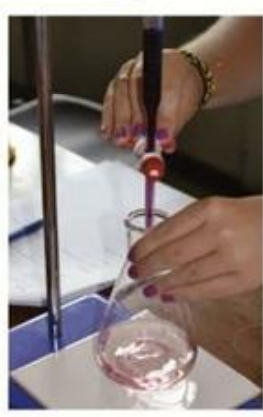
Step 4: Obtain concordant titres
The titration should be repeated until you obtain concordant titres - these are at least two titre values that agree within ±0.10 cm³ of each other. This ensures the accuracy and reliability of your results.
Reading the meniscus correctly
When taking burette readings during manganate(VII) titrations, a special technique is required. The solution has a deep purple colour that makes it extremely difficult to see the bottom of the meniscus clearly through the intense colour.
Important
To overcome this problem, burette readings should be taken from the top of the meniscus rather than the bottom. The key principle is consistency: as long as you use the top of the meniscus for both the initial reading and the final reading, the calculated titre volume (the difference between the two readings) will be accurate. This is because the difference between readings from the top of the meniscus is the same as the difference would be from readings at the bottom.
Why use sulfuric acid rather than hydrochloric acid?
In manganate(VII) titrations, sulfuric acid must be used to provide the acidic conditions - hydrochloric acid cannot be used as an alternative.
Important
This is because ions can be oxidised to chlorine by acidified ions. If hydrochloric acid were used, the manganate(VII) would react with the chloride ions from the acid as well as with the substance being analysed, leading to inaccurate results.
Analysing the percentage purity of iron(II) compounds
The redox reaction with iron(II) ions
Manganate(VII) titrations can be used to determine the percentage purity of iron(II) compounds such as iron(II) sulfate. To understand the calculations, you need to know the half-equations and the overall equation for this redox reaction.
Reduction half-equation (manganate(VII) is reduced):
Oxidation half-equation (iron(II) is oxidised):
To construct the overall equation, the oxidation half-equation must be multiplied by 5 so that the electrons balance (5 electrons in each half-equation). The reduction half-equation is multiplied by 1, and then the two half-equations are added together:
Overall equation:
Note
This equation shows that 1 mole of ions reacts with 5 moles of ions. This 1:5 molar ratio is crucial for all calculations involving this titration.
Worked example: Percentage purity of iron(II) sulfate heptahydrate
Example
Worked Example: Determining the Percentage Purity of
This worked example demonstrates how to determine the percentage purity of an impure sample of iron(II) sulfate heptahydrate, .
Procedure:
- Prepare a 250.0 cm³ solution of the impure in a volumetric flask
- Using a pipette, transfer 25.0 cm³ of this solution into a conical flask
- Add 10 cm³ of 1 mol dm⁻³ (in excess) to the flask
- Titrate this solution using a standard 0.0200 mol dm⁻³ solution of potassium manganate(VII),
- Analyse the results to calculate the percentage purity
Mass measurements:

| Measurement | Mass / g |
|---|---|
| Mass of weighing bottle + impure | 18.34 |
| Mass of weighing bottle | 11.37 |
| Mass of impure | 6.97 |
Titration readings:
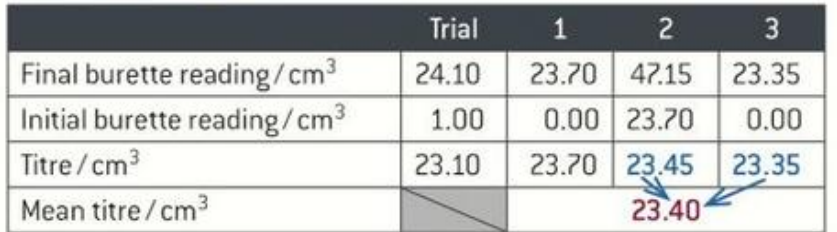
| Reading | Trial | 1 | 2 | 3 |
|---|---|---|---|---|
| Final burette reading / cm³ | 24.10 | 23.70 | 42.15 | 23.35 |
| Initial burette reading / cm³ | 1.00 | 0.00 | 23.70 | 0.00 |
| Titre / cm³ | 23.10 | 23.70 | 23.45 | 23.35 |
| Mean titre / cm³ | 23.40 |
Note that only the closest titres are used to calculate the mean titre. In this example, trials 2 and 3 give values of 23.70 cm³ and 23.35 cm³, which differ by 0.35 cm³. However, trial 3 (23.35 cm³) and the value shown as 23.45 cm³ are within ±0.10 cm³ of each other, so these concordant values are used to calculate the mean of 23.40 cm³.
Calculation steps
Example
Worked Example: Calculation Steps
Step 1: Calculate the amount of that reacted
The amount of substance can be calculated using the formula:
where is the amount in moles, is the concentration in mol dm⁻³, and is the volume in cm³.
Step 2: Calculate the amount of that reacted
Using the overall equation, we can see that the molar ratio is:
1 mol of reacts with 5 mol of
Therefore:
Step 3: Work out the unknown information in stages
(i) Scale up to find the amount of in the full 250.0 cm³ solution
The titration used only 25.00 cm³ of the prepared solution, so we need to scale up:
(ii) Find the mass of in the impure sample
Using the relationship , we can rearrange to find mass:
We need to calculate the molar mass of :
- Relative atomic masses: Fe = 56, S = 32, O = 16, H = 1
The amount of equals the amount of because there is one ion per formula unit.
When considering significant figures, we should use 3 s.f. (based on the mass of the impure sample being 6.97 g). However, during intermediate calculations, more figures should be retained to avoid rounding errors.
(iii) Calculate the percentage purity
This result tells us that the impure sample contains 93.3% by mass of , with the remaining 6.7% being impurities.
Practical application: Iron supplements
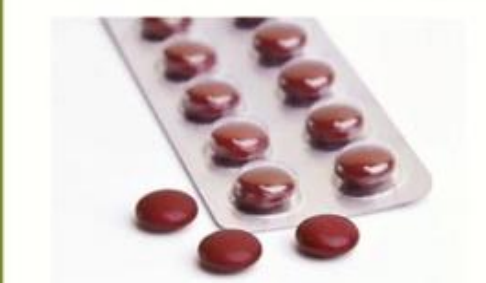
Iron supplements containing iron(II) are commonly used to treat iron deficiency anaemia. These tablets can be analysed using manganate(VII) titrations to verify their iron content.
Note
For example, if a 0.304 g iron supplement tablet is crushed and dissolved in 25.0 cm³ of dilute sulfuric acid, and the resulting solution requires 19.20 cm³ of 0.00750 mol dm⁻³ to reach the end point, the percentage by mass of iron in the tablet can be calculated using the same principles shown in the worked example above.
Determining molecular formulas using manganate(VII) titrations
Manganate(VII) titrations can also be used to determine the formula of hydrated organic compounds, particularly hydrated carboxylic acids. This worked example demonstrates the process using hydrated ethanedioic acid.
Worked example: Hydrated ethanedioic acid
Example
Worked Example: Determining the Formula of Hydrated Ethanedioic Acid
Hydrated ethanedioic acid has the formula . The value of (the number of water molecules of crystallisation) can be determined by reacting a solution of the hydrated acid with acidified manganate(VII) ions.
The half-equations and overall equation:
Reduction (manganate(VII) is reduced):
Oxidation (ethanedioic acid is oxidised):
To combine these half-equations, we need to balance the electrons. The reduction half-equation involves 5 electrons, and the oxidation half-equation involves 2 electrons. The lowest common multiple is 10, so:
- Multiply the reduction half-equation by 2
- Multiply the oxidation half-equation by 5
This gives 10 electrons in each half-equation, which cancel when we add them together:
Overall equation:
This shows that 2 moles of react with 5 moles of (a 2:5 ratio).
Procedure:
- A 0.1203 g sample of is dissolved in 25.0 cm³ of 1.0 mol dm⁻³ in a conical flask
- The contents of the flask are heated to 60°C (warming speeds up the reaction)
- The hot solution is titrated against 0.0200 mol dm⁻³ and 19.10 cm³ are required to reach the end point
Step 1: Calculate the amount of that reacted
Step 2: Calculate the amount of that reacted
From the overall equation, the stoichiometric ratio shows that:
2 mol of react with 5 mol of
Therefore:
Step 3: Determine the value of and the formula
(i) Calculate the molar mass of
Using the relationship and rearranging to :
(ii) Calculate the molar mass of just the anhydrous part
Relative atomic masses: C = 12, O = 16, H = 1
(iii) Find the mass of water in the hydrated compound
(iv) Calculate the value of
The molar mass of is 18.0 g mol⁻¹, so:
Therefore, the formula is (ethanedioic acid dihydrate).
Non-familiar redox titrations
The principles and calculation methods used for manganate(VII) titrations can be applied to analyse many different reducing agents. The key requirements are:
- The reducing agent must be capable of reducing to
- The reaction must occur in acidic conditions
Some examples of reducing agents that can be analysed using manganate(VII) titrations include:
- Iron(II) ions,
- Ethanedioic acid (oxalic acid),
- Other organic acids containing the carboxylic acid group
Additionally, potassium manganate(VII) can be replaced with other oxidising agents in redox titrations. The most commonly used alternative is acidified dichromate(VI), written as . The half-equation for dichromate(VI) reduction is:
Although the specific chemicals may differ, the essential calculation steps remain the same for all redox titrations:
- Calculate the amount of the substance in the burette (oxidising agent) that reacted
- Use the balanced equation to find the molar ratio
- Calculate the amount of the analyte (reducing agent) that reacted
- Work through the stages to determine the unknown information (concentration, purity, formula, etc.)
Note
When presented with an unfamiliar redox titration in an exam, focus on identifying the molar ratio from the balanced equation and follow the standard calculation procedure. The underlying principles do not change even when different chemicals are involved.
Remember!
Summary
Key Points to Remember:
-
Self-indicating titrations: Manganate(VII) titrations do not require a separate indicator because ions are deep purple and ions are very pale pink. The first permanent pale pink colour indicates the end point.
-
Essential conditions: Manganate(VII) titrations must be carried out in acidic conditions. Sulfuric acid is used (not hydrochloric acid) to provide excess ions required for the reduction reaction.
-
Meniscus reading technique: Read burette levels from the top of the meniscus (not the bottom) when using deeply coloured manganate(VII) solutions, but be consistent with both initial and final readings.
-
Key reduction half-equation:
-
Combining half-equations: Balance electrons by multiplying half-equations by appropriate factors (e.g., for titrations, multiply the iron oxidation equation by 5 to match the 5 electrons in the manganate reduction equation).
-
Concordant titres: Always obtain at least two titre values that agree within ±0.10 cm³ and use only these concordant values to calculate the mean titre for accurate results.
-
Calculation pathway: Follow the systematic approach: moles of oxidant → molar ratio → moles of reductant → scale up/down as needed → final answer (mass, concentration, purity, or formula).