Redox Reactions (OCR A-Level Chemistry A): Revision Notes
📚Revision Notes
Redox Reactions
Introduction to redox reactions
Redox reactions are fundamental chemical processes involving the transfer of electrons between chemical species. The term "redox" combines two complementary processes: reduction and oxidation, which always occur together in these reactions. Understanding redox chemistry is essential for explaining a wide range of chemical phenomena, from simple displacement reactions to complex electrochemical cells.
Note
Redox reactions can be analysed and described using two complementary approaches: tracking electron movement between species, or following changes in oxidation numbers. Both methods provide valuable insights and are used depending on the context and complexity of the reaction being studied.
Defining reduction and oxidation
Electron transfer definitions
When we consider electron movement, redox processes can be defined as follows:
- Reduction is the gain of electrons by a chemical species
- Oxidation is the loss of electrons by a chemical species
A helpful mnemonic to remember this is OILRIG:
- Oxidation Is Loss (of electrons)
- Reduction Is Gain (of electrons)
Oxidation number definitions
Alternatively, redox processes can be described in terms of oxidation number changes:
- Reduction is a decrease in oxidation number
- Oxidation is an increase in oxidation number
Note
Both definitions are equivalent and describe the same chemical processes. The oxidation number approach is particularly useful when dealing with complex molecules where electron tracking becomes difficult.
Rules for assigning oxidation numbers
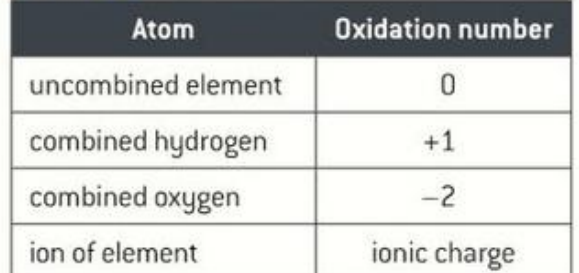
To use the oxidation number method effectively, you need to know the standard rules for assigning oxidation numbers to atoms in different chemical environments. These rules follow a specific hierarchy:
Important
Key rules to remember:
- Uncombined elements have an oxidation number of 0 (e.g., , , )
- Combined hydrogen usually has an oxidation number of +1 (with exceptions like metal hydrides)
- Combined oxygen usually has an oxidation number of -2 (with exceptions like peroxides)
- Ions of elements have an oxidation number equal to their ionic charge (e.g., is +1, is -1)
- The sum of oxidation numbers in a neutral compound equals 0
- The sum of oxidation numbers in an ion equals the charge on the ion
These rules form the foundation for analysing redox reactions using the oxidation number method.
Oxidising agents and reducing agents
In every redox reaction, there must be both an oxidising agent and a reducing agent. These terms describe the roles that different species play in facilitating electron transfer.
The oxidising agent
An oxidising agent is a substance that causes oxidation in another species. To do this, the oxidising agent must accept electrons from the species being oxidised. In accepting these electrons, the oxidising agent itself undergoes reduction.
Important
Key point: The oxidising agent contains the species that is reduced during the reaction.
The reducing agent
A reducing agent is a substance that causes reduction in another species. To do this, the reducing agent must donate electrons to the species being reduced. In donating these electrons, the reducing agent itself undergoes oxidation.
Important
Key point: The reducing agent contains the species that is oxidised during the reaction.
Worked example: identifying oxidising and reducing agents
Example
Worked Example: Identifying Oxidising and Reducing Agents
Consider the reaction between silver ions and copper metal:
Analysing oxidation numbers:
- Silver: +1 → 0 (decrease, so silver is reduced)
- Copper: 0 → +2 (increase, so copper is oxidised)
Therefore:
- is the oxidising agent (it has oxidised copper, and silver itself is reduced)
- is the reducing agent (it has reduced silver ions, and copper itself is oxidised)

This reaction is visible as the copper wire becomes coated with silver metal deposits, while the solution develops a blue colour from ions.
Note
Important note about terminology: When dealing with compounds like nitric acid (), be careful with language. Whilst nitric acid acts as an oxidising agent in many reactions, if we analyse oxidation numbers, only the nitrogen atom in is actually reduced - the hydrogen atoms don't change their oxidation number.
Constructing redox equations from half-equations
Half-equations are a powerful tool for representing the separate reduction and oxidation processes that occur in a redox reaction. By combining appropriately balanced half-equations, you can construct the overall redox equation.
The balancing procedure
The key principle when combining half-equations is ensuring that the number of electrons lost during oxidation exactly equals the number of electrons gained during reduction. This maintains charge balance in the overall equation.
Step 1: Balance the electrons
Examine both half-equations and identify how many electrons are involved in each. Find the lowest common multiple of these numbers, then multiply each half-equation by the appropriate factor to equalise electron numbers.
Step 2: Add and cancel electrons
Add the two balanced half-equations together. The electrons should appear equally on both sides, allowing you to cancel them completely.
Step 3: Cancel common species
Check if any species appear on both sides of the equation. If so, cancel the appropriate number to simplify the equation.
Worked example: combining half-equations
Example
Worked Example: Combining Half-Equations
Let's construct the redox equation for the reaction between hydrogen peroxide () and chromium(III) ions () in alkaline conditions.
Given half-equations:
Reduction:
Oxidation:
Step 1: Balance the electrons
The reduction involves 2 electrons, whilst the oxidation involves 3 electrons. The lowest common multiple is 6.
Multiply the reduction by 3:
Multiply the oxidation by 2:
Step 2: Add and cancel electrons
The cancels from both sides:
Step 3: Cancel common species
There are on the left and on the right. Cancel to leave on the left:
This is the balanced overall equation. You can verify this is correct by checking that atoms and charges balance on both sides.
Note
Exam tip: If you find fractions easier to work with, you can multiply the reduction equation by 1.5 instead of finding the common multiple. This is mathematically correct and may save time in exams.
Using oxidation numbers to write equations
An alternative method for constructing redox equations uses oxidation number changes directly. This approach is particularly useful when half-equations aren't provided, or when dealing with complex reactions involving multiple elements.
The oxidation number balancing procedure
The fundamental principle is that the total increase in oxidation number during oxidation must equal the total decrease in oxidation number during reduction.
Step 1: Write the unbalanced equation
Start by writing out all the reactants and products, even if you're unsure of some coefficients.
Step 2: Assign oxidation numbers
Determine the oxidation number of each element in all species. Identify which elements undergo oxidation number changes.
Step 3: Balance the species undergoing redox
Only balance the species containing elements that change oxidation number. Use the oxidation number changes to determine the correct stoichiometric ratios.
Step 4: Balance remaining atoms
Finally, balance any atoms that didn't change oxidation number (often hydrogen and oxygen).
Worked example: balancing using oxidation numbers
Example
Worked Example: Balancing Using Oxidation Numbers
Sulfur reacts with concentrated nitric acid to form sulfuric acid, nitrogen dioxide, and water:
Step 1: Summarise the information
The equation shows the reactants and products.
Step 2: Assign oxidation numbers
- Sulfur: 0 → +6 (oxidation number change: +6)
- Nitrogen: +5 → +4 (oxidation number change: -1)
Note that hydrogen and oxygen atoms don't change their oxidation numbers in this reaction.
Step 3: Balance only the redox species
To match the increase of +6 for sulfur, we need a total decrease of -6 from nitrogen. Since each nitrogen decreases by -1, we need 6 nitrogen atoms:
Step 4: Balance remaining atoms
Now the oxidation numbers are balanced. Count the hydrogen and oxygen atoms:
- Left side: 6 H, 18 O
- Right side (before balancing water): 2 H (in ), 16 O
We need 4 more H and 2 more O, which means 2 water molecules:
This equation is now fully balanced.
Note
Exam tip: This method removes much of the guesswork from balancing complex redox equations. The oxidation number changes tell you exactly what stoichiometric ratios are needed.
Writing half-equations
Sometimes you'll need to construct half-equations rather than just combine them. This skill is essential for understanding electrode processes and electrochemical cells.
Procedure for writing half-equations
Step 1: Assign oxidation numbers
Determine the oxidation numbers of the species being reduced or oxidised, and calculate the change.
Step 2: Balance the electrons
Add electrons to the appropriate side of the equation. Remember:
- For reduction (decrease in oxidation number), electrons go on the left (reactant side)
- For oxidation (increase in oxidation number), electrons go on the right (product side)
Step 3: Balance remaining atoms
Balance any other atoms present, then predict any additional species that must be formed.
Worked example: writing a half-equation
Example
Worked Example: Writing a Half-Equation
Acidified manganate(VII) ions () are reduced to manganese(II) ions ().
Step 1: Assign oxidation numbers
Manganese: +7 → +2 (oxidation number decreases by 5)
Step 2: Balance electrons
A decrease of 5 in oxidation number requires 5 electrons on the left:
Step 3: Balance remaining atoms
The left side has 4 oxygen atoms and hydrogen ions. No oxygen or hydrogen appears on the right side. The likely product is water ().
Add water to the right:
Now balance the hydrogen by adding 8 to the left:
This is the balanced half-equation.
Important
When writing half-equations, you should only add species that make chemical sense. In aqueous reactions, these are typically , (in acidic conditions), or (in alkaline conditions). Don't invent unusual species.
Predicting products of redox reactions
In exam questions and practical situations, you may not be given all the species involved in a redox reaction. You'll need to predict missing reactants or products based on your understanding of redox chemistry.
Key considerations when predicting products
1. Water is commonly formed
In aqueous redox reactions, water () is frequently produced, particularly when reactions involve oxygen-containing species.
2. Hydrogen ions or hydroxide ions
Depending on whether the reaction occurs in acidic or alkaline conditions:
- Acidic conditions: ions are likely to be involved
- Alkaline conditions: ions are likely to be involved
3. Charge must balance
As a final check, ensure that the total charge on the left side of your equation equals the total charge on the right side. This is a fundamental requirement for all balanced chemical equations.
4. Use oxidation numbers to predict half-equations
If you need to predict a missing half-equation, use oxidation numbers to identify what species makes chemical sense. The change in oxidation number will tell you how many electrons must be involved.
Example of predicting products
Suppose you're told that hydrogen iodide reacts with concentrated sulfuric acid, and you need to predict all products. You might know that iodide can be oxidised to iodine, and that sulfuric acid can be reduced. Using oxidation numbers:
- Iodine in HI: -1 → 0 (in ), so oxidation occurs
- Sulfur in : +6 → ? (reduction must occur)
Common reduction products of sulfuric acid include (where S is -2), showing sulfur has been reduced. Water would also be formed. This systematic thinking allows you to predict products logically rather than guessing.
Note
Exam tip: Always make predictions that are chemically sensible. If your predicted formula looks strange or unusual, you've probably made an error in your reasoning.
Remember!
Summary
Key Points to Remember:
-
Redox reactions involve both oxidation and reduction occurring simultaneously
- Oxidation is loss of electrons or an increase in oxidation number (remember OILRIG)
- Reduction is gain of electrons or a decrease in oxidation number
-
The oxidising agent is the species that gets reduced; the reducing agent is the species that gets oxidised
- The oxidising agent accepts electrons and causes oxidation in another species
- The reducing agent donates electrons and causes reduction in another species
-
Key oxidation number rules: Uncombined elements = 0, combined hydrogen = +1, combined oxygen = -2, ions = ionic charge
-
When balancing redox equations from half-equations: The number of electrons lost must equal the number of electrons gained
-
When using oxidation numbers to balance equations: The total increase in oxidation number must equal the total decrease in oxidation number
-
When predicting products: Consider , , and as likely products in aqueous reactions, and always check charge balance