Storage and Fuel Cells (OCR A-Level Chemistry A): Revision Notes
📚Revision Notes
Storage and Fuel Cells
Modern storage cells
Modern electrochemical cells and batteries rely on the principles of electrode potentials and redox chemistry. The fundamental requirement for any cell to generate electrical energy is that the two electrodes must have different electrode potentials. Understanding half-equations and cell reactions is essential for working with these systems.
Note
Cells can be categorised into three main types based on their operation: primary cells (non-rechargeable), secondary cells (rechargeable), and fuel cells (continuous operation with fuel supply). Each type has distinct characteristics that make them suitable for different applications in our technology-driven world.
Primary cells
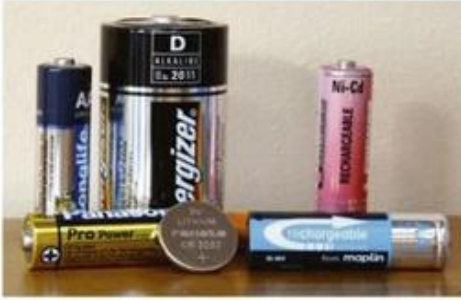
Primary cells are designed for single-use applications and cannot be recharged. When these cells are in use, electrical energy is generated through oxidation and reduction reactions occurring at the electrodes. As the cell operates, the chemical reactants are gradually consumed, which causes the voltage to decrease over time. Eventually, the chemicals become depleted, the battery "goes flat," and the cell must either be discarded or recycled.
These non-rechargeable cells are particularly useful for low-current, long-storage applications such as wall clocks, remote controls, and smoke detectors. Most modern primary cells use an alkaline design based on zinc and manganese dioxide (Zn/MnO₂) with a potassium hydroxide electrolyte.
Electrode reactions in alkaline primary cells:
The standard electrode potentials for the zinc-manganese dioxide system are:
When the cell operates:
Oxidation (at negative electrode):
Reduction (at positive electrode):
Overall cell reaction:
Important
In the MnO₂/Mn₂O₃ system, the more positive electrode undergoes reduction and accepts electrons. The Zn/ZnO system is less positive, so zinc is oxidised and manganese dioxide in MnO₂ is reduced. This is why the equilibrium equation shown above is reversed when writing the actual cell reaction.
Secondary cells
Unlike primary cells, secondary cells are rechargeable. The key advantage of these cells is that the chemical reaction producing electrical energy can be reversed by applying an external voltage during recharging. This regenerates the original chemicals in the cell, allowing it to be used repeatedly.
Common examples of secondary cells include:
- Lead-acid batteries: Used extensively in car batteries, these provide high current for starting engines
- Nickel-cadmium (NiCd) cells and nickel-metal hydride (NiMH) batteries: The cylindrical batteries commonly found in radios, torches, and similar devices
- Lithium-ion and lithium-ion polymer cells: Used in modern electronic appliances including laptops, tablets, cameras, and mobile phones. These are also being developed for electric vehicles
Lithium-ion and lithium-ion polymer cells
Lithium-ion cells have become extremely popular in modern technology. Lithium is a light metal, which gives these batteries a very high energy density compared to other types. This means they can store a large amount of energy for their size and weight.
Note
The physical form of lithium-ion cells varies. Camera cells and some other applications use regular-shaped cells, but lithium-ion polymer pouch batteries have a unique design. They contain an internal salt bridge made of a micro-porous polymer covered in an electrolyte gel. Because the solid polymer is flexible, these batteries can be easily formed into various shapes and sizes, making them ideal for fitting into the compact spaces available in laptops, tablets, and mobile phones.
Operation of lithium-ion cells:
When a lithium-ion cell charges and discharges, electrons flow through the connecting wires to power the appliance, while lithium ions (Li⁺) move between the electrodes within the cell to maintain electrical balance. The negative electrode is made of graphite coated with lithium metal, and the positive electrode is typically made of a metal oxide, commonly cobalt oxide (CoO₂).
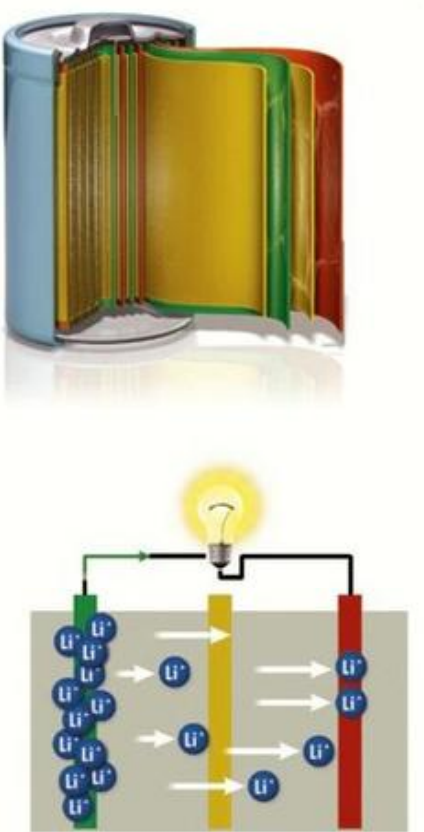
Electrode reactions during discharge:
Negative electrode:
Positive electrode:
When the cell is fully charged, it has a voltage of 4.2 V, but this decreases with use. The typical operational voltage is approximately 3.7-3.8 V.
Example
Worked Example: Calculating Cobalt Oxide Electrode Potential
The standard electrode potential for Li⁺ + e⁻ ⇌ Li is -3.04 V. Using this value, you can calculate the electrode potential of the cobalt oxide electrode when the cell is fully charged.
If the overall cell voltage is 4.2 V:
Limitations:
Important
While lithium-ion cells offer many advantages, they do have some limitations:
- They can become unstable at high temperatures
- In very rare cases, have been known to ignite laptops and mobile phones
- Lithium is a very reactive metal, so care must be taken during recycling
Fuel cells
A fuel cell operates on a different principle from storage cells. Instead of storing chemical energy within the cell, a fuel cell uses the energy from the reaction of a fuel with oxygen to continuously create a voltage, as long as fuel and oxygen are supplied.
Key characteristics of fuel cells:
- The fuel and oxygen flow into the fuel cell, and the products flow out
- The electrolyte remains in the cell throughout operation
- Fuel cells can operate continuously provided that fuel and oxygen are supplied to the cell
- Unlike storage cells, fuel cells do not need to be recharged
- They convert chemical energy directly into electrical energy with high efficiency

Note
Many different fuels can be used in fuel cells, but hydrogen is the most common. Hydrogen fuel cells produce no carbon dioxide during combustion; water is the only combustion product, making them environmentally friendly. Research is also ongoing into fuel cells using other hydrogen-rich fuels, such as methanol.
Hydrogen fuel cells
A hydrogen fuel cell can operate with either an alkali or acid electrolyte. Although both types of electrolyte are used, both produce the same cell voltage of 1.23 V. The difference lies in the redox systems and half-equations, as different ions are involved in the alkali and acid cells.
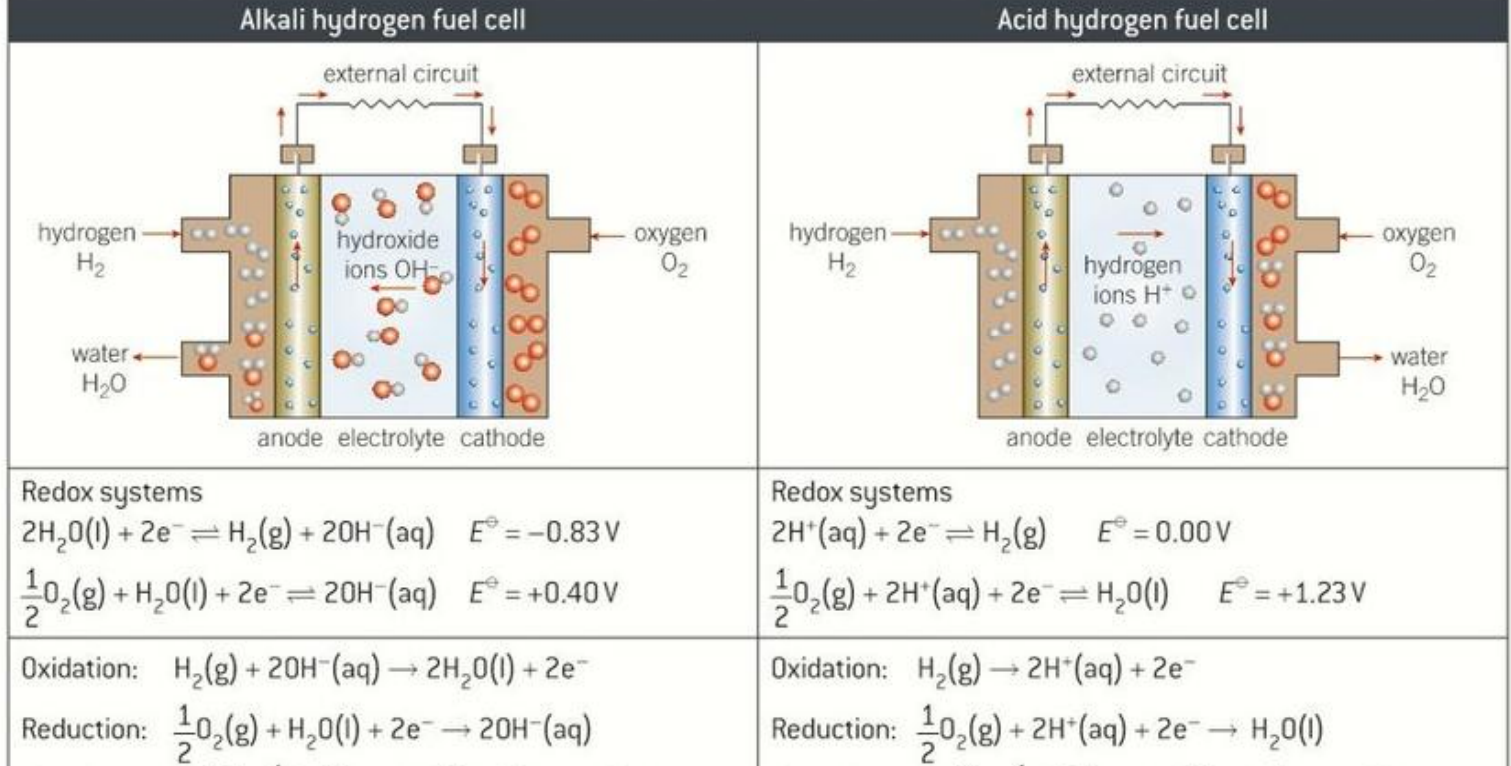
Alkali hydrogen fuel cell:
In an alkali fuel cell, hydroxide ions (OH⁻) are present in the electrolyte.
Standard electrode potentials:
Oxidation (at anode):
Reduction (at cathode):
Overall reaction:
Acid hydrogen fuel cell:
In an acid fuel cell, hydrogen ions (H⁺) are present in the electrolyte.
Standard electrode potentials:
Oxidation (at anode):
Reduction (at cathode):
Overall reaction:
Important
Notice that despite using different electrolytes and having different half-equations, both types of hydrogen fuel cell have the same overall reaction and the same cell voltage (1.23 V). The choice between alkali and acid electrolytes depends on practical considerations such as materials compatibility and operating conditions.
Remember!
Summary
Key Points to Remember:
-
Primary cells are non-rechargeable single-use cells where chemical reactants are consumed during use. Common examples include alkaline batteries (Zn/MnO₂).
-
Secondary cells are rechargeable cells where the chemical reaction can be reversed by applying an external voltage. Examples include lead-acid, NiCd, NiMH, and lithium-ion batteries.
-
Lithium-ion cells have very high energy density due to lithium being a light metal. They use a graphite/lithium negative electrode and metal oxide positive electrode, with Li⁺ ions moving between electrodes during charge and discharge.
-
Fuel cells generate electricity continuously from the reaction of a fuel (usually hydrogen) with oxygen. Unlike storage cells, fuel cells do not need recharging but require continuous fuel supply.
-
Hydrogen fuel cells can use either alkali or acid electrolytes. Both types produce water as the only product and have a cell voltage of 1.23 V, but they involve different ions in their half-equations (OH⁻ for alkali, H⁺ for acid).
Exam Focus Checklist:
- Be able to distinguish between primary, secondary, and fuel cells
- Know and be able to write half-equations and overall equations for cell reactions
- Understand how to calculate cell voltages from standard electrode potentials
- Be able to identify oxidation and reduction processes in cells
- Know the advantages and limitations of lithium-ion cells
- Understand the differences between alkali and acid hydrogen fuel cells
- Remember that fuel cells produce water as the only emission (for hydrogen fuel cells)