d-Block Elements (OCR A-Level Chemistry A): Revision Notes
📚Revision Notes
d-Block Elements
What are d-block elements?
The d-block elements occupy a central region of the periodic table, positioned between Group 2 and Group 13. This section covers the first row of d-block elements, from scandium (Sc) to zinc (Zn) in Period 4.
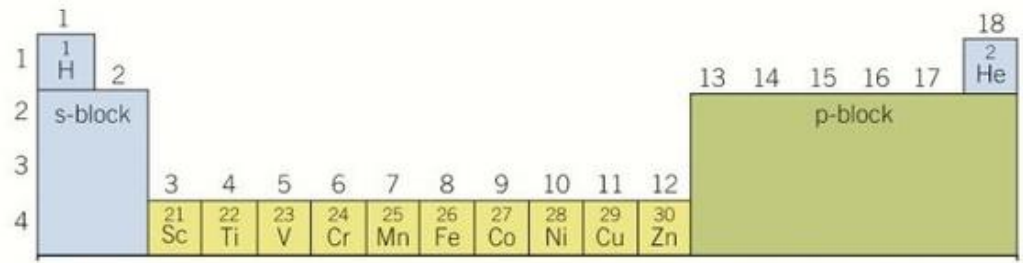
These elements are characterized by having their highest energy electrons entering the 3d sub-shell as you progress across the period. This makes them distinct from the s-block elements on the left and the p-block elements on the right of the periodic table.
Physical properties of d-block elements
All d-block elements are metals and display typical metallic characteristics:
- High melting and boiling points - They require significant energy to overcome metallic bonding
- Shiny appearance - They have a lustrous metallic surface
- Good electrical conductivity - Free electrons can move through the metal structure
- Good thermal conductivity - They efficiently transfer heat energy
Note
Practical Applications of d-Block Elements
These metallic properties make d-block elements extremely useful in everyday applications. For instance, copper is widely used in electrical wiring and plumbing due to its excellent conductivity. Iron is the backbone of construction and tool manufacturing. Titanium's exceptional strength-to-weight ratio makes it invaluable in aerospace engineering and medical implants such as joint replacements. Coinage often uses a mixture of copper, nickel, and zinc to balance durability with cost.
Electron configuration of d-block elements
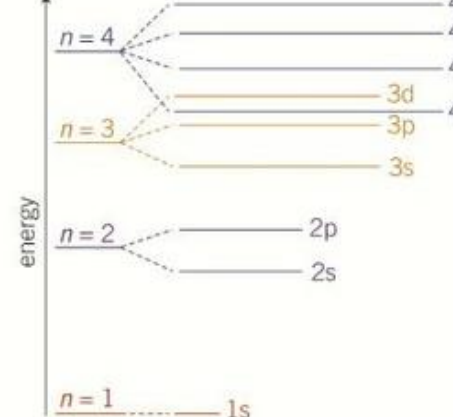
The arrangement of electrons in atoms follows a specific order based on energy levels. Understanding this helps explain the chemical behavior of d-block elements.
Important
Critical Principle: 4s vs 3d Energy Levels
The 4s sub-shell has lower energy than the 3d sub-shell, so it fills with electrons first. However, once both sub-shells contain electrons, the 3d sub-shell actually becomes lower in energy than the 4s sub-shell.
This energy reversal is crucial for understanding ion formation in d-block elements.
Electron configurations from scandium to zinc
As we move across the first row of d-block elements from scandium to zinc, the 3d sub-shell gradually fills with electrons. Here is how this progresses:
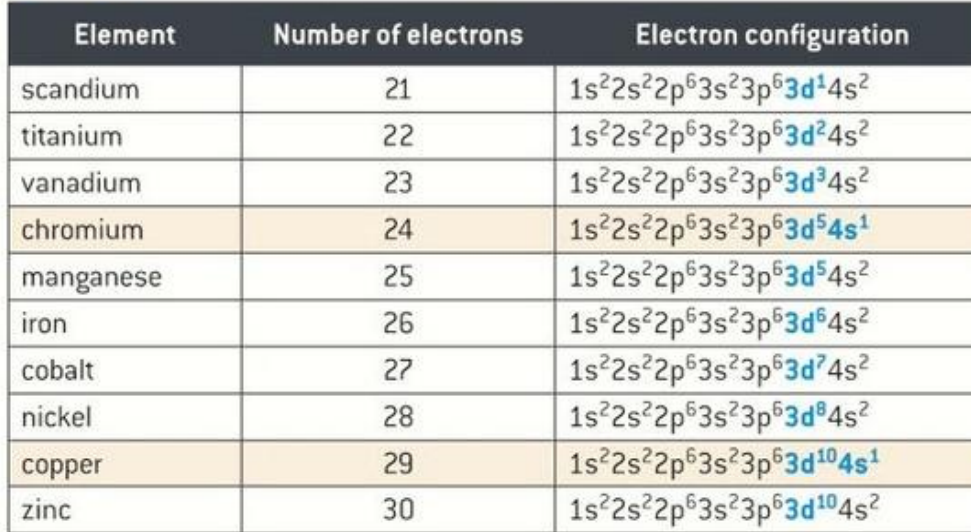
Most elements follow a regular pattern where electrons fill the 4s sub-shell first (giving ), and then the 3d sub-shell fills progressively. However, chromium and copper show exceptions to this pattern.
Special cases: chromium and copper
Important
Electron Configuration Exceptions
Chromium and copper have unusual electron configurations that don't follow the expected pattern:
-
Chromium (24 electrons): Expected configuration would be , but the actual configuration is
-
Copper (29 electrons): Expected configuration would be , but the actual configuration is
Why these exceptions occur: A half-filled sub-shell (chromium) and a fully filled sub-shell (copper) provide additional stability to the atom. This extra stability makes it energetically favorable to promote one electron from the 4s orbital to the 3d orbital.
Electron configuration of d-block ions
When d-block elements form positive ions, they lose electrons. A crucial point is that 4s electrons are always removed before any 3d electrons, even though the 4s sub-shell fills first when forming atoms.
Important
The 4s Filling and Emptying Rule
This means:
- When forming an atom, the 4s orbital fills before the 3d orbitals
- When forming an ion, the 4s orbital empties before the 3d orbitals
This is one of the most commonly confused concepts in d-block chemistry!
Example
Worked Example: Iron Ion Configurations
Let's look at iron as an example:

- Fe atom:
- Fe²⁺ ion: (two 4s electrons lost)
- Fe³⁺ ion: (two 4s electrons and one 3d electron lost)
Notice how the 4s electrons are removed first to form Fe²⁺, and only then is a 3d electron removed to form Fe³⁺.
Transition elements
Not all d-block elements are classified as transition elements. There is a specific definition that must be satisfied.
Important
Definition of Transition Elements
Transition elements are defined as d-block elements that form at least one ion with a partially filled d-orbital.
This means the element must be capable of forming an ion where the d-orbital contains between one and nine electrons (not zero and not ten).
Why scandium and zinc are not transition elements
Although scandium (Sc) and zinc (Zn) are both d-block elements, neither qualifies as a transition element:
Scandium:
- Electron configuration of Sc:
- Scandium only forms Sc³⁺ ions by losing two 4s electrons and one 3d electron
- Electron configuration of Sc³⁺:
- The Sc³⁺ ion has empty d-orbitals (no 3d electrons)
Zinc:
- Electron configuration of Zn:
- Zinc only forms Zn²⁺ ions by losing its two 4s electrons
- Electron configuration of Zn²⁺:
- The Zn²⁺ ion has full d-orbitals (ten 3d electrons)
Since neither scandium nor zinc forms ions with partially filled d-orbitals, they do not meet the definition of transition elements.
Properties of transition metals
Transition elements exhibit three characteristic properties that distinguish them from other metals:
- They form compounds with variable oxidation states
- They form colored compounds
- They can act as catalysts (both the elements and their compounds)
Variable oxidation states
Transition elements can form compounds where the metal exists in different oxidation states. This means they can lose different numbers of electrons when forming compounds.
For example, iron commonly forms two types of chloride:
- Iron(II) chloride (FeCl₂) - iron in +2 oxidation state
- Iron(III) chloride (FeCl₃) - iron in +3 oxidation state
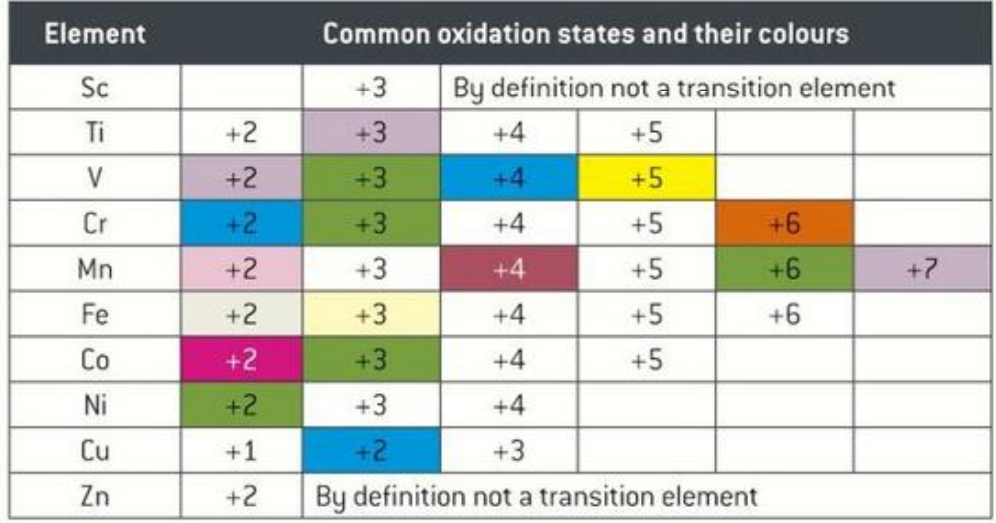
All transition elements form compounds with an oxidation state of +2, which results from the loss of their two 4s electrons. As you move across the series from scandium to manganese, the number of possible oxidation states increases, reaching a maximum at manganese with seven possible states (+2 to +7). After manganese, the number of oxidation states decreases.

Note
Oxidation State Characteristics
Each oxidation state often has a characteristic color. When a transition element is in its highest possible oxidation state, it typically forms a strong oxidizing agent, meaning it readily accepts electrons from other substances.
Common examples of oxidation states and their colors:
- Iron(II) compounds (Fe²⁺): pale green solutions (electron configuration )
- Iron(III) compounds (Fe³⁺): yellow solutions (electron configuration )
- Chromium(III) compounds (Cr³⁺): green solutions
- Chromium(VI) compounds (Cr⁶⁺): yellow or orange solutions
Determining oxidation states
You can calculate the oxidation state of a transition metal in a compound or ion using the rule that the sum of all oxidation numbers equals the overall charge.
Example
Worked Example: Finding the Oxidation State of Manganese in MnO₄⁻
To find the oxidation number of manganese in MnO₄⁻:
Step 1: Let Mn have oxidation number
Step 2: Identify known oxidation numbers
- Oxygen has oxidation number
- Overall charge is
Step 3: Set up the equation
Step 4: Solve for
Answer: Therefore, manganese has an oxidation number of +7 in the manganate(VII) ion.
Formation of colored compounds
Transition metal compounds and their aqueous solutions are frequently colored. This is one of the most visually distinctive properties of transition elements.

Note
Why Transition Metal Compounds Are Colored
The color arises because of the partially filled d-orbitals in transition metal ions. When these ions are in solution or in compounds, the d-orbitals split into different energy levels. Electrons can absorb specific wavelengths of visible light to jump between these levels, and the color we observe is the complementary color of the light absorbed.
Different oxidation states of the same element produce different colors because they have different numbers of d-electrons:
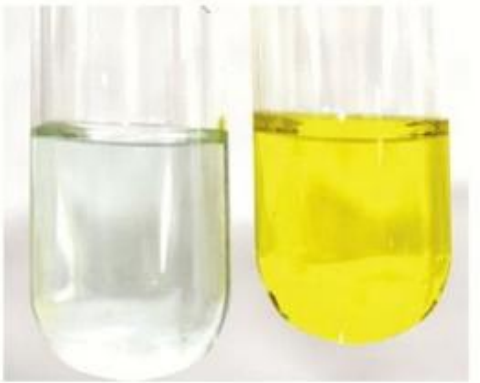
The image shows the distinct color difference between iron in +2 oxidation state (pale green/colorless solution on the left) and iron in +3 oxidation state (yellow solution on the right).
Important
Why Zinc Compounds Are Colorless
Zinc compounds, by contrast, form colorless solutions. This is because Zn²⁺ ions have a full configuration with no partially filled d-orbitals. Without partially filled d-orbitals, there can be no d-electron transitions to absorb visible light, so zinc solutions remain colorless.
This further confirms why zinc is NOT classified as a transition element!
Catalytic behavior
Transition metals and their compounds serve as catalysts in numerous chemical reactions. A catalyst is a substance that increases the rate of a reaction without being permanently changed or consumed itself. It works by providing an alternative reaction pathway with lower activation energy.
Catalysts can be classified into two types:
Note
Heterogeneous Catalysts
Heterogeneous catalysts - The catalyst is in a different physical state from the reactants. Common examples include:
-
Haber process: Iron metal catalyzes the reaction between nitrogen and hydrogen gases to produce ammonia:
-
Contact process: Vanadium(V) oxide, V₂O₅(s), catalyzes the oxidation of sulfur dioxide to sulfur trioxide in the production of sulfuric acid:
-
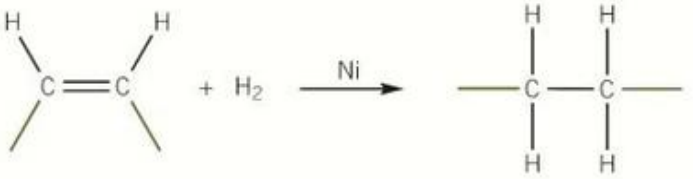
Hydrogenation of vegetable oils: Nickel metal catalyzes the addition of hydrogen to carbon-carbon double bonds in the manufacture of margarine:
-
Decomposition of hydrogen peroxide: Manganese(IV) oxide, MnO₂(s), catalyzes the breakdown of hydrogen peroxide to water and oxygen:
Note
Homogeneous Catalysts
Homogeneous catalysts - The catalyst is in the same physical state as the reactants. An important example involves iron ions in solution:
The reaction between peroxodisulfate ions (S₂O₈²⁻) and iodide ions (I⁻) in aqueous solution is catalyzed by Fe²⁺(aq) ions:
Example
Worked Example: How Fe²⁺ Catalyzes the Peroxodisulfate-Iodide Reaction
The iron(II) catalyst works through a two-step mechanism:
Step 1:
Step 2:
Notice that Fe²⁺ is used in step 1 but regenerated in step 2. This demonstrates the key principle of catalysis - although the catalyst participates in the reaction, it is not permanently consumed and can be used repeatedly.
Experimental observation: When testing this reaction with starch indicator, a blue-black color forms showing the production of iodine. Adding a small amount of Fe²⁺(aq) causes the blue-black color to form much more rapidly, clearly demonstrating the catalytic action of the transition metal ion.
Another example of homogeneous catalysis is the reaction of zinc metal with sulfuric acid, which is catalyzed by Cu²⁺(aq) ions:
Summary
Key Points to Remember:
-
Location and structure: d-block elements are located in the central section of the periodic table (between Group 2 and Group 13), with their highest energy electrons occupying d-orbitals.
-
Electron configuration key rule: When forming ions, 4s electrons are always removed before 3d electrons, even though the 4s sub-shell fills first when building atoms. Remember the exceptions: chromium () and copper ().
-
Transition elements definition: A transition element must form at least one ion with a partially filled d-orbital. This is why scandium (forms Sc³⁺ with empty d-orbitals) and zinc (forms Zn²⁺ with full configuration) are NOT classified as transition elements despite being d-block elements.
-
Three characteristic properties: Transition elements form compounds with variable oxidation states, form colored compounds and solutions, and act as catalysts in many reactions.
-
Catalytic versatility: Transition metals function as both heterogeneous catalysts (solid catalyst with gas/liquid reactants, e.g., iron in the Haber process) and homogeneous catalysts (catalyst in same phase as reactants, e.g., Fe²⁺ ions catalyzing reactions in aqueous solution).