Ligand Substitution and Precipitation (OCR A-Level Chemistry A): Revision Notes
📚Revision Notes
Ligand substitution and precipitation
Introduction to ligand substitution
A ligand is a molecule or ion that provides a pair of electrons to a central metal ion, forming a coordinate (or dative covalent) bond. In a ligand substitution reaction, one or more ligands in a complex ion are replaced by different ligands. These reactions are fundamental to transition metal chemistry and have important applications in both laboratory analysis and biological systems.
Note
When transition metal ions dissolve in water, they typically form aqua complexes where water molecules act as ligands. These aqua complexes can undergo ligand substitution when other potential ligands are introduced to the solution, often resulting in observable color changes due to changes in the bonding environment around the metal ion.
Reactions of aqueous copper(II) ions
Formation of the hexaaquacopper(II) complex
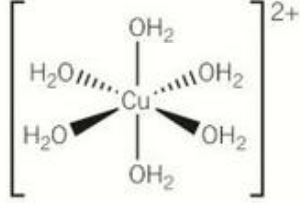
When copper(II) sulfate dissolves in water, it forms the hexaaquacopper(II) complex ion, . This complex has an octahedral geometry with six water molecules arranged symmetrically around the central copper ion. The solution appears pale blue in color.
Ligand substitution with ammonia
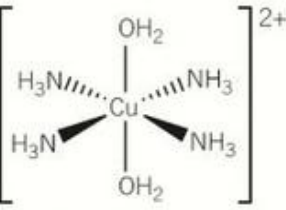
When excess aqueous ammonia is added to a solution containing the hexaaquacopper(II) ion, a ligand substitution reaction occurs. The pale blue solution transforms into a dark blue (or deep purple-blue) solution as ammonia ligands replace some of the water ligands.
The equation for this reaction is:
In this reaction, four ammonia ligands replace four water ligands, while two water molecules remain coordinated to the copper ion. Both the starting hexaaquacopper(II) complex and the product tetraammineaquacopper(II) complex maintain octahedral geometry.
Important
Practical observation technique: When performing this reaction in qualitative analysis, the ammonia solution should be added drop-wise to observe all stages of the reaction properly. If you observe carefully, you will notice that the reaction actually proceeds in two distinct steps:
- Initially, a pale blue precipitate of copper(II) hydroxide, , forms
- This precipitate then dissolves in the excess ammonia to produce the dark blue solution
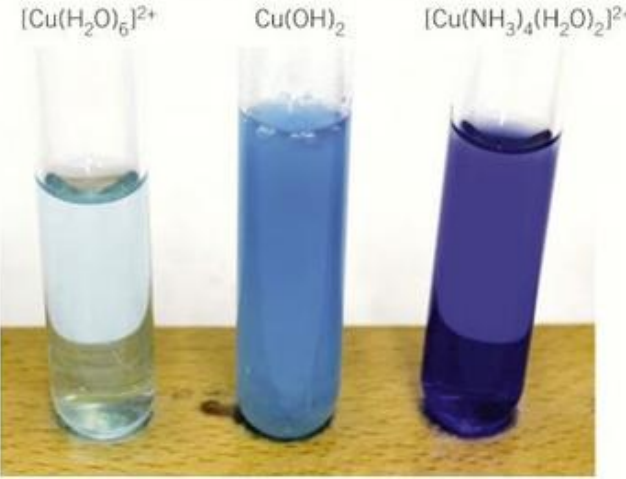
The color progression shows the transformation from pale blue (hexaaquacopper(II)) through the blue precipitate (copper(II) hydroxide) to the dark blue-purple final solution (tetraammineaquacopper(II)).
Ligand substitution with chloride ions
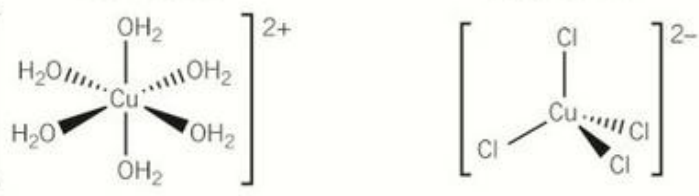
Concentrated hydrochloric acid provides a source of chloride ions that can act as ligands. When excess concentrated hydrochloric acid is added to a solution containing the hexaaquacopper(II) ion, the pale blue solution changes color to form a yellow solution. This represents another example of ligand substitution, where six water ligands are replaced by four chloride ligands.
The equilibrium equation for this reaction is:
Note
This reaction involves several significant changes:
- Change in coordination number: from 6 to 4
- Change in geometry: from octahedral to tetrahedral
- Change in color: from pale blue to yellow
- Change in charge: from 2+ to 2-
The oxidation state of copper remains +2 throughout. Chloride ligands are larger than water ligands, so fewer chloride ions can fit around the central copper ion, explaining the reduction in coordination number from 6 to 4 and the change from octahedral to tetrahedral geometry.
If water is subsequently added to the yellow solution, a blue solution forms (although more dilute and paler than the original). When making careful observations, you may notice an intermediate green solution. This is not a new species but simply the result of the yellow and blue solutions mixing as the equilibrium shifts back toward the hexaaquacopper(II) complex.
Reactions of aqueous chromium(III) ions
Formation of chromium(III) complexes
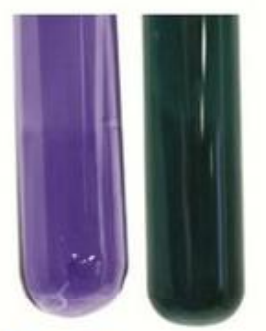
When chromium(III) potassium sulfate (chrome alum), , dissolves in water, the complex ion forms, producing a pale purple (or violet) solution.
Important
It's important to note that when chromium(III) sulfate dissolves in water, a green solution is actually formed. However, this solution does not contain the hexaaquachromium(III) ion, . Instead, it contains the complex , where one of the water ligands has been replaced by a sulfate ion. Both solutions contain chromium in the +3 oxidation state.
Reaction with ammonia
The hexaaquachromium(III) ion undergoes a ligand substitution reaction with excess aqueous ammonia. When ammonia is added drop-wise to the chromium(III) solution, the reaction occurs in two distinct steps:
- Initially, a grey-green precipitate of chromium(III) hydroxide, , forms
- The precipitate then dissolves in excess ammonia to form the complex ion , which produces a purple solution
The equation for the ligand substitution reaction is:
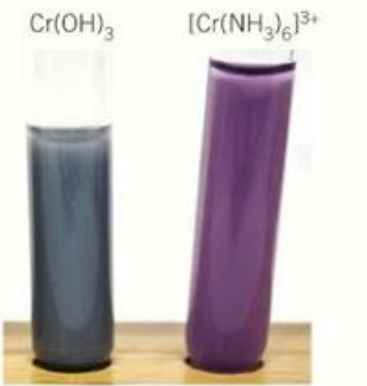
The observations show the progression from violet (hexaaquachromium(III)) through grey-green (chromium(III) hydroxide precipitate) to purple (hexaamminechromium(III)).
Ligand substitution and haemoglobin
Structure and function of haemoglobin
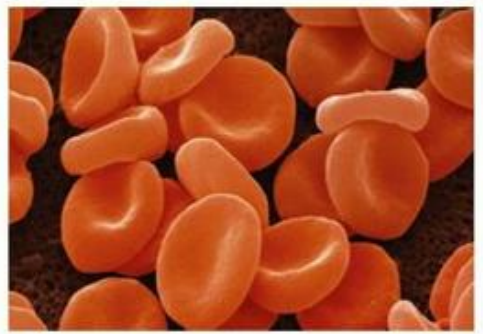
Haemoglobin is an iron-containing protein found in all red blood cells that is responsible for transporting oxygen around the body. The protein has a complex structure consisting of four protein chains held together by weak intermolecular forces. Each protein chain contains a haem molecule within its structure.
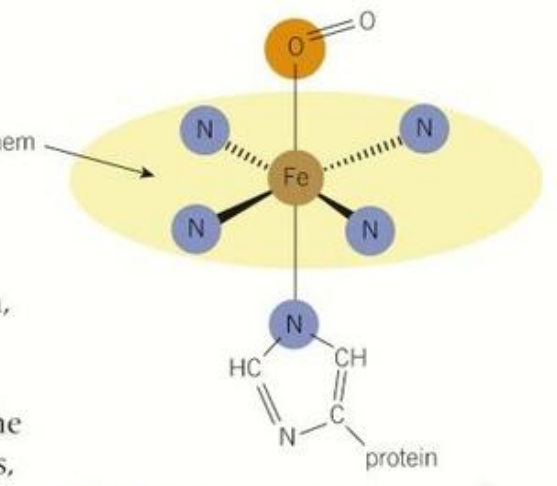
The central metal ion in a haem group is , which can bind to oxygen gas, . The iron ion is coordinated to four nitrogen atoms from the porphyrin ring system (the haem group) arranged in a plane, and one nitrogen atom from a histidine residue in the protein chain positioned below the iron.
Note
This diagram shows how oxygen binds to the iron(II) ion through the formation of a coordinate bond. For clarity, the 2+ charge on the iron has been omitted from the diagram, but the iron remains in the +2 oxidation state when bound to oxygen.
Oxygen transport mechanism
As blood passes through the lungs, haemoglobin binds to oxygen molecules due to the increased oxygen pressure in the lung capillaries. A compound called oxyhaemoglobin forms, which releases oxygen to body cells as and when required. This is an example of a reversible ligand substitution reaction where oxygen temporarily replaces one of the coordinating positions on the iron ion.
The ability of haemoglobin to bind and release oxygen reversibly is crucial for oxygen transport throughout the body. The binding strength is carefully balanced - strong enough to pick up oxygen in the lungs but weak enough to release it to tissues that need it.
Additionally, haemoglobin in red blood cells can bind to carbon dioxide, which is transported back to the lungs where it is released and then exhaled from the body.
Carbon monoxide poisoning
Carbon monoxide can also bind to the ion in haemoglobin through a ligand substitution reaction. The complex formed is known as carboxyhaemoglobin.
In carboxyhaemoglobin, oxygen in haemoglobin is replaced by carbon monoxide through ligand substitution. Crucially, carbon monoxide binds to haemoglobin much more strongly than oxygen does. This means that even a small concentration of carbon monoxide in the lungs can prevent a large proportion of haemoglobin molecules from carrying oxygen.
Important
Danger of carbon monoxide poisoning:
The bond between carbon monoxide and haemoglobin is so strong that this process is effectively irreversible under normal conditions. If the concentration of carboxyhaemoglobin becomes too high, oxygen transport is severely impaired or completely prevented, leading to death. This is why carbon monoxide is such a dangerous poison - it blocks the body's ability to transport oxygen to vital organs and tissues.
Precipitation reactions
Definition and overview
A precipitation reaction occurs when two aqueous solutions containing ions react together to form an insoluble ionic solid, called a precipitate. These reactions are commonly used in qualitative analysis to identify metal ions in solution.
Transition metal ions in aqueous solution react with aqueous sodium hydroxide and aqueous ammonia to form precipitates. However, the behavior of these precipitates differs - some will dissolve when excess sodium hydroxide or ammonia is added, forming complex ions in solution, while others remain insoluble.
Precipitation reactions with sodium hydroxide
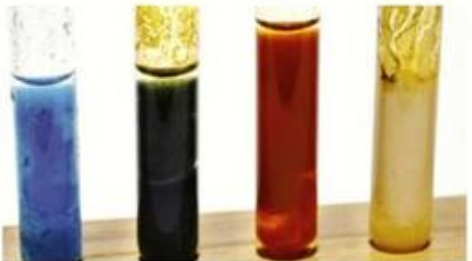
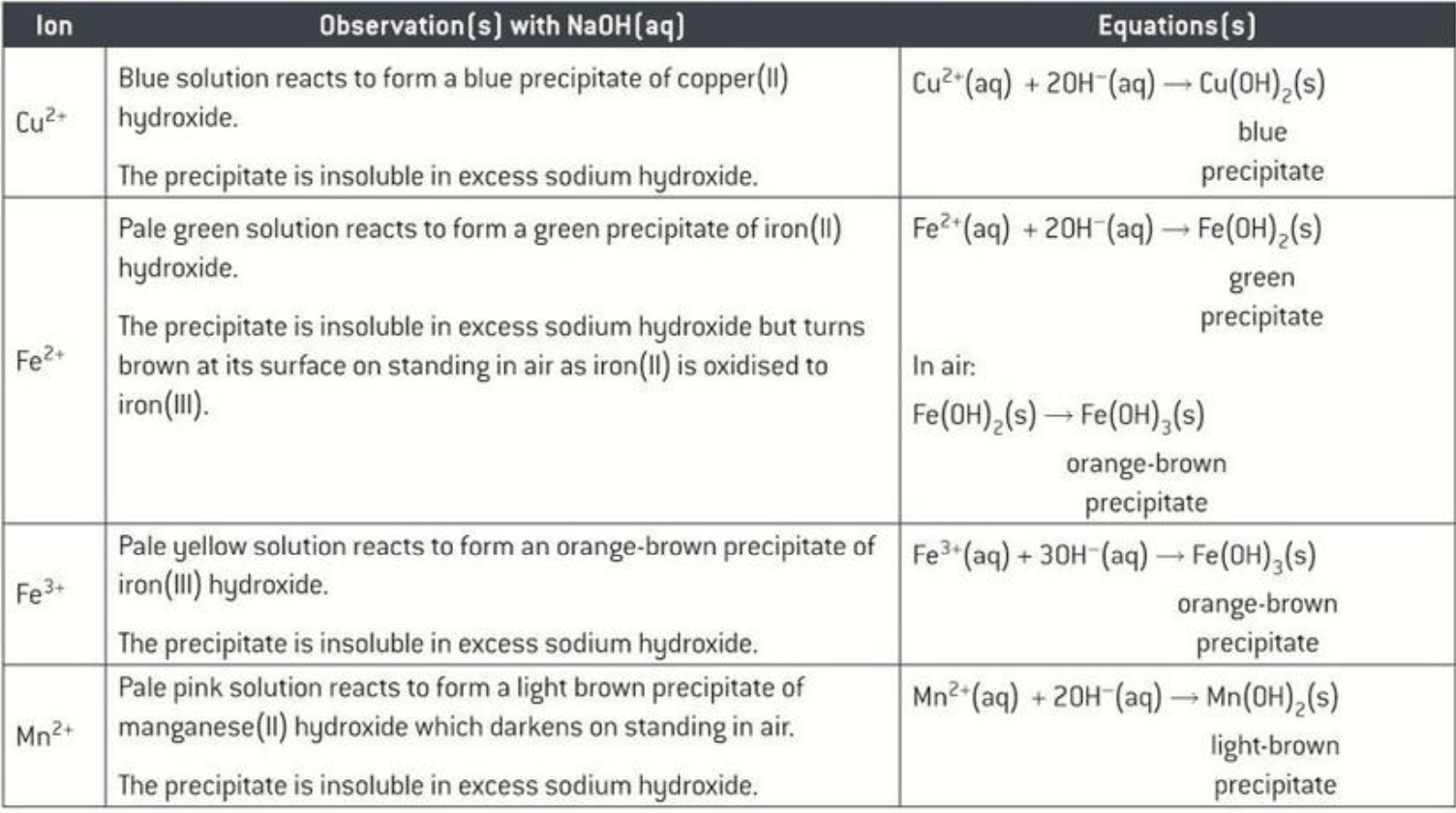
When aqueous sodium hydroxide is added to solutions containing transition metal ions, colored precipitates of metal hydroxides form. The table below summarizes the observations and equations for common transition metal ions.
Example
Worked Example: Copper(II) ions, Cu²⁺
- A blue solution reacts to form a blue precipitate of copper(II) hydroxide
- The precipitate is insoluble in excess sodium hydroxide
Example
Worked Example: Iron(II) ions, Fe²⁺
- A pale green solution reacts to form a green precipitate of iron(II) hydroxide
- The precipitate is insoluble in excess sodium hydroxide
- However, the precipitate turns brown at its surface on standing in air as iron(II) is oxidized to iron(III)
In air:
This oxidation produces an orange-brown precipitate.
Example
Worked Example: Iron(III) ions, Fe³⁺
- A pale yellow solution reacts to form an orange-brown precipitate of iron(III) hydroxide
- The precipitate is insoluble in excess sodium hydroxide
Example
Worked Example: Manganese(II) ions, Mn²⁺
- A pale pink solution reacts to form a light-brown precipitate of manganese(II) hydroxide
- The precipitate darkens on standing in air due to oxidation
- The precipitate is insoluble in excess sodium hydroxide
Example
Worked Example: Chromium(III) ions, Cr³⁺
- A violet solution reacts to form a grey-green precipitate of chromium(III) hydroxide
- Unlike the other metal hydroxides, this precipitate is soluble in excess sodium hydroxide, forming a dark green solution containing the complex ion
With excess sodium hydroxide:

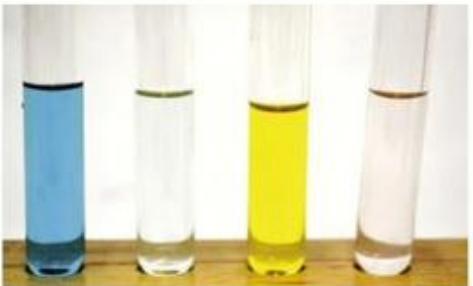
The images show the visual appearance of the precipitates formed. The ability of chromium(III) hydroxide to dissolve in excess sodium hydroxide distinguishes it from the other metal hydroxides listed.
Precipitation reactions with ammonia
Earlier in this topic, we examined the ligand substitution reactions of copper(II) and chromium(III) ions with excess aqueous ammonia. In the initial stage of these reactions, precipitation occurs before the metal hydroxide dissolves in the excess ammonia.
Note
For copper(II):
The precipitation reaction that occurs first is:
The copper(II) hydroxide precipitate is a blue solid which then dissolves in excess ammonia to form a deep blue solution containing the complex ion .
Note
For chromium(III):
The precipitation reaction is:
The chromium(III) hydroxide is a green precipitate which dissolves in excess ammonia to form the purple complex ion .
Important
Iron and manganese ions:
The ions , , and react with aqueous ammonia in exactly the same way as they react with aqueous sodium hydroxide, forming precipitates of (s), (s), and (s) respectively. Importantly, there is no further reaction with excess aqueous ammonia - these precipitates do not dissolve. This behavior contrasts with copper(II) and chromium(III), whose hydroxide precipitates dissolve in excess ammonia to form ammine complexes.
Remember!
Summary
Key Points to Remember:
-
Ligand substitution reactions involve replacing one type of ligand with another around a central metal ion, often resulting in observable color changes due to changes in the bonding environment
-
When ammonia is added to copper(II) solutions, a two-step process occurs: first forming a pale blue precipitate of Cu(OH)₂, then dissolving in excess ammonia to give a dark blue solution of [Cu(NH₃)₄(H₂O)₂]²⁺
-
Chloride ion substitution in copper(II) complexes causes both a geometry change (octahedral to tetrahedral) and coordination number change (6 to 4), resulting in a color change from blue to yellow
-
Haemoglobin contains Fe²⁺ ions that reversibly bind oxygen for transport, but carbon monoxide binds irreversibly and much more strongly, causing poisoning by blocking oxygen transport
-
In precipitation reactions with NaOH, all transition metal ions form colored hydroxide precipitates, but only Cr³⁺ dissolves in excess to form [Cr(OH)₆]³⁻
-
Precipitation reactions with ammonia - Cu²⁺ and Cr³⁺ hydroxide precipitates dissolve in excess ammonia to form ammine complexes, but Fe²⁺, Fe³⁺, and Mn²⁺ hydroxides remain insoluble