Redox and Qualitative Analysis (OCR A-Level Chemistry A): Revision Notes
📚Revision Notes
Redox and qualitative analysis
This topic explores how transition metal ions undergo redox reactions and how we can identify unknown ions in solution through simple chemical tests. Understanding electrode potentials helps explain why certain redox reactions occur, while qualitative analysis provides practical methods for identifying ions in the laboratory.
Redox reactions of iron ions
Iron exists in two common oxidation states: +2 (iron(II), ) and +3 (iron(III), ). These ions can be interconverted through redox reactions, making iron useful in many applications including redox titrations.
Oxidation of to
When iron(II) ions react with acidified manganate(VII) ions (permanganate), the iron(II) is oxidized to iron(III). This reaction is fundamental to redox titrations and demonstrates clear colour changes that make it easy to detect the endpoint.
Note
The manganate(VII) solution appears purple due to the ions. When ions are added, the solution loses its purple colour as the permanganate is reduced to colourless ions. This dramatic colour change from purple to colourless provides a clear visual indication that the reaction has occurred.
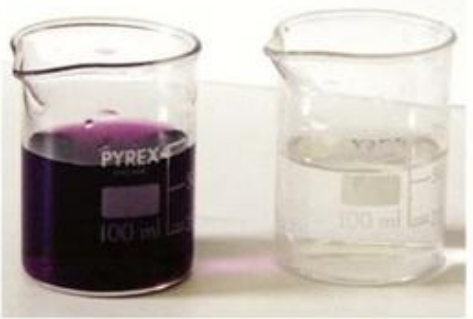
The balanced equation for this reaction shows the electron transfer:
In this reaction:
- is oxidized to (loses electrons)
- is reduced to (gains electrons)
Reduction of to
The reverse process occurs when iron(III) ions react with iodide ions. The orange-brown ions are reduced to pale green ions. However, this colour change is difficult to observe because iodide ions are simultaneously oxidized to brown iodine, , which obscures the green colour.
The equation for this reaction is:
In this reaction:
- is reduced to (gains electrons)
- is oxidized to (loses electrons)
Important
The pale green colour of ions is masked by the brown colour of iodine produced in the reaction. This makes it challenging to observe the colour change visually, even though the reduction of iron(III) to iron(II) is occurring. The presence of can be confirmed by adding starch solution, which turns blue-black.
Using electrode potentials to predict iron reactions
Standard electrode potentials () help us understand and predict which redox reactions will occur spontaneously. The more positive the electrode potential, the greater the tendency for a species to gain electrons and be reduced.

Example
Worked Example: Using Electrode Potentials to Predict Reactions
For the oxidation of by :
Step 1: Identify the values
- The value for is +1.33 V
- The value for is +0.77 V
Step 2: Determine which species is reduced
- Since permanganate has the more positive value, it is reduced
- Therefore, must be oxidized to
For the reduction of by :
Step 1: Identify the values
- The value for is +0.77 V
- The value for is +0.54 V
Step 2: Determine which species is reduced
- Since iron(III) has the more positive value, it is reduced
- Therefore, must be oxidized to
Redox reactions of chromium ions
Chromium chemistry is particularly rich because chromium can exist in three oxidation states: +2, +3, and +6. The colour changes associated with these transitions make chromium reactions visually striking and analytically useful.
Reduction of dichromate(VI) to chromium(III)
Acidified dichromate(VI) ions, , appear orange in aqueous solution. When a reducing agent such as zinc is added, the dichromate is reduced to green chromium(III) ions, .
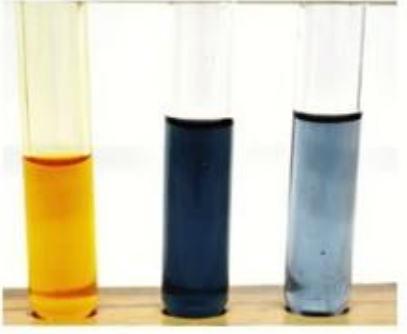
The equation for this reduction is:
Note
This dramatic colour change from orange to green is easily visible and makes this reaction useful for demonstrating reduction processes. The green colour of is distinct and characteristic.
Further reduction to chromium(II)
With an excess of zinc, chromium(III) ions can be reduced further to chromium(II) ions, which have a pale blue colour:
Understanding chromium reductions using electrode potentials
The electrode potential values explain why zinc can reduce dichromate through two successive steps:

Looking at the electrode potentials:
- Zinc has the most negative value (-0.76 V), making it a powerful reducing agent
- Dichromate has the most positive value (+1.33 V), making it easily reduced
- Zinc can reduce both to and to because it is a stronger reducing agent than both
Important
Chromium(II) ions are unstable in the presence of air and are readily oxidized back to chromium(III) by atmospheric oxygen. This is why the pale blue colour of often changes to green when exposed to air.
Oxidation of chromium(III) to chromate(VI)
Chromium(III) ions can be oxidized back to chromium(VI), but this time as chromate ions, , rather than dichromate. Hot alkaline hydrogen peroxide is used as the oxidizing agent:
In this reaction:
- Chromium is oxidized from +3 in to +6 in
- Oxygen is reduced from -1 in to -2 in and
Redox reactions of copper ions
Copper chemistry involves the +1 and +2 oxidation states. Copper(I) compounds are less stable than copper(II) compounds, which leads to interesting disproportionation behaviour.
Reduction of copper(II) to copper(I)
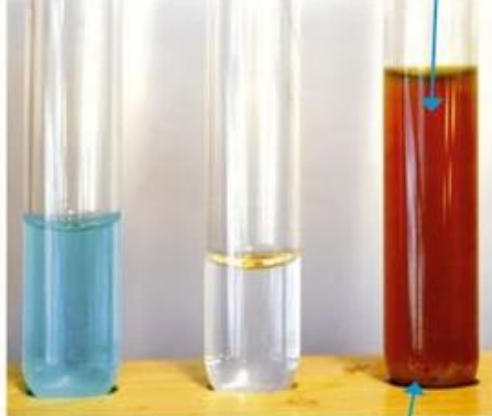
When aqueous copper(II) ions, , react with excess iodide ions, , a redox reaction occurs where:
- Iodide ions are oxidized to brown iodine,
- Copper(II) ions are reduced to copper(I),
- The copper(I) forms a white precipitate of copper(I) iodide
The equation for this reaction is:
Note
The white precipitate of copper(I) iodide can be difficult to see because it is masked by the brown colour of the iodine formed. This is similar to the iron(III)/iodide reaction where the product colour obscures other colour changes.
Disproportionation of copper(I)
Disproportionation is a special type of redox reaction where the same element is simultaneously oxidized and reduced. This occurs when solid copper(I) oxide, , reacts with hot dilute sulfuric acid.
In this reaction:
- A brown solid of metallic copper is formed (copper reduced from +1 to 0)
- A blue solution of copper(II) sulfate is formed (copper oxidized from +1 to +2)
- Water is also produced
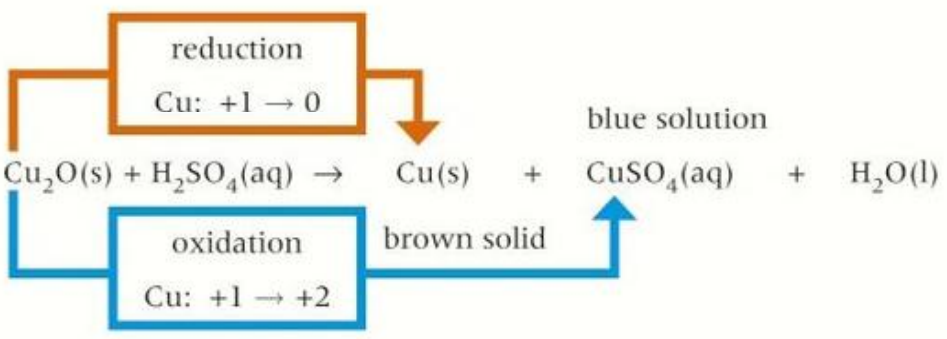
The equation for this disproportionation is:
Important
This reaction demonstrates that copper in the +1 oxidation state is unstable and readily disproportionates into the more stable 0 and +2 states. The simultaneous formation of brown copper metal and blue copper(II) solution provides clear visual evidence of this process.
Understanding electrode potentials
Electrode potentials are measured in volts and indicate the tendency of a species to gain electrons (be reduced). The more positive the electrode potential, the greater the tendency for reduction to occur.
When predicting redox reactions:
- Compare the values of the two half-reactions
- The species with the more positive value will be reduced
- The species with the less positive (or more negative) value will be oxidized
- The equilibrium position favours the formation of products when the difference in values is large
Note
For example, when combining half-equations to show an overall redox reaction, you need to:
- Write the reduction half-equation as shown (species gains electrons)
- Reverse the oxidation half-equation (species loses electrons)
- Balance the electrons by multiplying each half-equation by appropriate factors
- Add the half-equations together and cancel common species
Qualitative analysis
Qualitative analysis involves carrying out simple chemical tests to identify unknown ions in solution. These tests rely on characteristic precipitates, colour changes, or gas evolution.
Identifying transition metal ions
Aqueous sodium hydroxide, , produces coloured precipitates with aqueous transition metal ions. These precipitates form because metal hydroxides have low solubility. The colour of each precipitate is characteristic of the metal ion present, making this a useful identification test.
Note
The observations for common transition metal ions are summarized in Topic 24.4. Each metal ion forms a distinctive coloured precipitate that helps identify which ion is present in an unknown solution.
Identifying ammonium ions
Ammonium ions, , can be identified by heating with aqueous sodium hydroxide. When heated, the hydroxide ions react with ammonium ions to produce ammonia gas, :
Example
Worked Example: Testing for Ammonium Ions
Step 1: Add aqueous sodium hydroxide to the unknown solution
Step 2: Heat gently
Step 3: Hold damp red litmus paper near the mouth of the test tube
Step 4: Observe the result
- If ammonia is evolved, the litmus paper will turn blue
- This confirms the presence of ammonium ions
Explanation: This test is specific for ammonium ions because ammonia is a weak base and turns red litmus blue.
Identifying anions
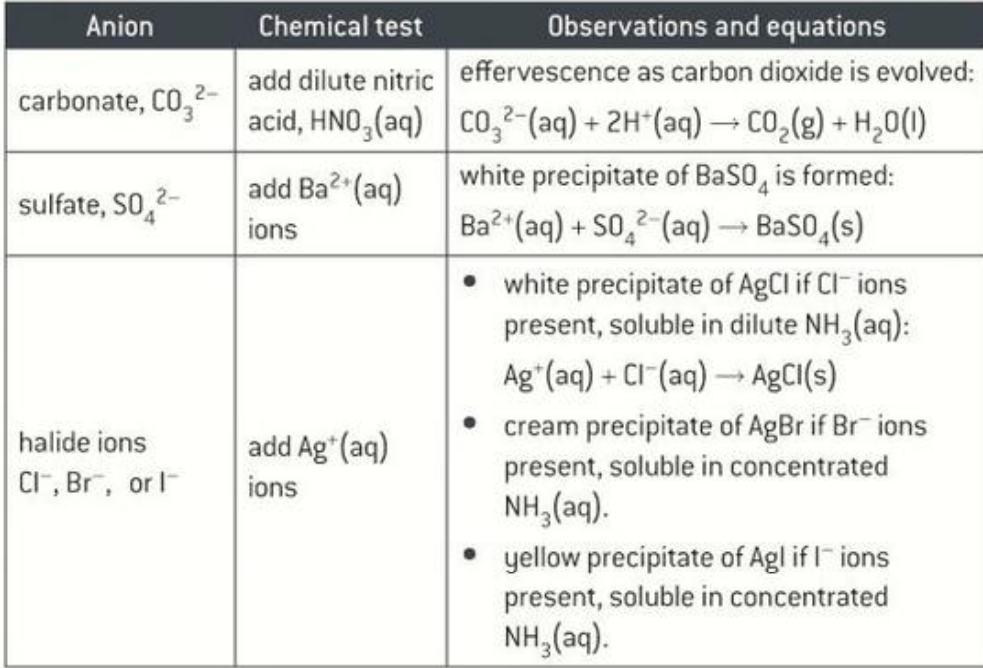
Several common anions can be identified through simple test-tube scale reactions. It is important to carry out these tests in the correct order to avoid interference between tests.
Testing for carbonate ions,
Carbonate ions react with dilute acids to produce carbon dioxide gas, which can be detected by its characteristic effervescence:
To test for carbonate:
- Add dilute nitric acid, , to the unknown solution
- Observe effervescence (fizzing) as carbon dioxide is released
- The carbon dioxide can be confirmed by bubbling through limewater, which turns milky
Note
The "fizzing" or effervescence is often the first sign of carbonate ions. The limewater test provides additional confirmation, as the milky appearance is due to the formation of insoluble calcium carbonate.
Testing for sulfate ions,
Sulfate ions form a white precipitate with barium ions because barium sulfate is insoluble:
To test for sulfate:
- Add aqueous barium ions, , to the unknown solution
- A white precipitate of barium sulfate forms immediately if sulfate ions are present
Important
This test must be carried out in acidic conditions (using dilute hydrochloric or nitric acid) to prevent false positives from other anions such as carbonate or sulfite, which also form white precipitates with barium ions but are soluble in acid.
Testing for halide ions
Halide ions (, , ) all form precipitates with silver ions, but each precipitate has a different colour, allowing identification:
Silver chloride precipitate:
- Forms a white precipitate
- Soluble in dilute ammonia,
Silver bromide precipitate:
- Forms a cream precipitate
- Soluble in concentrated ammonia,
Silver iodide precipitate:
- Forms a yellow precipitate
- Insoluble in concentrated ammonia,
Important
The solubility of these precipitates in ammonia provides a further confirmatory test. The trend in solubility decreases down the halide group, with chloride being the most soluble and iodide the least soluble in ammonia. This additional test is crucial for distinguishing between halide ions when colours are unclear.
Note
These tests should be carried out using acidified silver nitrate solution (acidified with dilute nitric acid) to prevent the formation of other silver precipitates such as silver carbonate or silver hydroxide, which would interfere with the results.
Exam tips and common mistakes
Summary
Key Exam Tips
When using electrode potentials:
- Always remember that more positive means greater tendency to be reduced (gain electrons)
- To find the overall cell potential, subtract the less positive from the more positive value
- A positive overall potential indicates the reaction is feasible as written
In redox equations:
- Always show state symbols
- Balance electrons first, then atoms, then charge
- In acidic conditions, use and to balance
- In alkaline conditions, use and to balance
For qualitative analysis:
- Always perform tests in the correct order to avoid interference
- Describe observations using correct colour terms (not just "precipitate forms")
- State whether precipitates are soluble or insoluble in specific reagents
- Remember that some tests require heating (e.g., ammonium ion test)
Common mistakes to avoid:
- Confusing oxidation and reduction - remember "OIL RIG" (Oxidation Is Loss, Reduction Is Gain of electrons)
- Forgetting that disproportionation involves the same element being both oxidized and reduced
- Not specifying whether silver halide precipitates are soluble in dilute or concentrated ammonia
- Using the wrong acid for tests - nitric acid is used for carbonate and halide tests to avoid interference
Remember!
Summary
Key Points to Remember:
Electrode potentials: More positive values indicate greater tendency to gain electrons and be reduced. Use values to predict which species will be oxidized and which will be reduced.
Iron redox chemistry: is oxidized by in acid (purple to colourless). is reduced by (orange-brown to pale green, but masked by brown ).
Chromium redox chemistry: (orange) is reduced to (green) by zinc, which can further reduce to (pale blue). is oxidized to by hot alkaline .
Copper chemistry: is reduced to white precipitate by . Copper(I) oxide undergoes disproportionation with acid, producing both metallic copper (brown) and copper(II) sulfate (blue solution).
Anion identification:
- Carbonate produces effervescence with acid
- Sulfate forms white precipitate
- Halides form coloured precipitates with : white (), cream (), yellow ()
Test order matters: When testing for multiple anions, perform tests in the order given to avoid interference between reagents.