Stages of Attachement Identified by Schaffer (OCR A-Level Psychology): Revision Notes
📚Revision Notes
3.1.3 Stages of Attachment Identified by Schaffer
Stages of forming an attachment:
- Pre-attachment stage: 0-3 months, where babies don't show a preference for anyone
- Indiscriminate attachment stage: 3-7 months, where babies recognise and prefer familiar people, but don't have an attachment to one person
- Discriminate attachment stage: 7-9 months, where babies develop a strong attachment to one person. High separation and stranger anxiety.
- Multiple attachment stage:
9 months onwards, where children are able to form attachments with several people
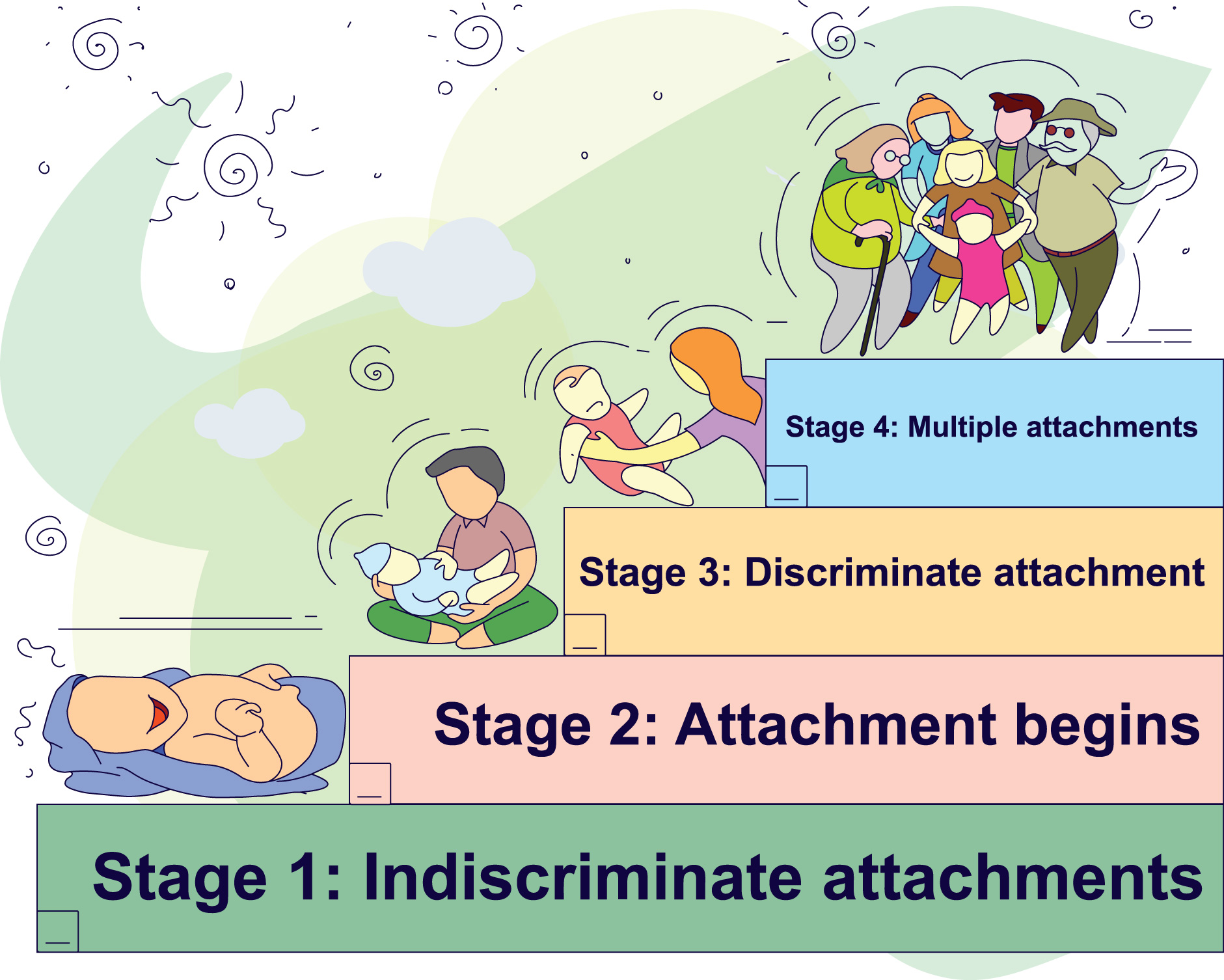
Stages of forming an attachment
Research support for stages of attachment:
Schaffer and Emerson (1964)
Schaffer's aim:
To investigate how babies develop attachments to their parents over time.
- Shaffer and Emerson conducted a longitudinal study, using a naturalistic observation. They followed 60 babies and their families from birth to 18 months
- Babies were observed in the presence of strangers to assess stranger anxiety and when their caregivers were removed to assess separation anxiety.
Note
(Additionally, interviews were conducted with family members.)
Shaffer and Emerson found:
-
Evidence for the four stages of attachment
-
Babies formed stronger attachments if caregivers displayed high sensitive responsiveness
-
87% of babies formed attachments with two or more caregivers (babies formed multiple attachments)
-
The main attachment figure wasn't always the main caregiver Sensitive responsiveness: Refers to how sensitive a caregiver is to their baby's needs. Caregivers who have a high degree of sensitive responsiveness are sensitive to the baby's needs and respond quickly when the baby tries to interact with them
-
Babies formed more attachments with those who were more sensitive to their needs, even if they spent less time with them.
Evaluation of Shaffer and Emerson's study - stages of attachment:
P: Families were observed in places where they usually interacted
E: This means results were more likely to generalise to how babies and their caregivers behave in their everyday life
E: Overall improving the ecological validity of the research
P: During interviews, families may have wanted to show themselves in a good light
E: For example, parents may have said they spent more time with their babies than they actually did
E: Therefore, participants may have demonstrated social desirability bias, decreasing the validity of the results
Additionally, because of the observational design, the research may have been prone to observer bias