Rusbult's Investment Model (OCR A-Level Psychology): Revision Notes
📚Revision Notes
9.3.3 Rusbult's Investment Model
Overview of Rusbult's Investment Model
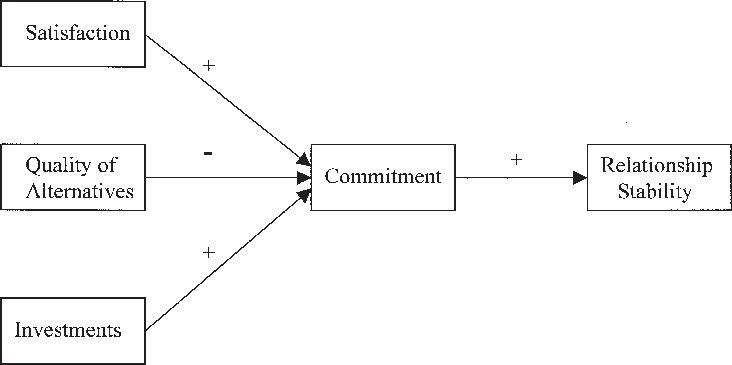
Rusbult's Investment Model was developed to understand why people persist in some romantic relationships but not others. The model suggests that relationships continue not only because partners are satisfied but also due to the investments they have made in the relationship and the absence of better alternatives.
Satisfaction Level
Satisfaction in a relationship is based on the concept of comparison levels, where the relationship is judged by comparing rewards and costs. A satisfying relationship is one where each partner feels they are getting more out of the relationship than they expected, based on previous experiences and social norms.
Comparison with Alternatives
This factor considers whether an individual believes their needs could be better fulfilled outside the current relationship. An attractive alternative might offer superior outcomes, and these alternatives do not necessarily involve other people; they could include being single or pursuing other life goals.
Investment Size
Investment size refers to the resources that are tied to the relationship and would be diminished or lost if the relationship ended. Investments are categorised into:
- Intrinsic Investments: Resources put directly into the relationship, such as time, effort, money, and self-disclosure.
- Extrinsic Investments: Resources that have become associated with the relationship, such as shared possessions, mutual friends, and children.
Commitment Level
Commitment level describes the likelihood that the relationship will persist. Commitment is high in partners who are satisfied, have made significant investments, and have no attractive alternatives. The formula for commitment is:
Note
Commitment = Satisfaction + Investments - Alternatives
Relationship Maintenance Mechanisms
Rusbult's model also outlines several mechanisms that help maintain relationships:
- Accommodation: Acting to promote the relationship and not retaliating in conflicts.
- Willingness to Sacrifice: Prioritising the partner's interests over one's own.
- Forgiveness: Forgiving serious transgressions to maintain the relationship.
- Positive Illusions: Maintaining an unrealistically positive view of the partner.
- Ridiculing Alternatives: Viewing alternatives and other relationships negatively.
Evaluation
Support for the Investment Model
Le and Agnew's Research:
- Point: Le and Agnew provide strong support for the Investment Model.
- Evidence: They reviewed 52 studies involving 11,000 participants from five countries and found that satisfaction, comparison with alternatives, and investment size all predicted relationship commitment. This pattern held true across different genders, cultures, and sexual orientations.
- Conclusion: This confirms that the three key factors—satisfaction, alternatives, and investments—are crucial in determining the level of commitment in relationships.
Real-World Application
Explanation for Staying in Abusive Relationships:
- Point: The Investment Model can explain why individuals may stay in abusive relationships.
- Evidence: Despite experiencing low satisfaction, many victims of abuse remain in their relationships. Rusbult and Martz found that for battered women in a shelter, the perceived lack of alternatives and the investments made in the relationship were strong predictors of their commitment and likelihood of returning to their partners.
- Conclusion: The model provides valuable insights into why victims of abuse may continue to stay in harmful relationships, highlighting the role of investments and perceived lack of alternatives.
Oversimplification of Investment
Goodfriend and Agnew's Perspective:
- Point: A key criticism is that the original model oversimplifies the concept of investment.
- Evidence: Goodfriend and Agnew argue that investment includes not just resources already put into the relationship, but also the future plans and aspirations partners have together. These future investments motivate partners to remain committed to each other to see their plans work out.
- Conclusion: This suggests that the original Investment Model is limited, as it fails to fully capture the complexity of what constitutes investment in a relationship.
Correlation vs. Causation
Limitations in Establishing Causality:
- Point: Although strong correlations have been found between the factors predicted by the Investment Model (e.g., commitment and satisfaction), this does not imply causation.
- Evidence: Most studies on the Investment Model are correlational, meaning they cannot conclusively prove that satisfaction, investments, or alternatives directly cause commitment in relationships.
- Conclusion: This limitation suggests that while the Investment Model is useful, it may not fully explain the dynamics of romantic relationships.
Measurement Challenges
Issues with Measuring Key Variables:
- Point: Measuring the key variables of the Investment Model, such as commitment, satisfaction, investment size, and quality of alternatives, can be challenging.
- Evidence: Rusbult developed the Investment Model Scale to address these challenges, and it has shown high reliability and validity across various populations. However, the scale relies on self-report measures, which are susceptible to social desirability bias.
- Conclusion: If individuals are not truthful in their responses, this could reduce the internal validity of research findings, potentially leading to a less accurate understanding of the relationship dynamics described by the Investment Model.