Duck's Phase Model of Relationship Breakdown (OCR A-Level Psychology): Revision Notes
📚Revision Notes
9.3.4 Duck's Phase Model of Relationship Breakdown
Overview of Duck's Phase Model
Duck proposed that the ending of a relationship is not a one-time event but a process that unfolds over time through four distinct stages. Each phase is marked by one or both partners reaching a threshold where their perception of the relationship changes. The breakup begins when a partner realises they are dissatisfied with the relationship.
Intra-Psychic Phase
This phase focuses on the cognitive processes occurring within the individual. The dissatisfied partner mulls over their partner's shortcomings and weighs the pros and cons of the relationship against potential alternatives. This phase is usually private, although the individual might confide in a trusted friend. When the threshold is reached, the partner voices their concerns, leading to the dyadic phase.
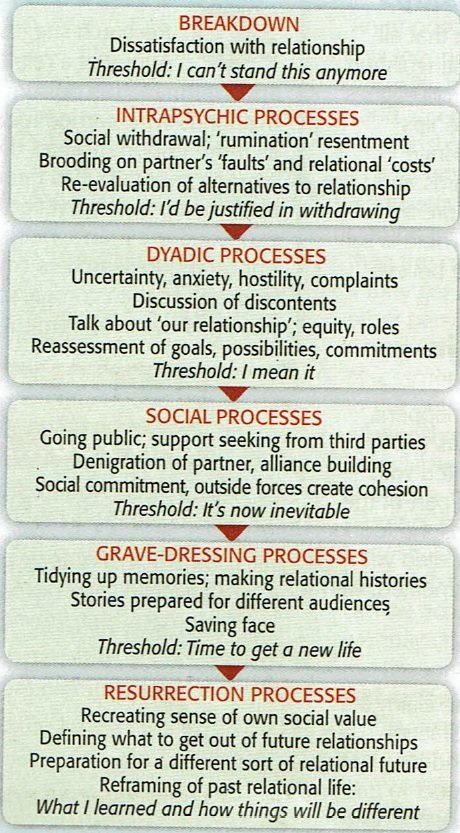
Dyadic Phase
In this phase, the focus shifts to the interpersonal processes between the partners. There are a series of confrontations where dissatisfactions are aired. The outcome of this phase can either be a determination to continue with the breakup or a renewed desire to repair the relationship.
Social Phase
Here, the breakup becomes public, involving the couple's social networks. Mutual friends may feel pressured to choose sides, and gossip becomes common as partners seek support. The involvement of social networks often accelerates the process of dissolution.
Grave-Dressing Phase
In the aftermath of the breakup, the focus is on creating a narrative that allows each partner to maintain a positive reputation. This often involves spinning a favourable story for public consumption, usually at the expense of the other partner. Additionally, individuals create a personal story that they can live with, reinterpreting once-positive traits in a negative light or simply acknowledging that they were incompatible.
Evaluation
Real-World Application
Practical Uses in Relationship Counselling:
- Point: The model is practical as it helps identify and understand the stages of relationship breakdown, offering strategies to reverse the process.
- Evidence: The model suggests different repair strategies for each phase, such as improving communication during the dyadic phase through counselling.
- Conclusion: This shows the practical value of the model in helping people navigate and potentially repair their relationships.
Support from Research Findings
Tashiro and Frazier's Study:
- Point: The model is supported by research findings.
- Evidence: Tashiro and Frazier found that individuals who experienced a breakup reported personal growth and new insights into themselves, supporting the existence of the grave-dressing phase.
- Conclusion: This suggests that Duck's phases are realistic and commonly experienced during relationship breakdowns.
Criticism of Oversimplification
Introduction of the Resurrection Phase:
- Point: The original model is criticised for being overly simplistic.
- Evidence: Duck later acknowledged this and introduced a fifth phase, the resurrection phase, where individuals prepare themselves for future relationships using the experiences from the past one.
- Conclusion: This addition adds depth to the model and addresses the complexity of relationship breakdowns, making it more comprehensive.
Cultural Bias
Limitations in Cross-Cultural Application:
- Point: The model is culturally biassed.
- Evidence: The original model is based on Western relationships and may not apply to non-Western cultures, where relationships are often more obligatory, less easily ended, and sometimes arranged.
- Conclusion: This cultural bias limits the generalizability of Duck's model, reducing its applicability across different types of relationships.
Reliance on Retrospective Data
Issues with Memory Accuracy:
- Point: A limitation of the model is its reliance on retrospective data.
- Evidence: Participants often recall their experiences of breakdown phases inaccurately, influenced by current emotions and circumstances. This can undermine the validity of the model's findings.
- Conclusion: The reliance on retrospective data can compromise the internal validity of the model, as it may not accurately reflect the actual experiences of relationship breakdown.
Ethical Issues in Research
Potential Harm to Participants:
- Point: Research on relationship breakdown can raise ethical concerns.
- Evidence: Investigating relationship breakdowns may cause distress to participants as they are required to recall painful memories. Ethical guidelines must be followed to minimise harm, which can limit the depth of information obtained.
- Conclusion: While ethical considerations are essential, they can restrict the research's depth and impact the model's development.
Criticism for Lack of Explanation
Comparison with Felmlee's Fatal Attraction Hypothesis:
- Point: Duck's model is less effective at explaining why breakdowns occur.
- Evidence: Felmlee's fatal attraction hypothesis suggests that the causes of relationship breakdown lie in the very traits that initially attracted the partners. Over time, these traits may become overwhelming, threatening the relationship.
- Conclusion: This criticism highlights that Duck's model, which describes the breakdown process in a linear fashion, may not fully capture the reasons behind relationship dissolution.
Further Development of the Model
Rollie and Duck's Modifications:
- Point: Rollie and Duck addressed the limitations of the original model.
- Evidence: They introduced the resurrection phase, where ex-partners focus on future relationships, and acknowledged that individuals might return to earlier phases at any point during the breakdown process.
- Conclusion: These modifications enhance the model's flexibility and provide a more nuanced understanding of the complexities involved in relationship breakdowns.