Plato's view of the soul (OCR A-Level Religious Studies): Revision Notes
📚Revision Notes
Plato's view of the soul
Context
Plato held that the soul and the body are two separate entities.
This view makes Plato a dualist which is the idea that there are two distinct entities.
Plato claimed that the soul was eternal and had lived before the body in the realm of the forms, where it would return after bodily death.
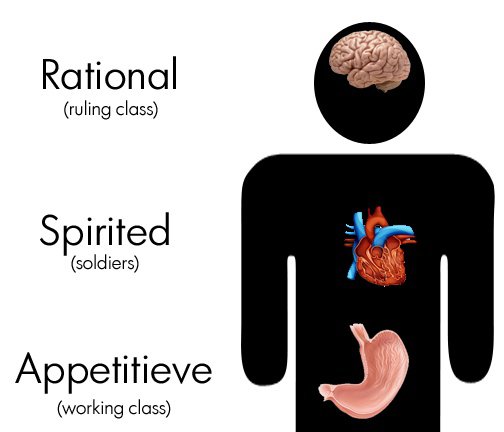
He presents the of an immortal tripartite soul, believing that the soul consisted of 3 elements:
Reason/logic: Understanding the Forms. Gaining knowledge of truth. This is, to Plato, the most important element of the soul. It is the only part that is not motivated by self interest and instead is motivated by understanding the forms, in particular the form of the good.
Emotion/spirit: Allows humans to love and be courageous. However, if left unchecked can lead us to be reckless & conceited.
Appetite: Needed so we can look after the wants of our body, but again if left unchecked can lead to lives of hedonism.
`
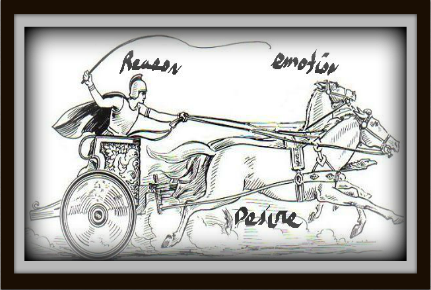
Plato analogously illustrates this using the Charioteer. Here he is highlighting that the tripartite nature of the soul works best when reason is in control of the emotion and appetite.
The charioteer represents reason, guiding and directing the horses of appetite and emotion to stop them running off wildly.
Rulers, Plato held could only be philosophers, were superior to the others in society because they were the ones who could show complete devotion to the wellbeing of the community since it was only they who understood the importance of the role of reason and were able to avoid succumbing to the temptations of appetite. In part then, Plato's view on the tripartite soul can also be attributed to his argument for philosopher kings.
In order to prove that the soul exists, Plato puts forth a number of a priori arguments, including:
The argument from opposites
Plato argues that every quality comes into being from its opposite, or, at least it depends on its opposite to have any existence at all. E.g:
Note
Something is "big" because something else is small.
- He argues that qualities depend on their status relative to each other, ultimately that if there were no such thing as big there would be no such thing as small.
- From a priori reasoning, Plato deduced that the opposite of death is life therefore, life and death must have a causal relationship with each other.
- This means that death must have the ability to cause life: life must come from death, and death must come from life in an endless chain of birth and death. In order for death to cause something else, then there must be something that can survive bodily death.
- For Plato, that thing is the immaterial, eternal soul.
Argument from knowledge
- Another a priori deduction to conclude the existence of the soul can be seen through the example of the slave boy in Plato's text Meno.
- Plato tells of a slave boy with no education who is given a geometry puzzle to solve by Socrates.
- Initially unable to do so, through questioning, the boy is able to arrive at the correct answer for the puzzle.
- For Plato, this was evidence of anamnesis, the process of the soul remembering knowledge of the forms.
- Therefore providing evidence for the existence of the soul and explains its role which is to communicate knowledge of the forms to us via a difficult education (as symbolised by the jagged path in the analogy of the cave).