The role of procurement (AQA GCSE Business): Revision Notes
📚Revision Notes
The role of procurement
What is procurement?
Procurement refers to the business function responsible for selecting and managing suppliers to ensure the company gets the goods and services it needs. A supplier is any business that provides goods or services to another company. This process involves much more than just choosing who to buy from - it includes determining what the business needs, how to order it, and managing the entire process of receiving and handling goods once they arrive.
Important
Getting procurement right is absolutely crucial for business success. When procurement fails, it can lead to serious problems that may even cause the business to fail entirely. This is why understanding different procurement approaches and supplier selection is so important.
Stock management fundamentals
Every business needs to maintain appropriate stock levels to meet customer demand effectively. Companies set target stock levels for their finished goods based on what they expect to sell within a specific time period. These targets are carefully calculated using information from the marketing department about expected demand and production department estimates of what can actually be produced.
When stock levels fall below these targets, it signals that productive efficiency has decreased. This means the business isn't producing enough per worker to meet its planned requirements. Modern manufacturing companies use sophisticated computer systems to plan production schedules and determine exactly how much raw material stock to keep on hand to fulfil orders.
Note
Stock management principles also apply to service businesses. For example, restaurants need to maintain appropriate staffing levels to handle expected customer demand, and supermarkets must ensure adequate checkout staff to avoid long queues that frustrate customers.
Inventory control approaches
There are two main approaches to managing inventory levels, each with distinct characteristics and implications for business operations.
Just in time (JIT) approach
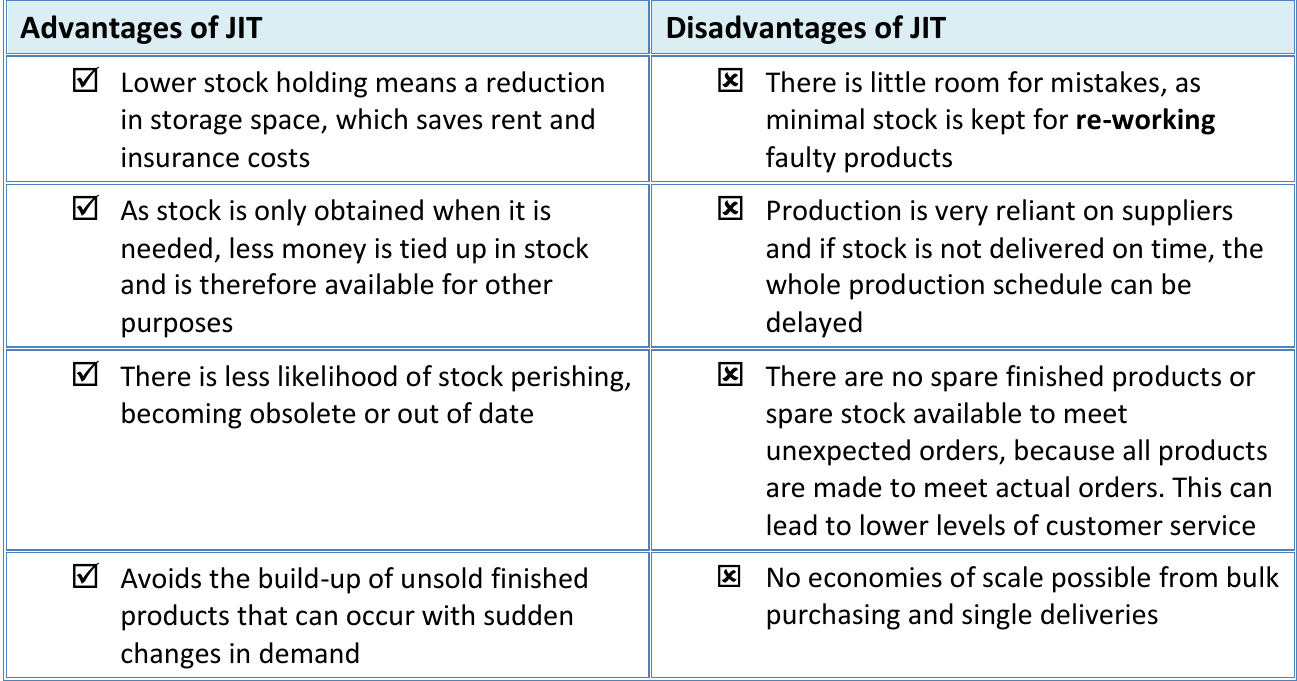
Just in time is a stock control method designed to minimise the amount of inventory held at any given time. This applies to raw materials, work in progress, and finished products. The goal is to receive supplies exactly when they're needed for production, rather than storing large quantities in advance.
For JIT to work effectively, businesses need carefully planned scheduling and smooth resource flow through their production processes. Suppliers must deliver materials directly to the production line precisely when needed.
Example
Worked Example: JIT in Car Manufacturing
A car manufacturing plant might receive exactly the right number and type of tyres for one day's production, with the supplier expected to deliver them to the correct loading bay within a very narrow time window.
Just in case (JIC) approach
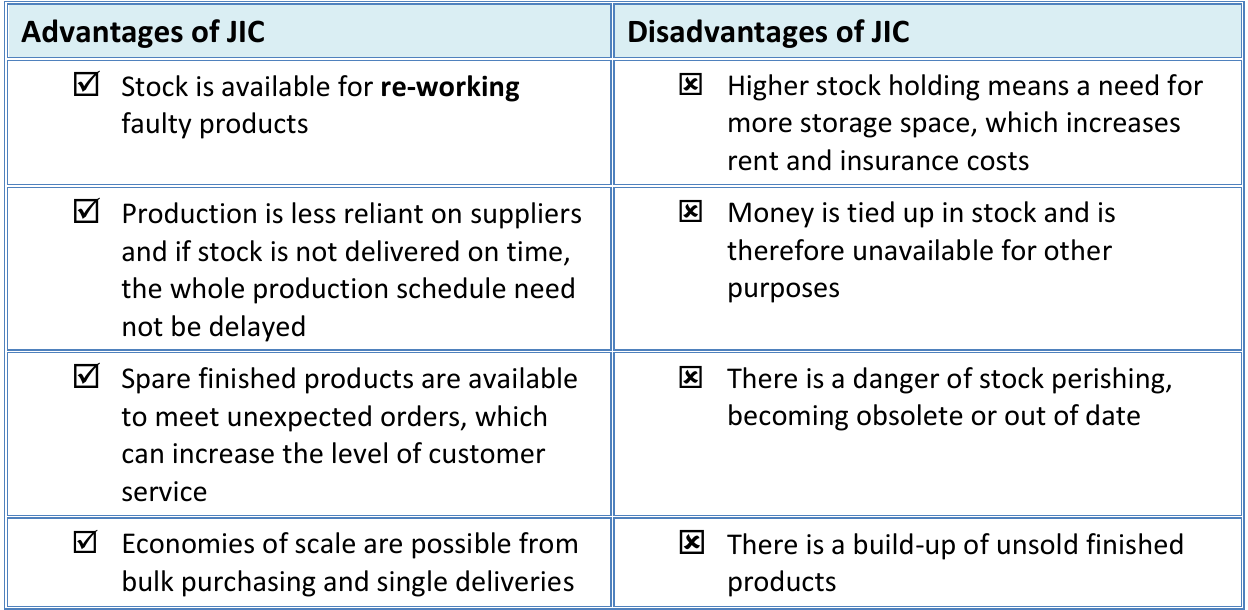
Just in case takes the opposite approach, maintaining large amounts of stock for raw materials, finished goods, or both. This method ensures the business won't run out of stock if it receives unexpectedly large orders, and provides spare inventory to handle returned products.
JIC is particularly useful when demand is difficult to predict, suppliers are located far away or are unreliable, and storage costs are manageable. It's less suitable for businesses dealing with products that spoil quickly or become obsolete rapidly, such as in the technology sector.
Comparing JIT and JIC approaches
Understanding the trade-offs between these approaches is essential for making informed procurement decisions.
Note
The success of JIT depends heavily on strong supplier relationships. Suppliers typically need to be located close to their customers to enable reliable deliveries. JIT works best when demand is consistent and predictable, allowing for smooth production planning.
Important
JIC provides more flexibility and security but comes with higher costs. The advantages and disadvantages of JIC are generally the opposite of JIT, making it suitable for different business situations and market conditions.
Supplier selection process
Choosing the right suppliers is a critical procurement decision that can significantly impact business performance. Managers must consider multiple factors and prioritise what matters most for their specific business needs.
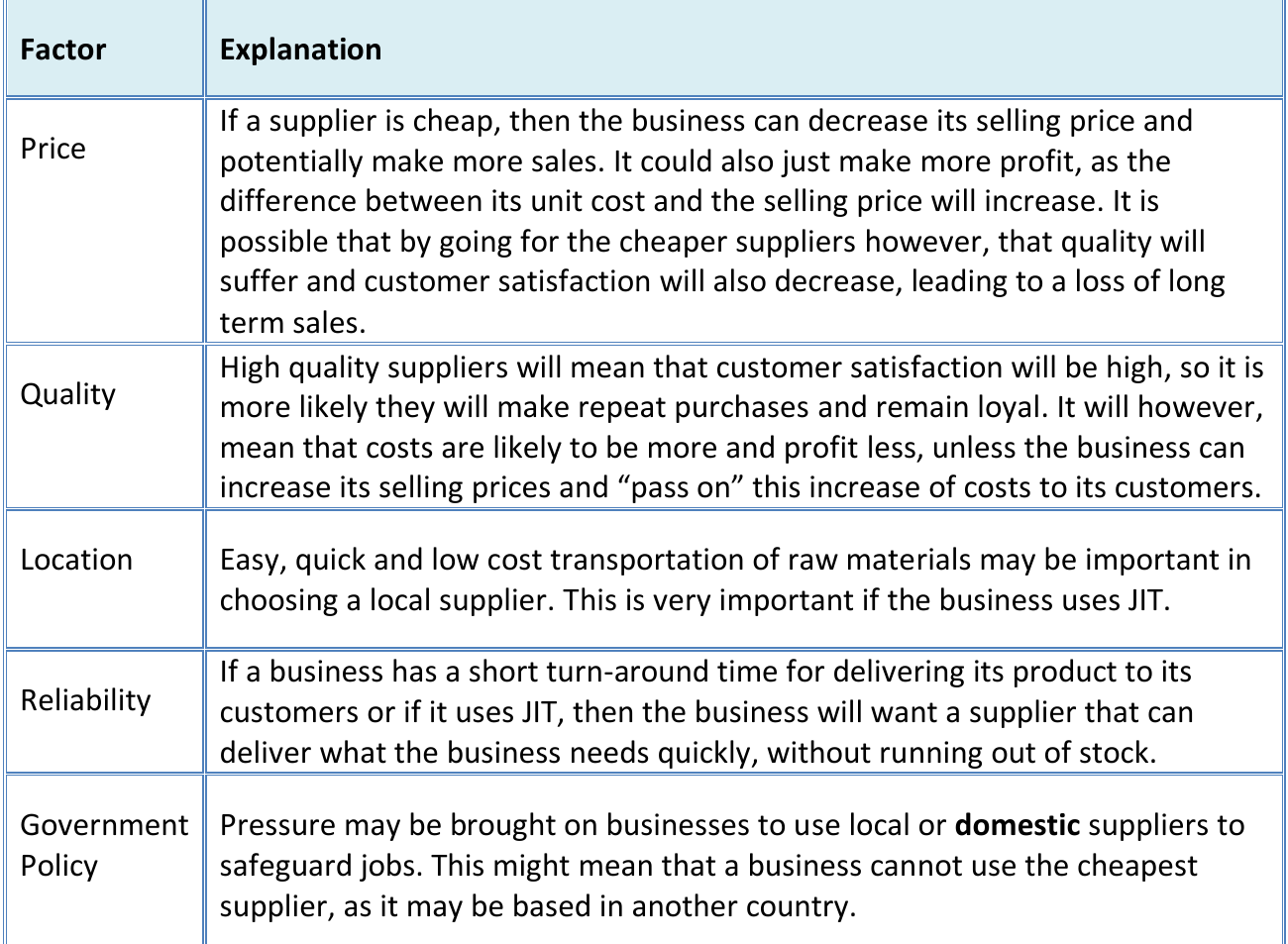
Beyond these core factors, businesses may also consider several additional criteria when selecting suppliers:
Industry considerations: In highly competitive industries where profit margins are tight, price becomes the primary concern, even if it means accepting lower quality standards.
Cash flow and finance: Some businesses lack the immediate cash flow to pay suppliers upfront, even for high-quality, reasonably priced goods. Suppliers offering credit terms can be invaluable, allowing businesses to purchase stock and pay later, ideally after they've had the opportunity to sell the products.
Customer expectations: Businesses serving customers who prioritise quality over price must ensure their suppliers can maintain high standards, even if costs increase. For instance, an expensive restaurant cannot compromise on ingredient quality as it would damage their reputation and lose customers.
Speed requirements: Some businesses need suppliers who can provide quick, reliable service rather than the cheapest option. This is particularly important for businesses using just in time production methods.
Tradition and relationships: Long-term supplier relationships often develop over many years, creating loyalty and consistency. Suppliers may prioritise loyal customers by ensuring timely deliveries and promised quality levels, leading to more consistent supply experiences.
Procurement and logistics integration
Procurement extends far beyond simply choosing suppliers - it encompasses the entire process of managing orders and receiving products or services. This broader view connects procurement closely with logistics operations.
Logistics forms a crucial part of the procurement process by planning, implementing, and controlling the distribution and storage of goods and services from supplier to customer. While often viewed as transportation, logistics actually involves comprehensive process management rather than just single activities.
Effective procurement and logistics management enables businesses to reduce unit costs and improve overall operational efficiency. This integration is particularly important in supply chain management.
Note
The supply chain encompasses all activities involved in getting products or services to customers, starting with suppliers and ending with final retail and distribution processes. Effective supply chain management ensures the right quantity of goods and services reaches the right place at the right time, maintaining required quality standards at minimum cost.
Businesses can take several steps to achieve effective supply chain management:
- Planning: Accurate demand forecasting helps ensure appropriate quantities of goods and services are provided when needed
- Procurement: Selecting the best suppliers results in good value and reliable supplies of the required quality
- Communication: Coordinating with suppliers and logistics providers helps prevent production delays
- Lean production: Eliminating waste from any supply chain area creates streamlined processes that are faster, cost less, offer improved quality, and provide better reliability. Manufacturing businesses can use methods like total quality management and just in time production to support this approach
- Transportation review: Logistics requirements need constant evaluation as new transport options become available and different distribution routes are required
Important
Continuous improvement can be achieved by examining each stage of the supply chain to identify potential improvements, helping ensure the process remains as streamlined and efficient as possible.
Summary
Key Points to Remember:
- Procurement is the complete process of selecting suppliers and managing the ordering and receipt of goods and services, not just choosing who to buy from
- JIT minimises stock holding costs but requires reliable suppliers and offers little room for error, while JIC provides security through higher stock levels but ties up more capital
- Supplier selection involves balancing multiple factors including price, quality, location, reliability, and government policy based on specific business needs
- Logistics and supply chain management integrate with procurement to ensure efficient flow of goods from supplier to customer
- Effective procurement and logistics management can significantly reduce unit costs and improve overall business efficiency