Converting Between Decimal and Hexadecimal (AQA GCSE Computer Science): Revision Notes
📚Revision Notes
Converting between decimal and hexadecimal
Understanding hexadecimal numbers
Hexadecimal is a base 16 number system that uses 16 different symbols to represent values. Unlike decimal (base 10) which uses digits 0-9, hexadecimal uses digits 0-9 plus the letters A, B, C, D, E, and F to represent values from 0 to 15.
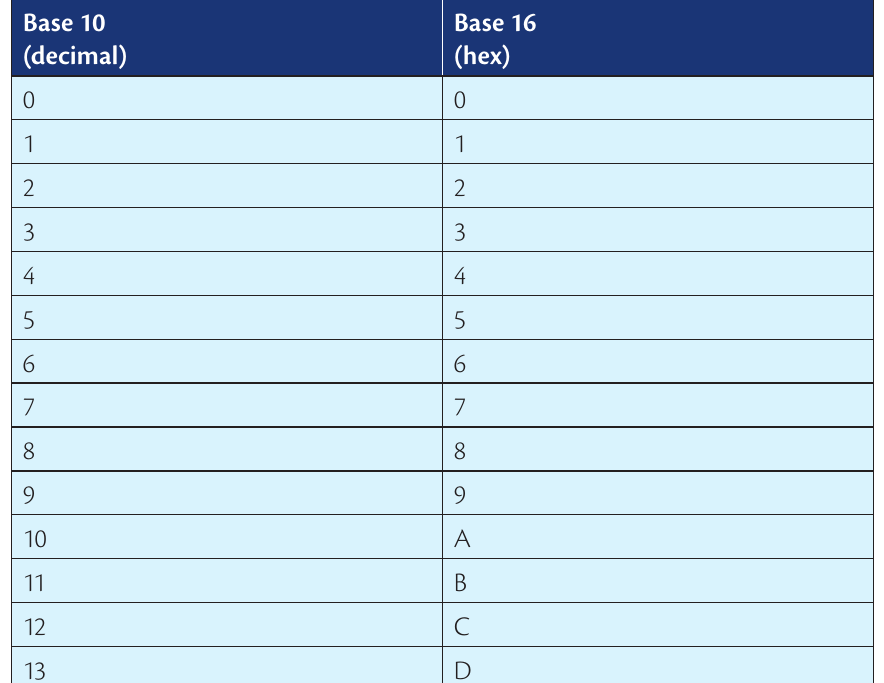
The reason we need letters is because hexadecimal counts up to 15 in a single digit position, but we only have 10 number symbols (0-9). So we use letters to represent the remaining values:
Note
The hexadecimal letter values are:
- A represents 10
- B represents 11
- C represents 12
- D represents 13
- E represents 14
- F represents 15
Important
This conversion table is essential to memorise - you'll need to know that A represents 10, B represents 11, and so on up to F representing 15.
Converting hexadecimal to decimal
To convert a hexadecimal number to decimal, we use the place value system, just like we do with decimal numbers. However, instead of each column being worth powers of 10, each column in hexadecimal is worth powers of 16.
The process involves three main steps:
- First, convert each hexadecimal symbol to its decimal equivalent using the conversion table
- Next, multiply each decimal value by its column position value (, , etc.)
- Finally, add all the results together to get your decimal answer
Example
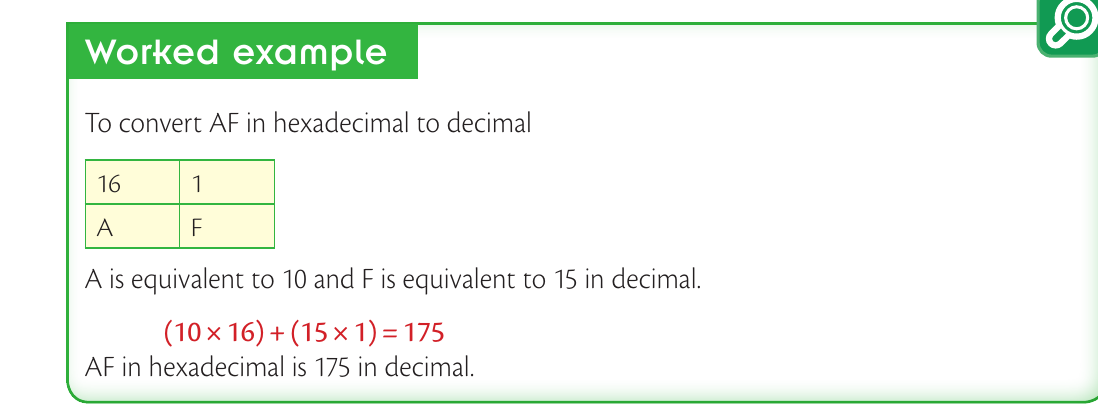
Worked Example: Converting AF₁₆ to decimal
Step 1: Convert each hexadecimal symbol to decimal
- A = 10 (decimal)
- F = 15 (decimal)
Step 2: Identify the place values
- A is in the column (worth 16)
- F is in the column (worth 1)
Step 3: Multiply each value by its place value
- A:
- F:
Step 4: Add the results
Therefore: AF₁₆ = 175₁₀
Converting decimal to hexadecimal
Converting from decimal to hexadecimal works differently. Instead of using place values, we use a division method that involves repeatedly dividing by 16 and keeping track of remainders.
Here's how the process works:
- Start by checking if 16 will divide into your decimal number
- If it does, write down how many times 16 goes into the number (this goes in the 16s column)
- The remainder gets converted into its hexadecimal symbol and goes in the 1s column
- For larger numbers, you continue this process with higher powers of 16
Example
Worked Example: Converting 189₁₀ to hexadecimal
Step 1: Divide 189 by 16 remainder
Step 2: Convert the results to hexadecimal
- Quotient: 11 = B (in hexadecimal)
- Remainder: 13 = D (in hexadecimal)
Step 3: Write the hexadecimal result The quotient becomes the left digit, remainder becomes the right digit.
Therefore: 189₁₀ = BD₁₆
Verification: ✓
Why hexadecimal matters in computing
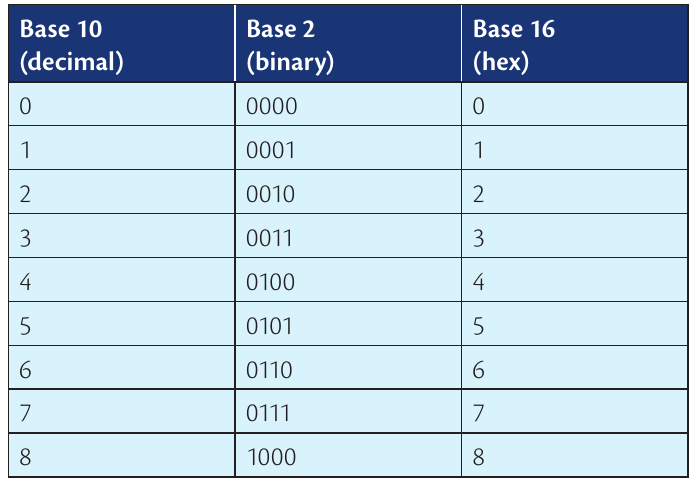
Hexadecimal is particularly important in computer science because it provides a more compact and readable way to represent binary data. Each hexadecimal digit represents exactly four binary digits, making it much easier for programmers to read and write large binary numbers.
Note
This table shows how decimal, binary, and hexadecimal relate to each other, demonstrating why hex is so useful as a "shorthand" for binary in computing contexts.
Exam tips and common mistakes
Important
Common Mistakes to Avoid:
- Always double-check that you're using the correct values for A-F (A=10, B=11, C=12, D=13, E=14, F=15)
- Remember that the rightmost column is always the 1s column ()
- When converting decimal to hex, don't forget to convert your remainders to the correct hexadecimal symbols
- Practice with small numbers first before attempting larger conversions
- Always verify your answers by converting back to check your work
The most common error students make is forgetting that A through F represent numbers, not just letters. Make sure you memorise the conversion values thoroughly.
Summary
Summary
Key Points to Remember:
- Hexadecimal uses base 16 and includes digits 0-9 plus letters A-F (where A=10, B=11, C=12, D=13, E=14, F=15)
- To convert hex to decimal: convert each symbol to decimal, multiply by place values (powers of 16), then add the results
- To convert decimal to hex: divide by 16 repeatedly, using quotients and remainders to build your hexadecimal number
- Each hexadecimal digit represents exactly four binary digits, making it valuable in computing
- Always check your work by converting back to verify your answer is correct