Calculating Bits Required for Huffman Coding (AQA GCSE Computer Science): Revision Notes
📚Revision Notes
Calculating bits required for Huffman coding
What is Huffman coding calculation?
When we use Huffman coding, we need to work out how many bits our encoded message will use. This is important because it helps us see how much space we're saving compared to other encoding methods like ASCII.
The key principle behind Huffman coding is that frequently used characters get shorter binary codes, while less common characters get longer codes. This makes the overall message smaller and more efficient for storage and transmission.
Note
Understanding Huffman coding calculations is essential for evaluating compression efficiency and comparing different encoding methods. The calculation process helps demonstrate why variable-length encoding is superior to fixed-length systems.
Understanding the Huffman table
Let's look at how to read a Huffman coding table and calculate the total bits needed.
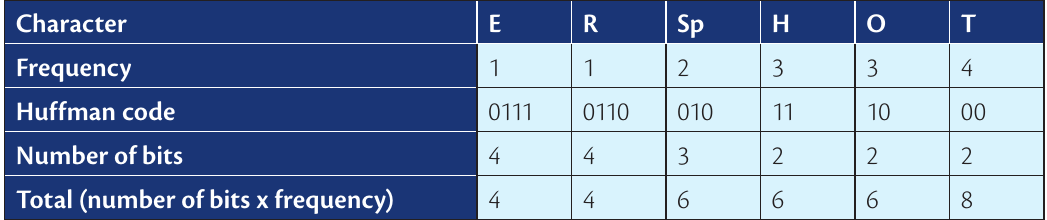
The table shows us several important pieces of information that we need for our calculations:
- Character: The letters we want to encode
- Frequency: How many times each character appears in our message
- Huffman code: The binary code assigned to each character
- Number of bits: How long each binary code is
- Total bits: Frequency × Number of bits for each character
Note
The "Total bits" column is crucial - it shows exactly how many bits each character type contributes to the final encoded message. The sum of this column gives us our final answer.
Step-by-step calculation method
To calculate the total bits required for Huffman coding, we need to follow a systematic approach that ensures accuracy and completeness.
Example
Worked Example: Calculating bits for "HOT HOT HOTTER"
Step 1: Identify character frequencies Count how many times each character appears in your message:
- E appears 1 time
- R appears 1 time
- Sp (space) appears 2 times
- H appears 3 times
- O appears 3 times
- T appears 4 times
Step 2: Note the Huffman codes Each character gets a unique binary code. Notice the pattern:
- T (most frequent) gets the shortest code: 00 (2 bits)
- H and O get medium codes: 11 and 10 (2 bits each)
- Space gets: 010 (3 bits)
- E and R (least frequent) get longest codes: 0111 and 0110 (4 bits each)
Step 3: Calculate bits for each character Use the formula: Frequency × Code length
- E: bits
- R: bits
- Sp: bits
- H: bits
- O: bits
- T: bits
Step 4: Add them all up Total bits =
Comparing with other encoding methods
Understanding how Huffman coding compares to other methods helps us appreciate its efficiency and practical value.
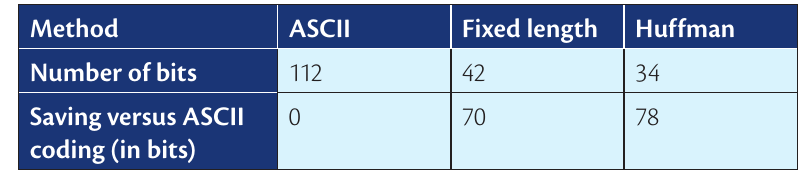
This comparison shows us why Huffman coding is so effective for data compression:
Note
Encoding Method Comparison:
- ASCII encoding: Uses 7 bits for every character, so our message needs bits
- Fixed length encoding: Uses the same number of bits for each character (in this case 3 bits), needing bits total
- Huffman coding: Uses variable lengths based on frequency, needing only 34 bits
The savings are substantial and demonstrate the power of frequency-based encoding:
Savings calculation:
- Huffman vs ASCII: 112 - 34 = 78 bits saved (69% reduction)
- Huffman vs Fixed length: 42 - 34 = 8 bits saved (19% reduction)
Practical example: Decoding with Huffman codes
We can also work backwards to decode messages using our Huffman table, which helps verify our understanding of the encoding process.

Example
Worked Example: Decoding Binary Sequence
If we receive the binary sequence: 00110111010011010000
We can split it using our Huffman codes:
- 00 = T
- 11 = H
- 0111 = E
- 010 = Space
- 0110 = R
- 10 = O
- 10 = O
- 00 = T
This gives us: "THE ROOT"
Why does this work so well?
The magic of Huffman coding comes from its intelligent approach to character frequency distribution.
The effectiveness stems from giving shorter codes to more common characters. This optimisation strategy means:
- Characters that appear often (like T in our example) use fewer bits each time they occur
- Characters that appear rarely (like E and R) use more bits, but since they're infrequent, this doesn't significantly impact the overall total
- The overall message becomes much smaller than with fixed-length encoding
This approach minimises the expected length of the encoded message, making it theoretically optimal for the given character frequencies.
Important
Common Mistake to Avoid:
Don't assume that longer codes are "bad" - they're actually optimal when applied to rare characters. The key is the weighted average where frequent characters dominate the space savings.
Exam tips
When working with Huffman coding calculations in exams, following a systematic approach will help you avoid common mistakes and ensure accuracy.
Important
Essential Calculation Steps:
- Always multiply frequency × code length for each character - this is the core calculation
- Add up all the individual totals to get the final answer
- Check your arithmetic - small mistakes add up quickly in these problems
- Remember the formula: Total bits =
- Compare with ASCII by multiplying total characters × 7 bits to show space savings
- Double-check the Huffman codes from the table before calculating
Summary
Summary
Key Points to Remember:
- Frequent characters get shorter codes - this is the fundamental principle of Huffman coding
- Total bits formula: for each character
- Huffman coding saves significant space compared to fixed-length encoding like ASCII
- Decoding process: Split binary sequences using the Huffman code table
- Verification step: Always double-check your multiplication and addition when calculating total bits
- Efficiency comparison: Calculate savings by comparing with ASCII (7 bits/character) and fixed-length alternatives