Using and working with polymers (AQA GCSE Design and Technology): Revision Notes
📚Revision Notes
Using and working with polymers
Understanding how to select and work with polymers is essential for creating successful products. Manufacturers must carefully consider multiple factors when choosing materials and may need to enhance polymers to meet specific requirements.
Selecting materials for polymer products
When manufacturers design products using polymers, they need to evaluate several important factors to ensure they choose the most appropriate material for their specific application.
Functionality and performance requirements
The first consideration is what the product needs to do and how well it must perform. This includes understanding the specific tasks the product will carry out and any measurable performance standards it must meet.
Note
Performance Standards Matter
Different applications require different performance levels. For example, a garden chair needs to support human weight safely, while a food container must maintain freshness and prevent contamination. Always start with clear functional requirements.
Availability and sourcing considerations
Manufacturers must consider whether the chosen polymer is readily available and what standard sizes or forms can be obtained. They also need to think about which components might need to be joined together during assembly.
Important
Supply Chain Risks
Limited availability of certain polymers can significantly impact production schedules and costs. Always have backup material options or alternative suppliers identified before committing to large-scale production.
Scale of production factors
The manufacturing scale affects many decisions, including how polymers will be processed, which joining methods will be used, and what manufacturing capabilities are required. Large-scale production might justify expensive tooling, while small batches might require different approaches.
Cost considerations
Budget constraints play a crucial role in material selection. This includes not only the cost of raw materials but also the expenses involved in converting the polymer into the finished product. Manufacturers must balance material costs against their target selling price to maintain profitability.
Ethical and environmental factors
Modern manufacturing increasingly considers ethical sourcing of raw materials and relationships with fair trade organisations. Environmental factors include sustainability concerns, waste management strategies, energy demands during production, and recycling possibilities at the end of the product's life.
Note
Sustainability Focus
Today's consumers and regulations increasingly demand environmentally responsible choices. Consider the full lifecycle impact - from raw material extraction through disposal or recycling.
Mechanical properties
These properties determine how the material behaves under different types of stress and force. Key mechanical properties include:
- Strength - resistance to breaking under tension or compression
- Hardness - resistance to surface indentation or scratching
- Toughness - ability to absorb energy before breaking
- Malleability - ability to be hammered or pressed into shape
- Ductility - ability to be drawn into wires or thin sheets
- Elasticity - ability to return to original shape after deformation
- Plasticity - ability to be permanently deformed without breaking
Aesthetic considerations
The visual appeal of the final product is often crucial for commercial success. This includes how the material will appear to customers, including colour options, surface texture, and overall form. Some polymers accept dyes and finishes better than others.
Physical properties
These properties affect how the material interacts with its environment. Important physical properties include absorbency (how much liquid the material can soak up), density and weight characteristics, fusibility (how easily it melts), electrical and thermal conductivity, fluidity during processing, and compatibility with various additives.
Enhancing materials
Polymers can be modified and enhanced through various techniques to improve their properties and make them suitable for more demanding applications.
Laminating and reinforcing techniques
Laminating involves using glass fibres to reinforce polymer resin, creating much stronger and more rigid structures. This technique is commonly used for manufacturing car bodies, boat hulls, and canoes where high strength-to-weight ratios are essential.
The laminating process follows several key steps. First, a shaped mould is prepared to define the final product's form. Next, a release agent is applied to prevent the polymer from sticking to the mould surface. The polymer is then mixed with a catalyst (hardener) and painted or sprayed onto the mould. Glass fibre strands are carefully laid into the resin while it's still workable. This layering process may be repeated multiple times to build up the required thickness and strength. Finally, the assembly is left to cure and harden completely.
Important
Critical Process Points
- The polymer must be mixed with catalyst in correct proportions
- Glass fibres must be laid while resin is still workable
- Proper curing time is essential for maximum strength
- Rushing the process will result in weak, unreliable products
Stiffening methods
Plastic mouldings can be made significantly more rigid and strong by incorporating ribs and gussets into their design. These structural elements add strength without requiring much additional material.
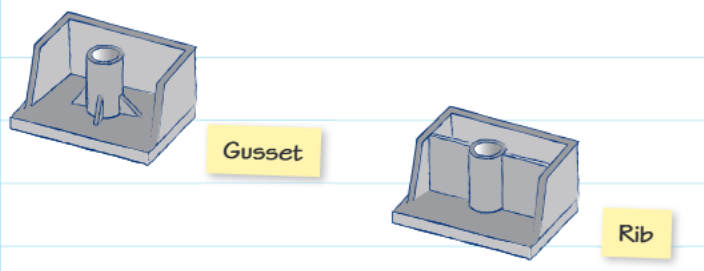 Ribs are thin, raised sections that run along surfaces to provide additional structural support. Gussets are triangular or angled reinforcements typically used at corners or joints where extra strength is needed. Both features can be moulded directly into the product during manufacture.
Note
Design Efficiency
Ribs and gussets are examples of smart design - they provide maximum structural benefit with minimal additional material cost. This approach is both economical and environmentally efficient.
Practical applications and examples
HDPE outdoor furniture example
Example
Worked Example: HDPE Outdoor Chair Selection
Material Choice: High Density Polyethylene (HDPE)
Analysis of Selection Factors:
Mechanical Properties: HDPE's strength allows the chair to safely support a person's weight without breaking or deforming under normal use conditions.
Physical Properties: HDPE softens when heated, making it ideal for injection moulding into complex chair shapes during manufacture.
Environmental Benefits: Excellent recyclability makes it environmentally responsible - old chairs can be processed into new products.
Cost Effectiveness: Relatively low material costs help keep the final product affordable for consumers.
Availability: Readily available since it's derived from oil, a widely accessible raw material.
Aesthetic Options: Can be produced in various colours to suit different garden environments and customer preferences.
Electrical applications example
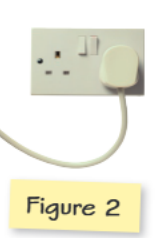 Urea formaldehyde (UF) represents another excellent example of matching material properties to application requirements. For electrical sockets and similar applications, UF offers specific advantages that make it particularly suitable.
Example
Worked Example: UF Electrical Socket Application
Material Choice: Urea Formaldehyde (UF)
Primary Selection Driver: Safety requirements in electrical applications
Key Properties Analysis:
- Electrical Insulation: Excellent insulation properties prevent dangerous electrical currents from reaching users
- Heat Resistance: Good thermal stability crucial since electrical components generate significant heat during operation
- Durability: Long-term stability ensures safe operation over many years
- Flame Resistance: Important safety feature in case of electrical faults
Why This Matters: In electrical applications, safety often becomes the primary material selection criterion, overriding cost or aesthetic considerations.
Important
Safety First in Electrical Applications
When designing electrical products, material properties that ensure user safety must take priority over all other considerations including cost, appearance, or ease of manufacturing.
Summary
Key Points to Remember:
- Material selection involves multiple factors - functionality, availability, costs, environmental impact, and various physical and mechanical properties must all be considered together
- Enhancement techniques expand possibilities - laminating with glass fibres and adding structural features like ribs and gussets can significantly improve polymer performance
- Real applications demonstrate theory - HDPE chairs and UF electrical sockets show how material properties directly relate to product requirements and safety considerations
- Environmental and ethical considerations matter - modern manufacturing increasingly prioritises sustainability, recyclability, and responsible sourcing
- Safety often drives material choice - particularly in electrical applications, material properties that ensure user safety become the most important selection criteria