Domain and range of a function (AQA GCSE Further Maths): Revision Notes
📚Revision Notes
Domain and range of a function
What are domain and range?
Understanding domain and range is essential for working with functions effectively. These concepts help us identify what values we can use as inputs and what outputs we can expect.
Note
Domain represents all the possible x-values (input values) that we can substitute into a function. Think of it as the collection of all valid inputs that make the function work properly.
Range represents all the possible y-values or f(x) values (output values) that the function can produce. The range depends directly on what domain we're working with.
Understanding domain
When working with functions, the domain tells us which x-values are allowed. Sometimes a function is defined for all real numbers, but often there are restrictions we need to consider.
Types of domain restrictions
Unrestricted domain: Some functions work for any real number. For example, if we have without any stated restrictions, we can use any real value for x.
Explicitly restricted domain: Many functions come with specific restrictions written using inequality symbols. For instance:
- where means we can only use x-values of 1 and greater
- where means x must be between 1 and 5 (including both endpoints)
Important
Pay careful attention to whether the inequality uses and (which include the endpoint) or and (which exclude the endpoint). This affects both the domain and resulting range.
Understanding range
The range of a function depends heavily on its domain. Once we know what x-values are allowed, we can determine what f(x) values are possible.
How to find the range
Note
Step 1: Identify the domain restrictions
Step 2: Evaluate the function at the boundary points of the domain
Step 3: Consider the behaviour of the function between these points
Step 4: Write the range using appropriate inequality notation
Worked example: linear function with restricted domain
Example
Worked Example: Finding Range from Domain Restrictions
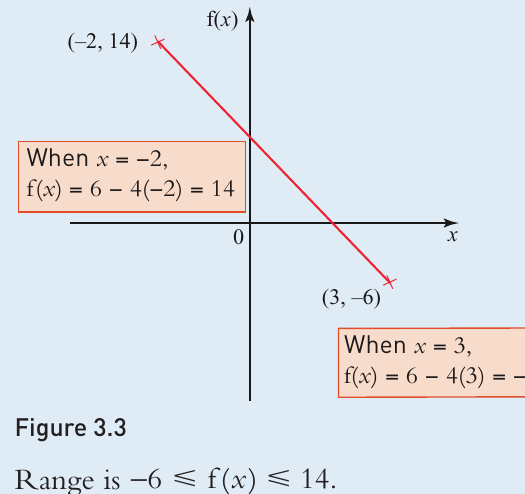
Let's examine where .
Step 1: Identify the domain can take any value from -2 to 3 (including both endpoints).
Step 2: Evaluate at boundary points
- When :
- When :
Step 3: Consider function behaviour Since is a linear function with negative slope, it decreases as x increases. The highest output occurs at the smallest x-value (-2), and the lowest output occurs at the largest x-value (3).
Step 4: Write the range Therefore, the range is .
Working with quadratic functions
Quadratic functions require special attention because their graphs are parabolas, which have minimum or maximum points.
For with unrestricted domain, the function produces all non-negative values because squaring any real number gives a positive result or zero. Therefore, the range is .
Note
When we restrict the domain of a quadratic function, we must carefully consider which part of the parabola we're using. The vertex (turning point) may or may not be included in the restricted domain.
Reading domain and range from graphs
Graphs provide visual representations that make identifying domain and range more intuitive.
Note
For domain: Look at the x-axis and identify all x-values where the graph exists. The domain spans from the leftmost point to the rightmost point of the graph.
For range: Look at the y-axis and identify all y-values that the graph reaches. The range spans from the lowest point to the highest point on the graph.
When examining graphs, pay attention to:
- Open circles (which indicate points not included)
- Closed circles (which indicate points included)
- Arrows (which indicate the graph continues indefinitely)
Common exam tips
Important
Tip 1: Always check whether boundary points are included or excluded. The symbols and include the boundary, while and exclude it.
Tip 2: For linear functions, the range will be determined by evaluating the function at the boundary points of the domain.
Tip 3: For quadratic functions, consider whether the vertex (turning point) falls within the given domain, as this affects the range significantly.
Tip 4: When writing your answer, use the same notation style as given in the question (inequality symbols or interval notation).
Remember!
Summary
Key Points to Remember:
- Domain = all possible x-values (inputs) that work in the function
- Range = all possible y-values (outputs) that the function can produce
- Range depends on domain - restricting the domain changes the range
- Linear functions: Range is found by evaluating at domain boundaries
- Always check whether boundary points are included (, ) or excluded (, )