Inverse functions (AQA GCSE Further Maths): Revision Notes
📚Revision Notes
Inverse functions
What are inverse functions?
An inverse function essentially "undoes" what the original function does. When you have a function f(x), its inverse function f⁻¹(x) reverses the process, taking you back to where you started.
Note
Think of it this way: if a function takes the number 5 and transforms it into 12, then the inverse function would take 12 and transform it back into 5. The inverse function maps each element from the range back to its corresponding element in the domain.
For example, consider the simple function . This function adds 2 to any input value. The domain {1, 2, 3} maps onto the range {3, 4, 5}. The inverse function would subtract 2 from each value, so , mapping {3, 4, 5} back to {1, 2, 3}.
The key requirement for inverse functions
Not every function has an inverse. A function will only have an inverse if it is a one-to-one function within its given domain.
Important
A one-to-one function means that each input value produces exactly one output value, and each output value corresponds to exactly one input value.
Here's why this matters: if a function produces the same output for different inputs, then the inverse wouldn't know which input to map back to. For instance, the function produces the same output (4) for both and . This creates ambiguity when trying to reverse the process.
Note
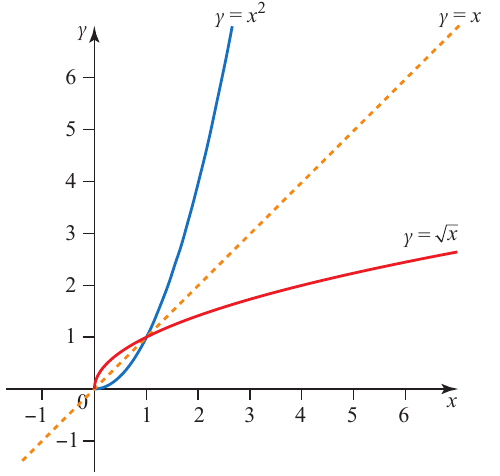
To solve this problem, we sometimes need to restrict the domain of a function. For example, can have an inverse if we restrict it to , giving us the inverse .
How to find inverse functions algebraically
There's a systematic method for finding inverse functions that works reliably:
Step-by-step method
Note
Step 1: Write the function in the form
Step 2: Interchange x and y (swap them around)
Step 3: Rearrange to make y the subject of the equation
Step 4: The result is your inverse function
Example
Worked Example 1: Finding the inverse of f(x) = 2x + 3
Let's find the inverse of .
Starting with the function , we can think about what operations are being performed:
- First, x is multiplied by 2
- Then, 3 is added
To reverse this process:
- First, subtract 3
- Then, divide by 2
Following our systematic method:
Step 1: Write as
Step 2: Interchange variables:
Step 3: Make y the subject:
- Subtract 3:
- Divide by 2:
Therefore,
The graphical relationship
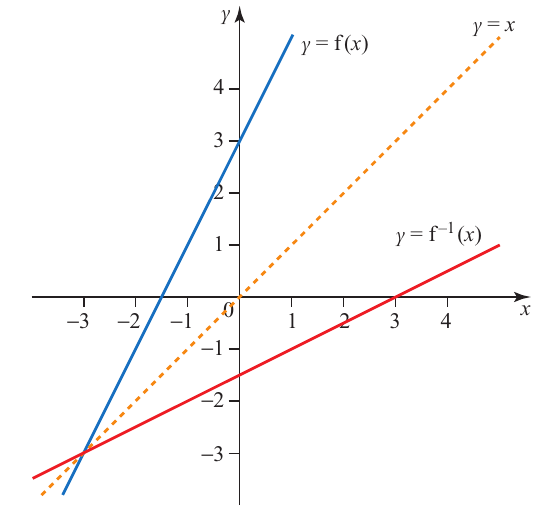
One of the most beautiful aspects of inverse functions is their graphical relationship. When you plot a function and its inverse on the same coordinate system, they are perfect reflections of each other across the line y = x.
Note
This reflexion property makes sense when you think about it: the inverse function swaps the x and y coordinates of every point on the original function. A point (a, b) on the original function becomes the point (b, a) on the inverse function, and this swapping is exactly what reflexion across the line y = x achieves.
Example
Worked Example 2: Finding the inverse of f(x) = x² - 2 for x ≥ 0
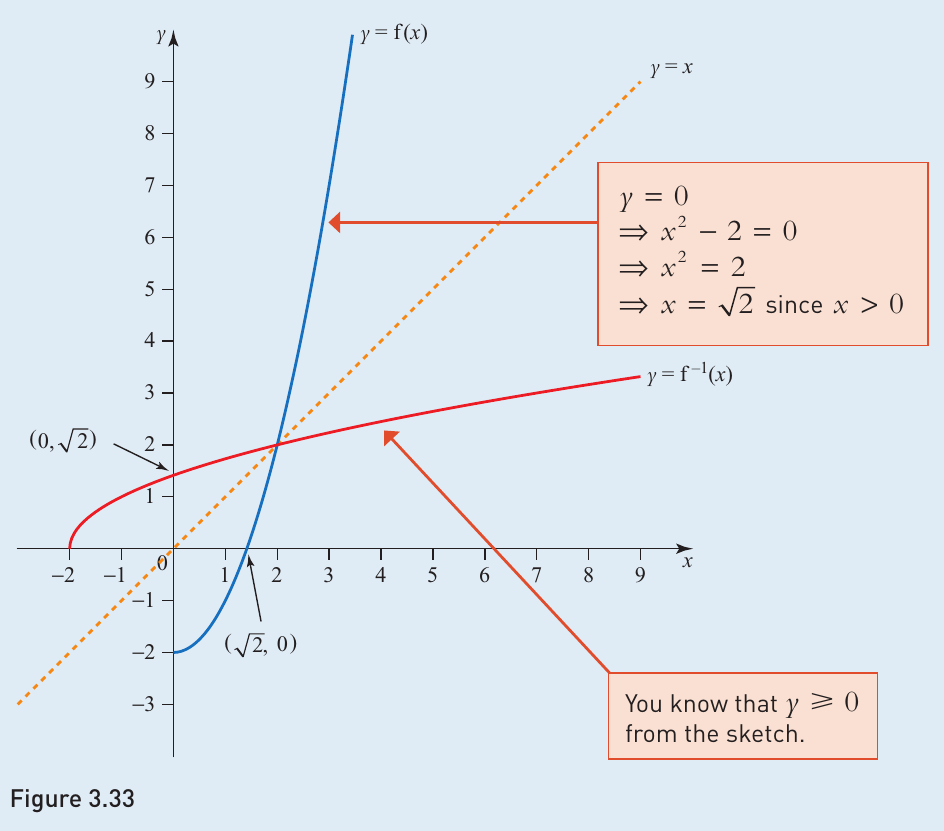
Let's examine for and find its inverse.
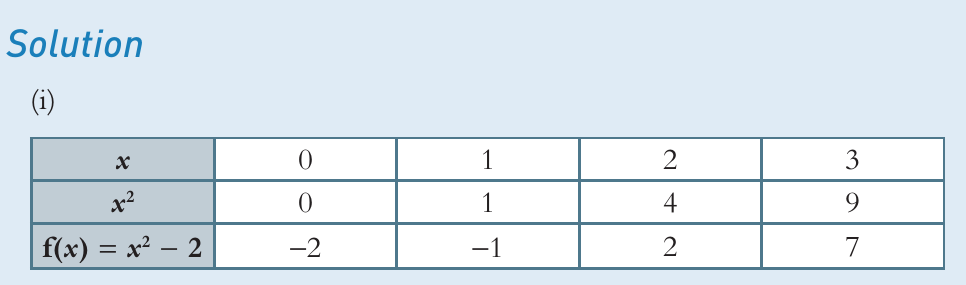
First, let's create a table of values to understand the function:
Now, following our algebraic method:
Step 1: Write as
Step 2: Interchange:
Step 3: Make y the subject:
- Add 2:
- Take the positive square root:
So
The domain restriction for the original function ensures it's one-to-one, and correspondingly, the range of the inverse function is .
Important points to remember
When working with inverse functions, keep these key points in mind:
Domain and range considerations: The domain of the original function becomes the range of the inverse function, and vice versa. Always check that your inverse function makes sense within these constraints.
Checking your answer: You can verify your inverse function by checking that and . If both of these are true, you've found the correct inverse.
Important
Notation clarity: Be careful with notation. means the inverse function, not . The superscript -1 in this context indicates "inverse," not "reciprocal."
Restricted domains: Many functions need their domains restricted before they can have inverses. Quadratic functions are common examples where we typically restrict to or .
Summary of the method
Summary
Key Steps to Find Inverse Functions:
- Write the function in the form
- Interchange x and y to get
- Rearrange to make y the subject
- The result is your inverse function
Summary
Key Points to Remember:
- Only one-to-one functions have inverses - each input must produce a unique output
- Functions and their inverses are reflections of each other across the line y = x
- To find an inverse algebraically: write as , swap x and y, then solve for y
- The domain of f(x) becomes the range of f⁻¹(x), and vice versa
- Always check if domain restrictions are needed to make a function one-to-one