Scalars & Vectors (AQA GCSE Physics Combined Science): Revision Notes
📚Revision Notes
5.1.1 Scalars & Vectors
Scalar Quantities
Note
Scalars have magnitude (size) only, with no direction.
Example
Examples:
- Mass
- Temperature
- Speed
- Energy
- Distance
- Time
Vector Quantities
Note
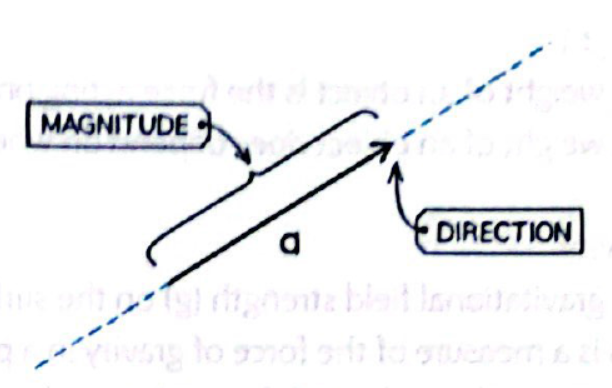
Vectors have both magnitude and direction.
Example
Examples:
- Displacement (distance in a specific direction)
- Weight
- Force
- Velocity
- Acceleration
- Momentum
Representation of Vectors
- Arrows: Vectors are represented by arrows.
- Length: Indicates the magnitude of the vector.
- Direction: Indicates the direction of the vector.
Key Differences Between Scalars and Vectors
- Scalar: Has only magnitude (e.g., speed, distance, mass). Scalars are generally non-negative.
- Vector: Has both magnitude and direction (e.g., velocity, displacement, force). Vectors can have positive or negative values, depending on the direction.
Note
Explanation with Examples
- Displacement:
- Imagine a ball thrown off a cliff. If the top of the cliff is the zero point, the ball has positive displacement when above the cliff and negative displacement when below it. The choice of the zero point is arbitrary and can be adjusted based on the situation.
- Speed vs. Velocity:
- Speed is the magnitude of how fast something moves, while velocity includes direction. For instance, a ball thrown at 10 m/s has a speed of 10 m/s, but if it's thrown at 10 m/s at 30° above the horizontal, that's its velocity.
- Roundabout Example:
- A car moving at a constant speed around a roundabout has a constant speed, but since its direction is constantly changing, its velocity is also changing. This change in velocity means the car is accelerating, even if its speed remains constant.