Discovery of the Proton & Neutron (AQA GCSE Physics): Revision Notes
📚Revision Notes
4.1.9 Discovery of the Proton & Neutron
Development of the Model of The Atom
Note
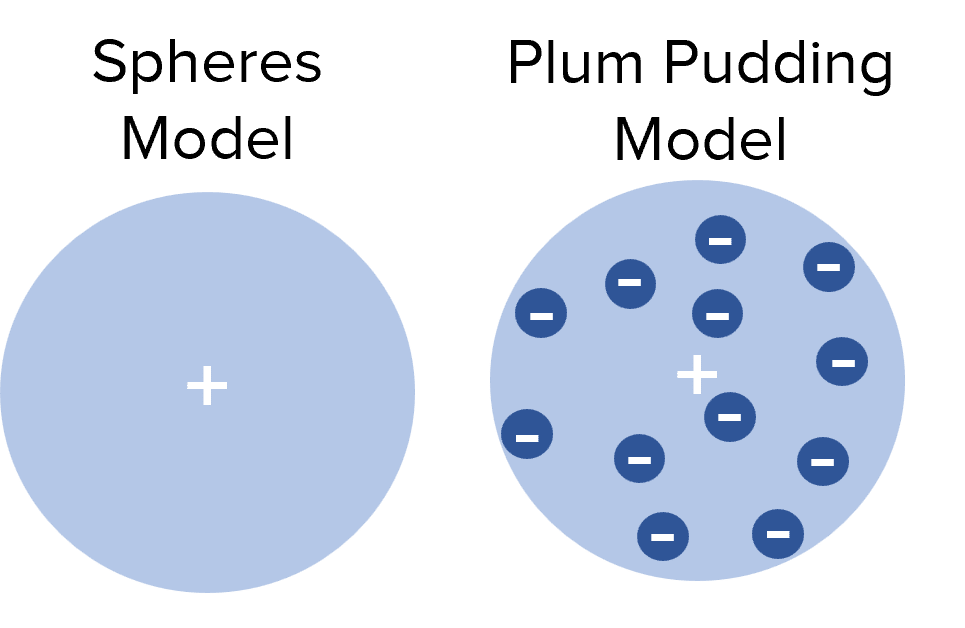
In 1803, John Dalton came up with the spherical model of the atom. This model suggests that atoms are tiny spheres that can't be broken into smaller parts.
Note
This spherical model was the accepted scientific opinion until 1909 when JJ Thomson discovered the electron. This led to the development of the "plum pudding model" where electrons were thought to be distributed randomly in a positively charged sphere, like fruit in a plum pudding.
Note
Then, in 1909, Ernest Rutherford conducted an experiment where he fired positively charged alpha particles at a thin gold foil. He found that most alpha particles went straight through the foil but a small percentage were scattered in different directions. This suggested that the majority of the gold foil must be empty space but there must be small positive charges to reflect the alpha particles.
Note
In 1917, following his gold foil experiment, Ernest Rutherford identified the proton as the positively charged particle in the nucleus. This discovery built on his earlier work, establishing that the nucleus not only is dense and positively charged but also contains these protons.
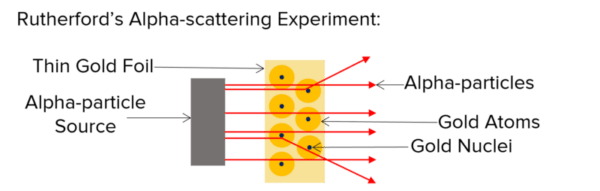
From this experiment, Rutherford concluded that:
- The mass of an atom must be concentrated in a very small and dense central nucleus.
- The nucleus is positively charged.
Note
These conclusions led to the nuclear model of the atom that we use today. It is possible that in the future, new evidence may be found to change the nuclear model of the atom.