Free Body Diagrams (AQA GCSE Physics): Revision Notes
📚Revision Notes
5.1.7 Free Body Diagrams
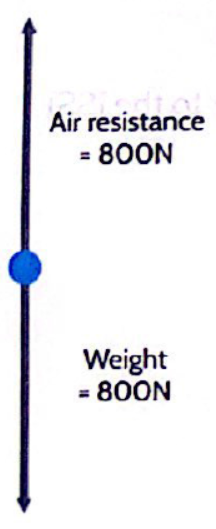
Free-body Diagram for a Skydiver
- In a free-body diagram, the object is shown as a point.
- The forces are drawn as arrows starting at the point.
- The length of the arrow represents the size of the force.
- The direction of the arrow represents the direction of the force.
Example
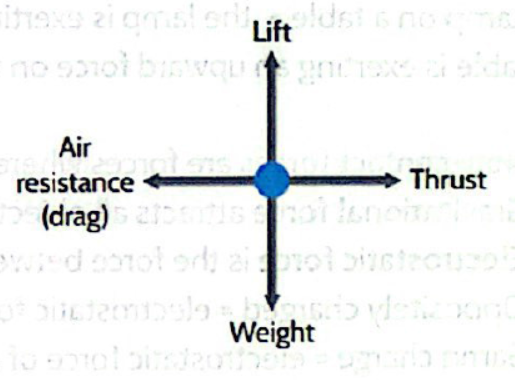
Example: Aeroplane Flying at a Constant Altitude and Velocity
- Altitude: Height above the ground.
- Constant altitude means there must be a force of the same magnitude as the weight acting in the opposite direction (lift).
- Thrust: A forwards force provided by the engines.
- The aeroplane also experiences the force of air resistance (drag) acting in the reverse direction.
- Due to constant velocity, the forwards and backwards forces must be balanced.
Vector Diagrams
Vector Diagrams
- Used to calculate the resultant of two forces acting at an angle.
Example
Example:

- Two forces are acting on an object.
- One force has a magnitude of 10N.
- Another force has a magnitude of 8N.
- The angle between the two forces is 30°.
- Calculate the resultant force.
- 1cm = 4N
- Resultant force = 17.5N
Resolving Forces
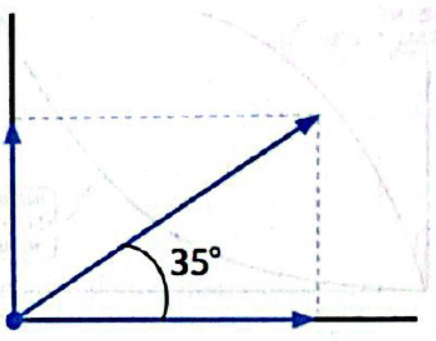
- Vector diagrams can be used to resolve a single force into two forces.
Example
Example:
- A 100N force is acting at an angle of 35° with the horizontal.
- Determine the horizontal and vertical components of this force.