Mode and median (AQA GCSE Statistics): Revision Notes
📚Revision Notes
Mode and median
When working with grouped data in frequency tables, you cannot determine exact values for the mode and median. Instead, you can only identify the class intervals where these averages are located and estimate their values using specific methods.
Understanding grouped data limitations
In grouped data, individual data values are organised into class intervals rather than being listed separately. This means you only know which interval each data point falls into, not the precise value. As a result, you cannot calculate exact averages but must work with class intervals and estimates instead.
Note
Unlike individual data where you can find exact values, grouped data only allows you to work with ranges of values. This is why we focus on identifying classes and making estimates rather than finding precise averages.
Modal class
The modal class is the class interval that contains the mode. Since you cannot determine the exact mode value from grouped data, identifying the modal class is the best you can achieve.
To find the modal class, examine your frequency table and identify which class interval has the highest frequency. This interval contains the most data values and is therefore the modal class.
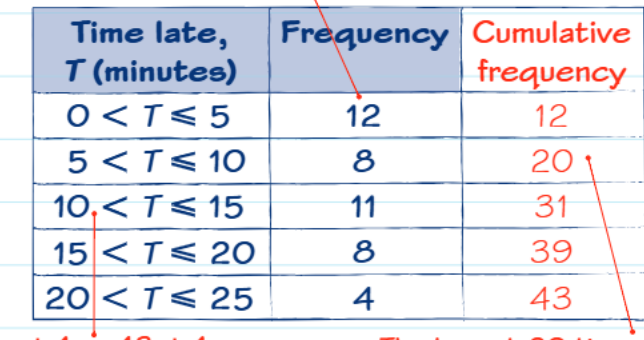
For example, in the time late data shown above, the modal class is 0 < T ≤ 5 because it has the highest frequency of 12.
Class containing the median
The median class is the class interval that contains the median value. To find this interval, you need to use cumulative frequency.
Finding the median position
First, calculate the position of the median using the formula:
Median position =
Where n is the total number of data values (the sum of all frequencies).
Using cumulative frequency
Create a cumulative frequency column by adding up the frequencies as you go down the table. The median class is the first interval where the cumulative frequency reaches or exceeds the median position.
In the example above:
- Total frequency (n) = 43
- Median position =
- Looking at cumulative frequencies: 12, 20, 31, 39, 43
- The 22nd data value lies in the interval 10 < T ≤ 15 (cumulative frequency 31)
Estimating the median value
Once you've identified the median class, you can estimate the actual median value using this formula:
Estimated median =
Where:
- L = lower boundary of the median class interval
- n = total number of values
- F = cumulative frequency of intervals before the median class
- f = frequency of the median class interval
- w = width of the median class interval
Note
This formula works by finding how far into the median class the median value lies, then calculating the corresponding position within that interval.
Worked example
Example
Worked Example: Estimating the Median Age
Let's work through a complete example step by step.
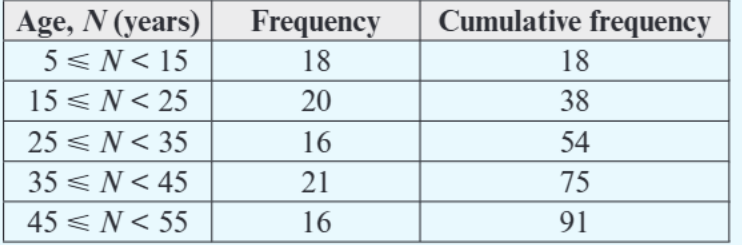
Question: Calculate an estimate for the median age. Give your answer correct to 3 significant figures.
Step 1: Find the total frequency
Step 2: Calculate the median position Median position = th data value
Step 3: Use cumulative frequency to find the median class
- Up to 15 years: 18 people
- Up to 25 years: 38 people
- Up to 35 years: 54 people
The 46th person falls in the 25 ≤ N < 35 age group.
Step 4: Apply the median estimation formula
- L = 25 (lower boundary of median class)
- n = 91 (total frequency)
- F = 38 (cumulative frequency before median class)
- f = 16 (frequency of median class)
- w = 10 (width of median class: 35 - 25)
Step 5: Calculate the estimate Estimated median = = = = = years (3 significant figures)
Key examination tips
Note
Essential Examination Strategies
When tackling grouped data questions in exams:
- Always check your cumulative frequency - Make sure it adds up correctly and matches your total frequency
- Be careful with inequalities - Pay attention to whether intervals include their boundaries (≤ vs <)
- Show your working clearly - Examiners award marks for method even if your final answer is incorrect
- Round appropriately - Follow the question's instructions for significant figures or decimal places
- Check your median position calculation - Remember it's , not just
Common mistakes to avoid
Important
Critical Points to Remember
- Confusing modal class with mode - you can only find the class interval, not the exact value
- Forgetting to create cumulative frequency when finding the median class
- Using the wrong values in the median estimation formula
- Mixing up F and f - F is cumulative frequency before the median class, f is frequency of the median class
Summary
Key Points to Remember:
- For grouped data, you can only find the modal class (highest frequency interval) and median class, not exact values
- Use to find the median position, then use cumulative frequency to locate the median class
- The median estimation formula is: - make sure you identify each component correctly
- Modal class is simply the interval with the highest frequency
- Always show your working step by step and check your arithmetic carefully