Ecosystems (Edexcel GCSE Biology Combined Science): Revision Notes
📚Revision Notes
Ecosystems
Note
An ecosystem refers to the interaction between a community of living organisms and their environment. A community consists of two or more populations of organisms. An ecosystem involves the interactions between these populations and their surrounding environment.
Levels of Organisation in Ecosystems
Note
- Individual: A single organism.
- Example: A rabbit.
- Population: All the organisms of one species living in a habitat.
- Example: A population of rabbits in a woodland.
- Community: All the populations of different species living together in a habitat.
- Example: Rabbits, foxes, trees, and birds living in the same woodland.
- Ecosystem: A community of organisms interacting with their environment, including both biotic (living) and abiotic (non-living) factors.
- Example: A woodland ecosystem where animals, plants, and decomposers interact with non-living elements like sunlight, water, and soil.
Producers and Consumers
Feeding relationships illustrate which organisms consume others and are consumed, reflecting the levels of organisation within an ecosystem. These relationships can be represented through food chains, which combine to form food webs for a particular habitat.
Note
For example, a simple food chain might look like this: grass → rabbits → foxes
At the foundation of nearly every food chain are producers, such as plants or algae, which perform photosynthesis. During this process, they convert energy from sunlight into glucose, creating biomass. This biomass serves as food for the rest of the organisms in the food chain.
All organisms above the producer level are classified as consumers. The first group of consumers are the primary consumers, followed by the secondary consumers. Animals that hunt and kill others are referred to as predators, while those that are hunted are called prey. The top predator in a food chain is known as the apex predator.
Decomposers
Note
Decomposers, such as bacteria and fungi, break down dead organisms through a process called decomposition. They secrete enzymes onto dead matter to break it down, and then consume the resulting substances. Decomposers play a crucial role in recycling nutrients, as the breakdown of dead organisms releases nutrients that are absorbed by plants through their roots.
Communities
Note
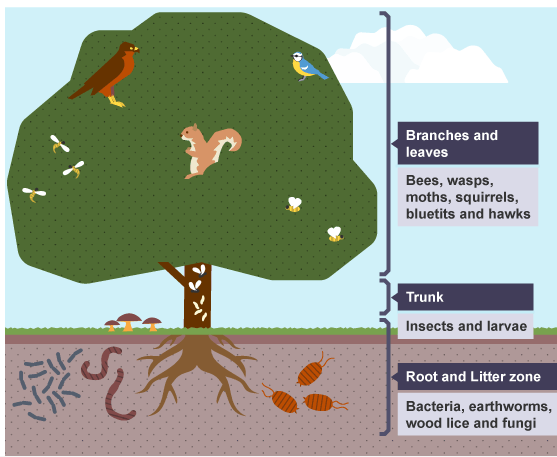
When multiple populations of different species live together and interact in the same habitat, they form a community. The populations within a community are often dependent on each other for survival.
Note
Species: An individual organism belongs to a species, which is a group of similar organisms capable of interbreeding.
Note
Habitat: The specific environment where an organism lives.
Note
Population: A group of individuals of the same species living in a habitat.
Competition
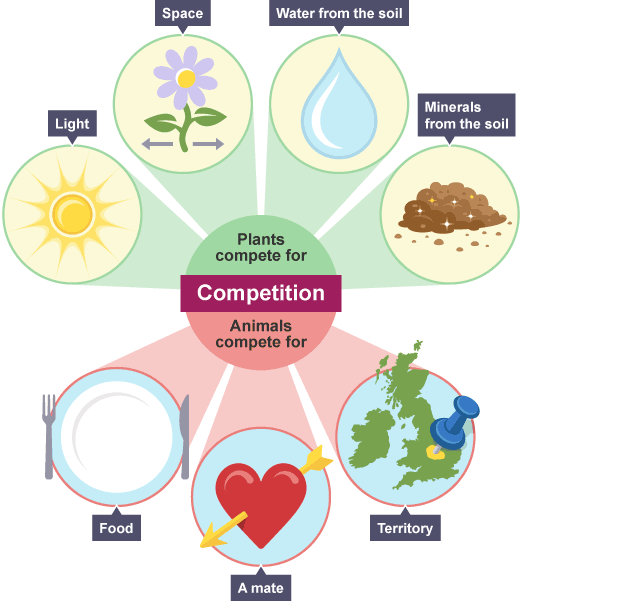
Organisms within a community often compete for the same resources.
-
Intraspecific competition: Competition within the same species.
-
Interspecific competition: Competition between different species. Plants may compete for:
-
Light: Needed for photosynthesis.
-
Space: To grow and spread out.
-
Water: Essential for all biological processes.
-
Mineral ions: Needed for growth, like nitrates for making proteins. Animals may compete for:
-
Space (territory): To live and raise offspring.
-
Food: Necessary for energy and growth.
-
Water: Vital for survival.
-
Mates: To reproduce and pass on genes.
Interdependence
Interdependence is the way in which organisms in a community depend on each other for survival.
- Vital Services:
- Food: Some species are food for others.
- Shelter: Some organisms provide shelter or protection for others.
- Reproduction: Involves processes like pollination and seed dispersal. For example, bees pollinate flowers, while birds may help in spreading seeds. The removal or addition of a species can greatly impact the entire community. For example, changing the number of predators can alter the population sizes of prey species, leading to a ripple effect throughout the community.
Stable Communities
A stable community is one where all biotic (living) and abiotic (non-living) factors are in balance, resulting in population sizes that remain relatively constant over time. Stable communities are often hard to replace once lost.
Examples of stable communities:
- Tropical rainforests
- Oak woodlands
- Coral reefs
Note
Ecosystem: This is the interaction of a community with the non-living (abiotic) parts of the environment, such as water, temperature, and soil. Organisms are adapted to their specific environment, which influences their survival and reproduction.
Abiotic Factors
Note
Abiotic factors are non-living elements of the environment that can influence the survival and growth of organisms within a community. Changes in these factors can have significant effects on ecosystems.
Key Abiotic Factors and Their Effects on Communities
- Light Intensity
- Light is essential for photosynthesis in plants.
- The rate of photosynthesis affects plant growth, which in turn influences the availability of food and shelter for other organisms.
- Impact: Changes in light intensity can affect plant populations and the species that depend on them.
- Temperature
- Temperature influences the rate of enzyme activity and, consequently, metabolic processes in organisms.
- Impact: Fluctuations in temperature can affect reproduction, growth rates, and seasonal behaviours such as migration and hibernation.
- Moisture Levels
- Water is crucial for the survival of all living organisms as it is involved in various biological processes.
- Impact: Low moisture levels can limit plant growth, leading to a decrease in food and habitat for animals.
- Soil pH and Mineral Content
- Soil pH affects the rate of decay and the availability of mineral ions, which are vital for plant nutrition.
- Different plant species have varying requirements for soil pH and nutrients.
- Impact: Changes in soil composition can affect plant distribution and health, influencing the entire ecosystem.
- Wind Intensity and Direction
- Wind affects the rate of transpiration (the movement of water from roots to leaves) in plants.
- Transpiration is important for temperature regulation in plants and the distribution of water and minerals.
- Impact: High wind intensity can increase water loss, affect plant growth, and influence seed and pollen dispersal.
- Carbon Dioxide (CO₂) Levels
- CO₂ is necessary for photosynthesis in plants.
- Different organisms may thrive in varying CO₂ concentrations.
- Impact: Increased CO₂ levels can enhance plant growth but also affect the distribution of species that require specific CO₂ levels.
- Oxygen Levels for Aquatic Animals
- Oxygen levels in water can vary greatly, unlike in air, due to temperature and water movement.
- Most fish and other aquatic organisms require a high concentration of dissolved oxygen for respiration.
- Impact: Low oxygen levels can lead to decreased survival rates for aquatic life, affecting the entire aquatic food chain.
Biotic Factors
Note
Biotic factors are living components of an ecosystem that can influence the survival, reproduction, and distribution of organisms within a community. Understanding these factors helps explain changes in population sizes and community structure.
Key Biotic Factors and Their Effects on Communities
- Food Availability
- The amount of food available in an ecosystem directly affects the population size of organisms.
- Impact: When food is plentiful, organisms can breed more successfully, leading to an increase in population. Conversely, a shortage of food can cause populations to decline.
- New Predators
- The introduction of a new predator to an ecosystem can have a significant impact on existing species.
- Impact: New predators can reduce the population of prey species, potentially leading to their decline or even extinction if they cannot adapt or escape.
- New Pathogens
- Pathogens are disease-causing organisms like bacteria, viruses, or fungi.
- Impact: If a new pathogen is introduced to a community, the population may have no immunity or resistance to it, leading to rapid spread of disease and potentially wiping out large portions of the population.
- Competition
- Competition occurs when different species or individuals within a species vie for the same resources, such as food, water, or territory.
- Impact: If one species is better adapted to the environment than another, it will outcompete the less adapted species. This can lead to a decline in the population of the less adapted species, sometimes to the point where they cannot reproduce and may face local extinction.
Environmental changes
The environment changes all the time due to abiotic & biotic factors which affect the community
- Population size can decrease/ increase
- Distribution of population may change
Parasitism and Mutualism
Note
The survival of some organisms is closely linked to their interactions with other species through relationships such as parasitism and mutualism. These relationships demonstrate how species rely on one another for survival, either in a beneficial or harmful way.
Parasitism:
In parasitism, one organism (the parasite) benefits at the expense of another organism (the host). The parasite relies on the host for survival, often causing harm to the host in the process. However, parasites generally do not kill their hosts immediately, as their survival depends on the host remaining alive for as long as possible.
Example: Fleas on a dog
-
Fleas (parasites) feed on the blood of the dog (host). While the fleas benefit by getting nutrients, the dog may suffer from irritation, blood loss, and potential infections. Example: Tapeworms in humans
-
Tapeworms live inside the intestines of humans or other animals, absorbing nutrients from the host's food. The host may suffer from malnutrition, weight loss, and other health problems.
Note
In parasitic relationships, the parasite depends on the host for resources like food and shelter, while the host is harmed, although the parasite typically does not intend to kill the host.
Mutualism:
Note
In mutualism, both organisms involved benefit from the relationship. This type of interaction is crucial for the survival of both species, as they rely on each other to gain resources or services that they wouldn't be able to obtain on their own.
- Example: Bees and flowering plants
- Bees collect nectar from flowers for food (benefit to bees), and in the process, they pollinate the plants (benefit to the plant), which is essential for plant reproduction.
- Example: Clownfish and sea anemones
- The clownfish gains protection by living among the sea anemone's stinging tentacles (benefit to the clownfish), while the sea anemone benefits as the clownfish attracts prey and keeps the area clean of debris (benefit to the sea anemone). In mutualistic relationships, both species are interdependent and benefit from the association, making it crucial for their continued survival.
| Mutualism | Parasitism |
|---|---|
| Relationship between two organisms where both benefit | Parasites live very close to host species (in/on them) & take what they need to survive but the host doesn't benefit |
| Bees & flowering plants Bees• get food (nectar) Flowers• able to reproduce due to bees spreading nectar | Fleas & mammals (dogs) Flea• feeds on host but don't return anything |
Biomes:
- Forest biome
- Aquatic biome
- Desert biome
- Tundra biome
- Grassland biome