Exchange of materials (Edexcel GCSE Biology): Revision Notes
📚Revision Notes
Exchange of materials
Note
Organisms must exchange substances with their environment to survive. These substances include oxygen, carbon dioxide, water, dissolved food molecules, mineral ions, and urea. Transporting these substances efficiently is crucial for their functioning, and different organisms have evolved systems to handle this exchange based on their size and complexity.
Note
Substances that Need to be Exchanged:
- Oxygen: Required for aerobic respiration, which releases energy for cells.
- Carbon Dioxide: A waste product of respiration, which must be removed from cells to avoid toxicity.
- Water: Essential for many chemical reactions, as well as maintaining cell structure.
- Dissolved Food Molecules: Nutrients like glucose, amino acids, and fatty acids are transported to cells for energy and growth.
- Mineral Ions: Such as sodium, potassium, and calcium, which are needed for various cellular functions.
- Urea: A waste product formed from the breakdown of excess amino acids in the liver, which must be removed from the body to prevent toxic buildup.
Unicellular Organisms:
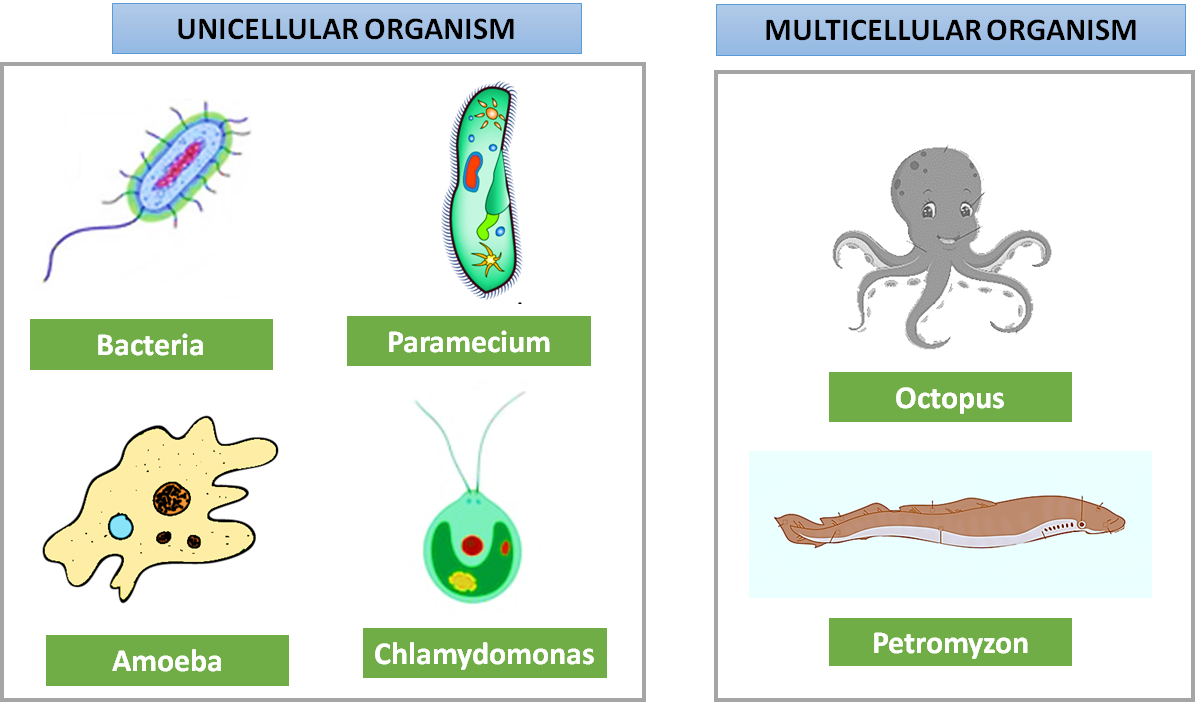
- Single-celled organisms, like amoeba, have a large surface area (SA) relative to their volume (a high surface area to volume ratio).
- This means that substances can easily diffuse into and out of the cell directly through the cell membrane.
- Because of their small size, diffusion, osmosis, and active transport are sufficient to meet their needs, so they do not require specialised transport systems.
Multicellular Organisms:
- Multicellular organisms (such as humans) are larger and more complex than single-celled organisms. As a result, they have a smaller surface area to volume ratio.
- In these organisms, the distance between the surface of the organism and its internal cells is too large for diffusion alone to provide all necessary substances.
- As a result, multicellular organisms require specialised exchange surfaces and transport systems to meet the demands of all cells.
Transport Systems:
Animals:
-
The circulatory system transports substances like oxygen, carbon dioxide, nutrients, and waste products around the body.
-
The blood carries these substances to and from cells, ensuring that all cells receive oxygen and nutrients while waste products like urea are removed. Plants:
-
The xylem transports water and mineral ions from the roots to the rest of the plant.
-
The phloem transports sugars and amino acids produced in the leaves to other parts of the plant.
The Need for Exchange Surfaces in Multicellular Organisms:
Note
Because larger organisms have a smaller surface area to volume ratio, they require exchange surfaces to efficiently transport substances into and out of their bodies.
| Cell | Rate of exchange |
|---|---|
| Single celled | Can diffuse directly into the cell across membrane, because of large surface area compared to volume ratio so enough can be diffused to supply the cell |
| Multi celled | Smaller surface area compared to volume. Makes it difficult to exchange substances across membrane. • Has to supply entire volume across outside surface area alone. • Require mass transport system to exchange substances across the whole body. |
Exchange Surfaces in Animals:
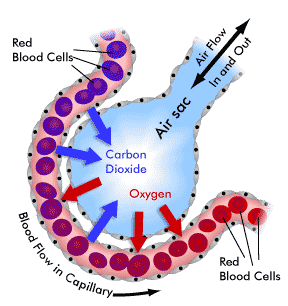
- Lungs and Alveoli: These are specialised for gas exchange. Oxygen moves from the air into the blood, and carbon dioxide moves from the blood into the air.
- Small Intestine and Villi: The villi in the small intestine absorb dissolved food molecules (like glucose and amino acids) from digested food into the bloodstream.
Exchange Surfaces in Plants:
- Roots and Root Hairs: Water and mineral ions are absorbed from the soil through the root hairs, which increase the surface area for absorption.
- Leaves: Gases are exchanged through small openings called stomata, where oxygen and carbon dioxide move in and out of the plant for photosynthesis and respiration.
Properties of Effective Exchange Surfaces:
To maximise the efficiency of diffusion, osmosis, and active transport, exchange surfaces in multicellular organisms are adapted in the following ways:
- Large surface area: Maximises the amount of substance that can diffuse at one time.
- Thin barriers: Provides a short diffusion path, allowing substances to move quickly between regions.
- Good blood supply: In animals, exchange surfaces like the alveoli are surrounded by blood vessels, ensuring that substances can be transported quickly to and from cells.
- Ventilation: In animals, well-ventilated gas exchange surfaces (such as the lungs) maintain a concentration gradient, allowing oxygen and carbon dioxide to diffuse more effectively.
Surface Area to Volume Ratio:
The surface area to volume ratio (SA
) is a measure of how much surface area an organism has relative to its volume. As organisms increase in size, their SA ratio decreases, making diffusion alone insufficient for transporting substances. The SA ratio can be calculated for simple shapes like cubes:- Surface Area (SA): The total area of all surfaces of the shape.
- Volume (V): The total amount of space occupied by the shape.
- SA Ratio = Surface Area ÷ Volume A smaller organism, like a single cell, has a higher SA ratio, which allows substances to diffuse in and out quickly. Larger organisms have a lower SA ratio, necessitating specialised exchange surfaces and transport systems.
Note
A hippo can be represented by a 2 cm × 4 cm × 4 cm block.
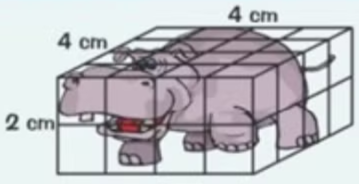
The area of a surface is found by the equation: .
So the hippo's total surface area is:
The volume of a block is found by the equation: .
So the hippo's volume is:
The surface area to volume ratio of the hippo can be written as 64 : 32.
To get the ratio in the form , divide both sides of the ratio by the volume.
So the surface area to volume ratio of the hippo is 2 : 1.
A mouse can be represented by a 1 cm × 1 cm × 1 cm block.
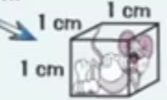
Its surface area is:
Its volume is:
So the surface area to volume ratio of the mouse is 6 : 1.
The cube mouse's surface area is six times its volume, but the cube hippo's surface area is only twice its volume.
So the mouse has a larger surface area compared to its volume.
Summary:
- Organisms need to exchange essential substances like oxygen, carbon dioxide, water, nutrients, and waste products with their environment.
- Single-celled organisms rely on simple processes like diffusion due to their high surface area to volume ratio.
- Multicellular organisms, however, require specialised exchange surfaces and transport systems due to their lower surface area to volume ratio.
- Efficient exchange surfaces in animals and plants are adapted with features like large surface area, thin membranes, and blood supply to optimise the transport of substances.