Darwin and Wallace (Edexcel GCSE Biology): Revision Notes
📚Revision Notes
Darwin and Wallace
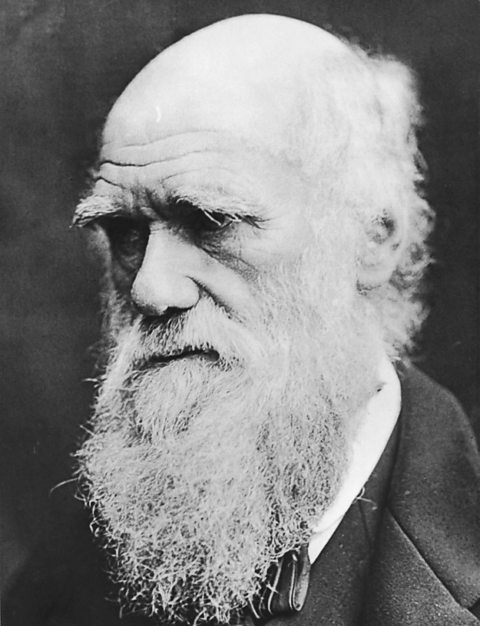
Charles Darwin
- Charles Darwin was a pioneering scientist and naturalist who proposed the theory of evolution.
- His ideas were based on extensive experimentation, observations during his voyage on the HMS Beagle, and his studies of geology and fossils.
- He published his ground breaking work, "On the Origin of Species," in 1859, which introduced the concept of natural selection.
Theory of Evolution
-
Variation within species arises from mutations in DNA, leading to differences in traits among individuals.
-
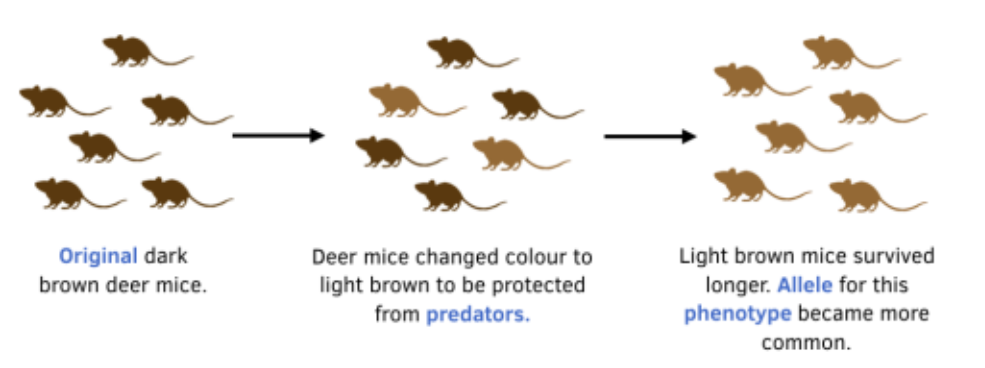
Natural Selection (often referred to as "survival of the fittest"): Organisms with traits best suited to their environment are more likely to survive, reproduce, and pass on these advantageous traits to their offspring.
-
Over many generations, the frequency of alleles (versions of a gene) that confer these beneficial traits increases in the population, leading to evolutionary change.
Controversy Surrounding Darwin's Ideas
Darwin's theory was met with significant resistance due to several factors:
- Religious Beliefs: His theory challenged the widely held belief that God created all species as they are.
- Lack of Evidence: At the time, there was limited evidence and understanding of how species changed over time.
- Unknown Mechanisms: The concepts of genetic inheritance and variation were not understood during Darwin's era.
Alternative Theories: Jean-Baptiste Lamarck
- Lamarck's Hypothesis: Jean-Baptiste Lamarck proposed that traits acquired during an organism's lifetime could be passed on to its offspring. He believed that repeated actions could enhance certain characteristics, which would then be inherited.
Example
EXAMPLE Lamarck suggested that a giraffe's neck would become longer over its lifetime by stretching to reach higher leaves, and this longer neck would be passed on to its offspring.
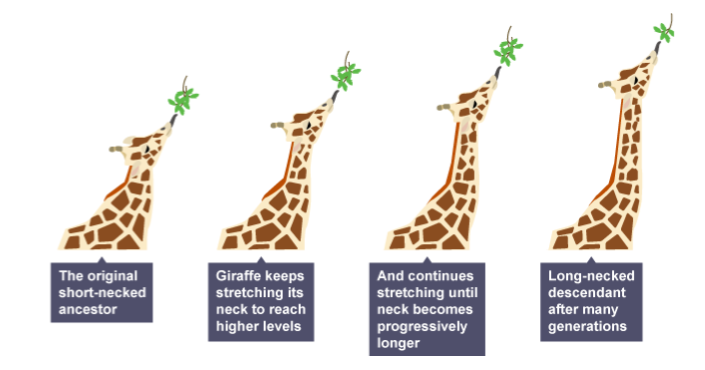
- Refutation: Lamarck's theory was eventually disproven when it was understood that only genetic information in sex cells (not traits acquired during an organism's life) is passed on to the next generation.
Supporting Evidence for Darwin's Theory
- Genetics: The discovery of genetics provided a mechanism for how beneficial traits, caused by mutations, could be inherited.
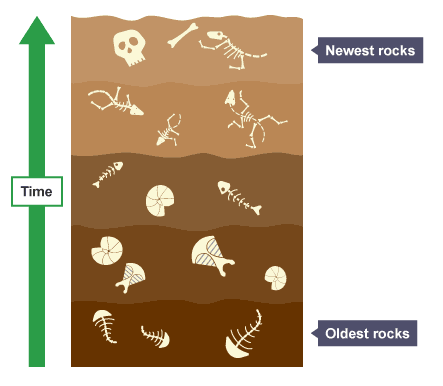
- Fossil Record: Fossil evidence supported Darwin's theory by showing gradual changes in species over time, illustrating the process of evolution.
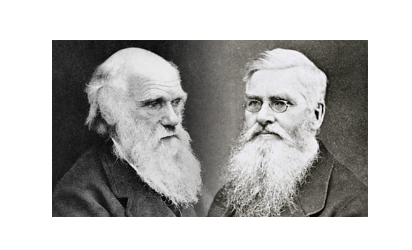
They developed the theory of evolution by natural selection
Alfred Russel Wallace
Alfred Russel Wallace was a scientist working at same time as Darwin. He also came up with the idea of natural selection independently of Darwin. • Darwin and Wallace published evolution theory together and acknowledged each other's work although they didn't agree with the mechanisms involved in natural selection. • Wallace's observation made a big impact in evolution. Eg. Realised warning colours are used by some species (butterflies) to deter predators from eating them. This is an example of useful characteristic involved in natural selection. • Darwin's famous book "On the Origin of Species" made scientists realise the discovery and famously we know Darwin; however, Wallace had an impact too.
Influence of evolution in modern technology
- Theory of evolution still relevant today-helps us understand many aspects of biology.
- Life changes because of evolution as we have all descended from a common ancestor This has affected many areas of biology including:
Classification-
If we have all descended from a common ancestor we all must be related in some way. We know classify organism by how closely related we are to them.
Antibiotic resistance-
Now understand the importance of finishing the course of drugs to prevent resistant bacteria and know we know we have to constantly develop new antibiotics to fight old evolved ones.
Conservation-
We understand the importance of genetic diversity and how it helps populations adapt to changing environments . Led to conservation projects to protect species.