More evidence for evolution (Edexcel GCSE Biology): Revision Notes
📚Revision Notes
More evidence for evolution
Development of stone tools provides evidence
- Different Homo species continue to evolve . Can tell this because they started using stone tools and gradually became more complex (so brain getting larger): Not just fossils- you can find human evidence from the tools they used too.
Ancient stone tool or hominid tool found in different ways and how old it is :
- Looking at structural features of the tool or fossil. (Simpler tools older then complex)
- Stratigraphy - study of rock layers. Older rock layers found below younger layers, so tools/fossils in deeper rock are generally older
- Stone tools often found with carbon containing material eg. wooden handle Carbon 14 dating can be used to date this material
| Homo species | Tool use |
|---|---|
| Homo habilis (2.5-1.5 millions years ago) | Made simple stone tools called pebble tools by hitting rocks together= sharp flakes. Could also scrape meat from bones/crack bones open |
| Homo erectus (2-0.3 million years ago) | Sculpted rocks into shapes to produce more complex tools eg. simple hand axes. Used for hunting dig, chop and scrape meat from bones |
| Homo Neanderthalis (300000-25000 years ago) | More complex tools. Evidence of flint tools, pointe tools and wooden spears |
| Homo Sapiens (200000• now years ago) | Flint tools widely uses (arrowheads), fish hooks, buttons and needles appeared 50000 years ago |
Pentadactyl limb- evidence for evolution
- Pentadactyl limb is 5 digits
- You can see it in many species eg. mammals, reptiles
- In each of these species limb has similar bone structure but different function. Eg. humans hand and bats wing are both pentadactyl limb ...
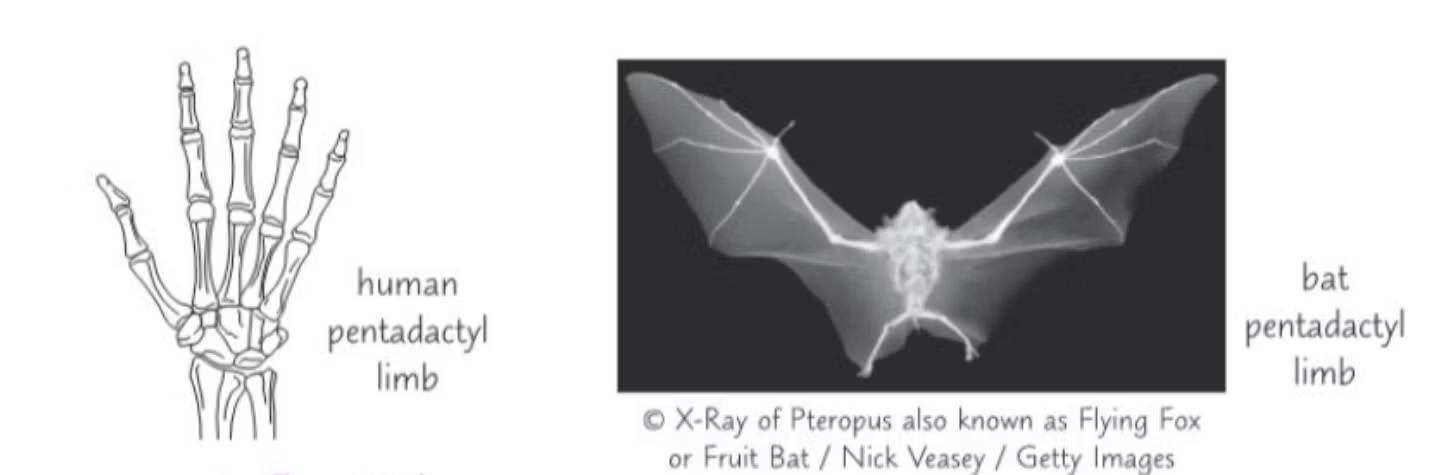
We can't fly?
- Similarity of bone structure provides evidence that species with this limb have all evolved from a common ancestor (that had a pentadactyl limb)
- -If they all evolved from different ancestors it is unlikely we had the same structure
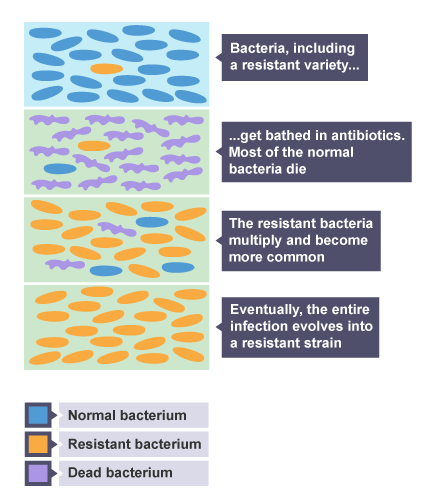
Antibiotic Resistance in Bacteria:
- Antibiotic resistance occurs when bacteria evolve in response to the selective pressure exerted by the use of antibiotics.
- Mutations in bacterial DNA can lead to resistance, allowing those bacteria to survive and reproduce in the presence of antibiotics.
- Over time, these resistant strains become more common, providing a real-time example of natural selection and evolutionary change in response to environmental pressures.