Alcohols (Edexcel GCSE Chemistry Combined Science): Revision Notes
📚Revision Notes
Alcohols
Note
Alcohols are a group of organic compounds that contain the –OH functional group (called a hydroxyl group).
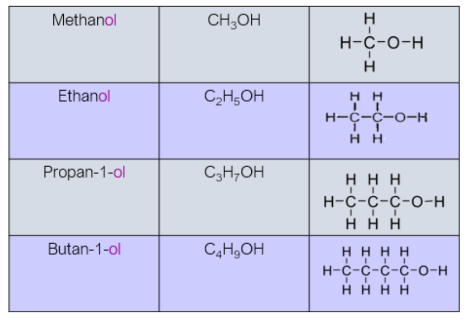
Alcohols as a Homologous Series
Note
Alcohols form a homologous series, meaning they have similar chemical properties and a regular pattern in their structure and physical properties. In this series:
-
Same general formula: All alcohols follow the formula CₙH₂ₙ₊₁OH, where n represents the number of carbon atoms.

-
Gradual change in physical properties: As the number of carbon atoms increases, the boiling points of alcohols gradually increase.
-
Similar chemical properties: All alcohols react in similar ways due to the –OH functional group.
-
Differ by CH₂ units: Each alcohol differs from the next by a CH₂ unit.
The Functional Group
Note
The key feature of alcohols is the hydroxyl group (–OH), which gives alcohols their typical reactions.
- Note: The –OH group in alcohols is not the same as the hydroxide ion (OH⁻) found in bases.
Note
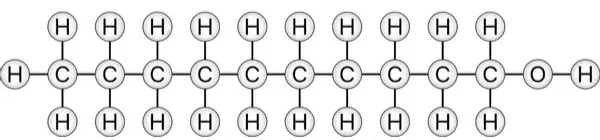
Worked Example: Decanol
Decanol is an alcohol with 10 carbon atoms. To predict its formula:
- Using the general formula CₙH₂ₙ₊₁OH, substitute n = 10:
- The hydrogen atoms: 2n + 1 = (2 × 10) + 1 = 21.
- So, the formula for decanol is C₁₀H₂₁OH.