Homologous series (Edexcel GCSE Chemistry Combined Science): Revision Notes
📚Revision Notes
Homologous series
Note
A homologous series is a family of organic compounds that share similar features and follow a regular pattern. These compounds are important in chemistry because they have predictable properties and similar reactions.
Key Features of a Homologous Series:
Note
- Same functional group:
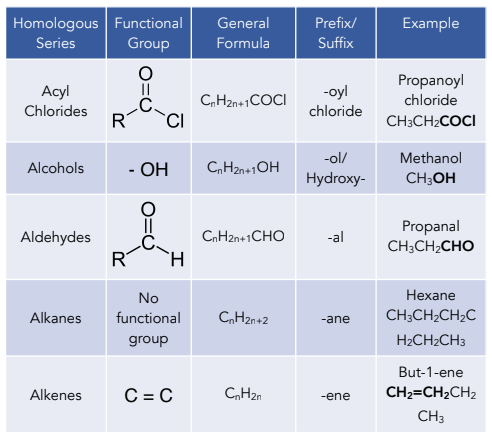
- All members of a homologous series have the same functional group, which is the part of the molecule that determines how it reacts. For example, alcohols all contain the OH group, which is responsible for their similar reactions.
Note
- Similar chemical properties:
- Because they have the same functional group, members of a homologous series behave in similar ways in chemical reactions. For example, all alcohols react with sodium to produce hydrogen gas.
Note
- Each member differs by CH₂:
- Each successive compound in the series differs by a CH₂ group. For example, methane (CH₄), ethane (C₂H₆), and propane (C₃H₈) are all part of the alkane series, with each one being larger by one carbon atom and two hydrogen atoms than the last.
Note
- Gradual change in physical properties:
- As you go up the series, there is a gradual change in physical properties. For example, as the molecules get bigger, their boiling points increase. This happens because larger molecules have more surface area, so it takes more energy (heat) to separate them.
Note
- Same general formula:
- Every compound in a homologous series follows a general formula. For example, alkanes have the general formula CnH₂n+₂, where 'n' is the number of carbon atoms.
Isomers
Note
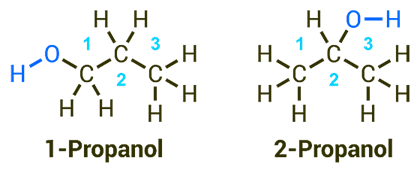
Isomers are compounds that have the same molecular formula (same number and type of atoms) but a different structural formula (atoms are arranged differently).
For example:
- Propan-1-ol and Propan-2-ol both have the formula C₃H₈O, but in Propan-1-ol, the OH group is attached to the first carbon, while in Propan-2-ol, it is attached to the second carbon.
Note
Important Fact:
All members of a homologous series react in similar ways because they have the same functional group. For example, all alcohols (with an -OH group) will react similarly in chemical reactions like combustion.