Catalysts (Edexcel GCSE Chemistry Combined Science): Revision Notes
📚Revision Notes
6.1.8 Catalysts
Note
A catalyst is a substance that participates in a chemical reaction but remains unchanged at the end of the reaction. Although it interacts with the reactants, it is not consumed and is typically regenerated, allowing it to be reused in multiple reaction cycles. For this reason, catalysts are not included in the overall balanced chemical equation.
Role of Catalysts:
Catalysts are used to speed up chemical reactions. They achieve this by providing an alternative reaction pathway with a lower activation energy compared to the reaction without a catalyst.
- Activation Energy: The minimum energy that reacting particles must have for a reaction to occur.
- By lowering the activation energy, catalysts increase the number of particles that have enough energy to successfully react when they collide. This results in a higher frequency of successful collisions and, consequently, a faster reaction rate.
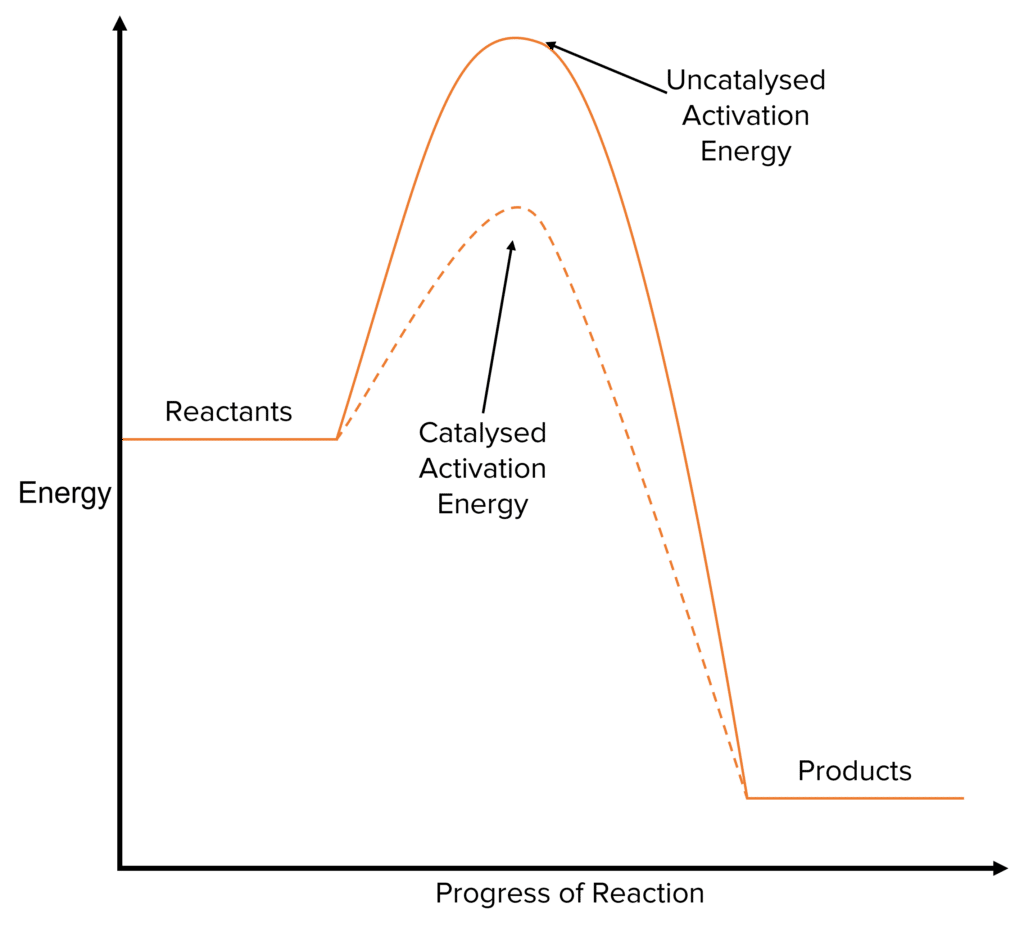
Applications of Catalysts:
- Industrial Use: Catalysts are widely employed in the chemical industry to accelerate reactions that would otherwise proceed too slowly to be practical for manufacturing processes.
- Biological Catalysts: In nature, enzymes act as biological catalysts, facilitating vital biochemical reactions in living organisms. Enzymes play a crucial role in processes such as digestion, respiration, and DNA replication.