Wired versus wireless (Edexcel GCSE Computer Science): Revision Notes
📚Revision Notes
Wired versus wireless networks
What are transmission media?
Transmission media are the communication channels that carry data between devices on a network. Think of them like roads that allow information to travel from one place to another. There are two main types: wired and wireless transmission media.
Wired transmission
Wired networks use physical cables to connect devices together. The two most common types of cables are copper wire and fibre-optic cable, and each has different strengths and weaknesses.
Copper wire cables
Copper wire cables are made from thin strands of copper metal. They're the traditional choice for network connections and transmit data as electrical pulses. You might have seen these as Ethernet cables that plug into your computer or router.
Note
Copper wire cables have been the backbone of networking for decades, but they do have limitations in terms of range and susceptibility to electrical interference.
Fibre-optic cables
Fibre-optic cables are the modern alternative to copper wire. They're made from incredibly thin strands of glass that transmit data as pulses of light. While they offer significant advantages over copper, they are much more expensive and fragile because they're made of glass.
Comparing copper wire and fibre-optic cables
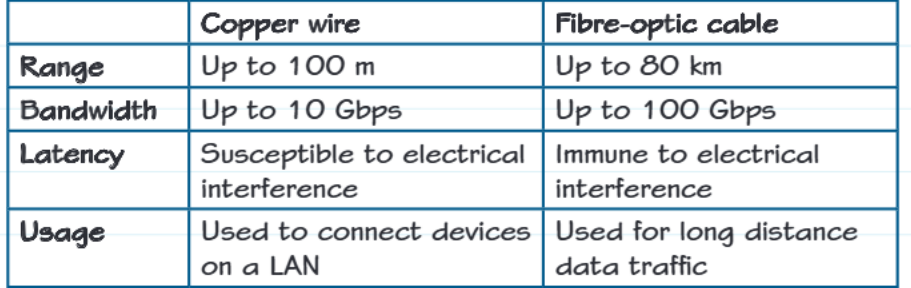
Let's break down what these technical terms mean:
Note
Understanding Key Network Terms:
- Range is the distance over which data can be transferred
- Bandwidth is the volume of data that can be transferred, measured in bits per second (bps)
- Latency is the time lag between data leaving its source and arriving at its destination, measured in milliseconds
- Electrical interference can slow down or disrupt data transmission
Key advantages of fibre-optic over copper:
- Much longer range (80km vs 100m)
- Higher bandwidth (100 Gbps vs 10 Gbps)
- No electrical interference problems
- Perfect for long-distance data traffic
When to use each:
- Copper wire: Connecting devices within a Local Area Network (LAN)
- Fibre-optic: Long-distance connections and high-speed internet backbones
Wireless transmission
Wireless transmission uses radio waves to transmit data through the air - no cables needed! Wi-Fi is the most well-known wireless technology, but there are several others designed for different purposes.
Comparing wireless technologies
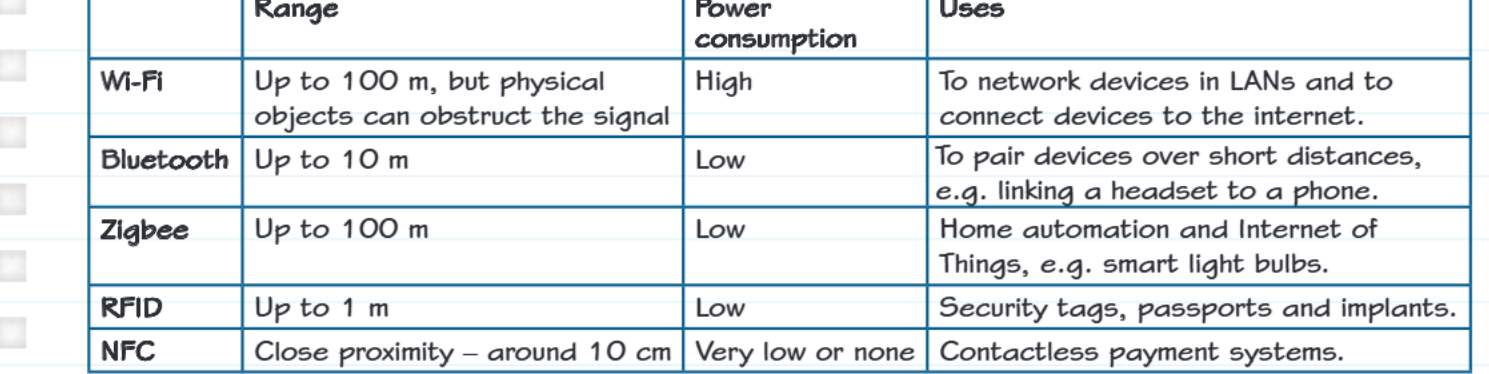
Each wireless technology is designed for specific uses:
Wi-Fi is perfect for home and office networks. It has good range (up to 100m) but physical objects like walls can block the signal. However, it uses high power consumption.
Bluetooth is ideal for connecting devices over short distances, like linking your headphones to your phone. It uses low power and works within 10 metres.
Zigbee is specially designed for smart home devices and Internet of Things applications. It's great for devices like smart light bulbs because it uses very little power and can reach up to 100m.
RFID (Radio Frequency Identification) works over very short distances (up to 1m) and is commonly used in security tags, passports, and even implants for pets.
NFC (Near Field Communication) requires devices to be almost touching (around 10cm apart). It's perfect for contactless payments because it uses virtually no power and is very secure.
Important
Power Consumption Considerations: When choosing wireless technologies, always consider the power requirements. Battery-powered devices need low-power options like Bluetooth or Zigbee, while mains-powered devices can use higher-power technologies like Wi-Fi.
Worked example: RFID in passports
Example
Worked Example: RFID in Passports
Question: The UK uses RFID-embedded passports. Explain two reasons why RFID is suitable for this purpose. (4 marks)
Step 1: Identify the key characteristics of RFID technology
- Wireless data transmission
- Short range (up to 1m)
- No physical connection required
Step 2: Relate these characteristics to passport applications
Answer: RFID is suitable for passports because there's no need for a physical cable connection - data is transmitted wirelessly between the RFID chip and reader. This makes the process quick and convenient at border control.
Additionally, the risk of data being intercepted by unauthorised parties is reduced because the chip and reader must be within 1 metre of each other to transfer data. This short range provides built-in security.
Exam tips
Important
Common exam questions:
- Compare wired vs wireless technologies
- Explain why certain technologies are chosen for specific applications
- Calculate bandwidth or discuss latency issues
Key strategies:
- Always explain why a technology is suitable for its use case
- Remember that fibre-optic is faster and longer range but more expensive
- Consider power consumption when discussing wireless technologies
- Think about security implications of different transmission methods
Summary
Key Points to Remember:
- Wired connections use physical cables (copper wire or fibre-optic) and are generally more reliable and secure
- Fibre-optic cables beat copper wire in almost every technical measure but cost more
- Wireless technologies each have specific ranges and power requirements designed for different applications
- Range, bandwidth, and latency are the key technical specifications to compare transmission media
- RFID and NFC are short-range technologies perfect for security and payment applications