River valley changes (Edexcel GCSE Geography A): Revision Notes
📚Revision Notes
River valley changes
Rivers undergo significant transformations as they flow from their source in mountainous areas down to their mouth where they meet the sea. Understanding these changes is crucial for appreciating how landscapes are shaped by flowing water over time.
Understanding river profiles
The long profile of a river demonstrates how the elevation changes as water flows downstream from its source to its mouth. This profile creates a distinctive curved shape that tells an important story about river behaviour.
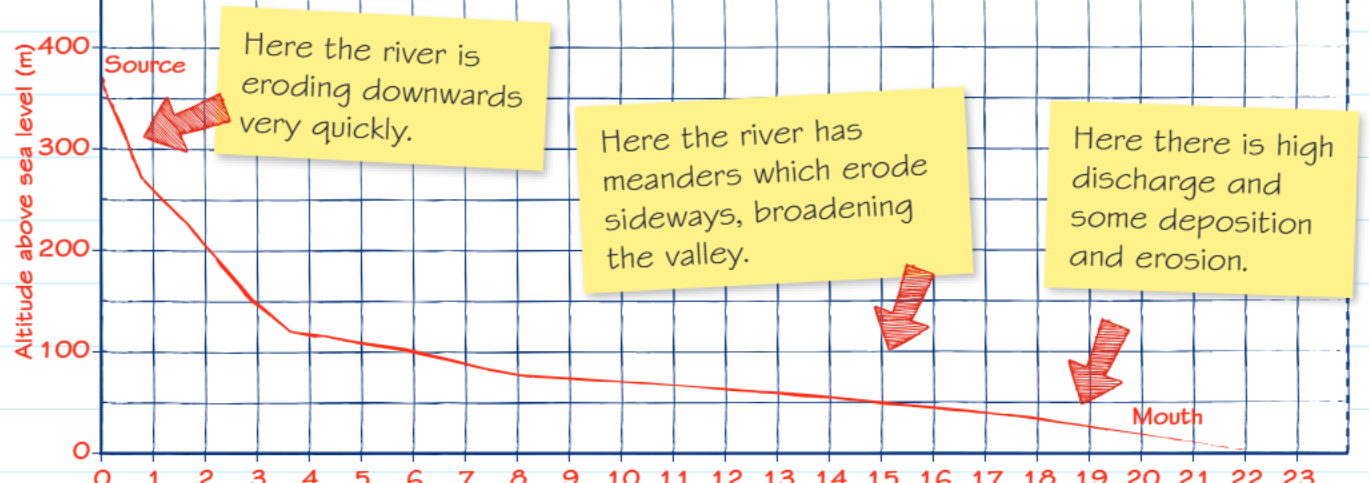
At the source, rivers begin at high elevations, often in mountainous regions where the gradient is extremely steep. As the river progresses towards the sea, this gradient gradually becomes much gentler, creating the characteristic curved appearance when plotted on a graph.
Note
The Nant Peris river in North Wales provides an excellent example of this pattern, starting at around 400 metres above sea level and descending to sea level over approximately 23 kilometres.
The long profile reveals three distinct zones where different processes dominate. Near the source, rapid downward erosion carves deep valleys as the river cuts through the landscape. In the middle sections, the river begins to meander and erode sideways, which gradually broadens the valley. Finally, near the mouth, high discharge combined with both erosional and depositional processes creates distinctive lowland features.
How rivers change along their course
Rivers display dramatically different characteristics as they flow from their source to their mouth. These changes reflect the varying conditions and processes that occur in different parts of the river system.
Upper course characteristics
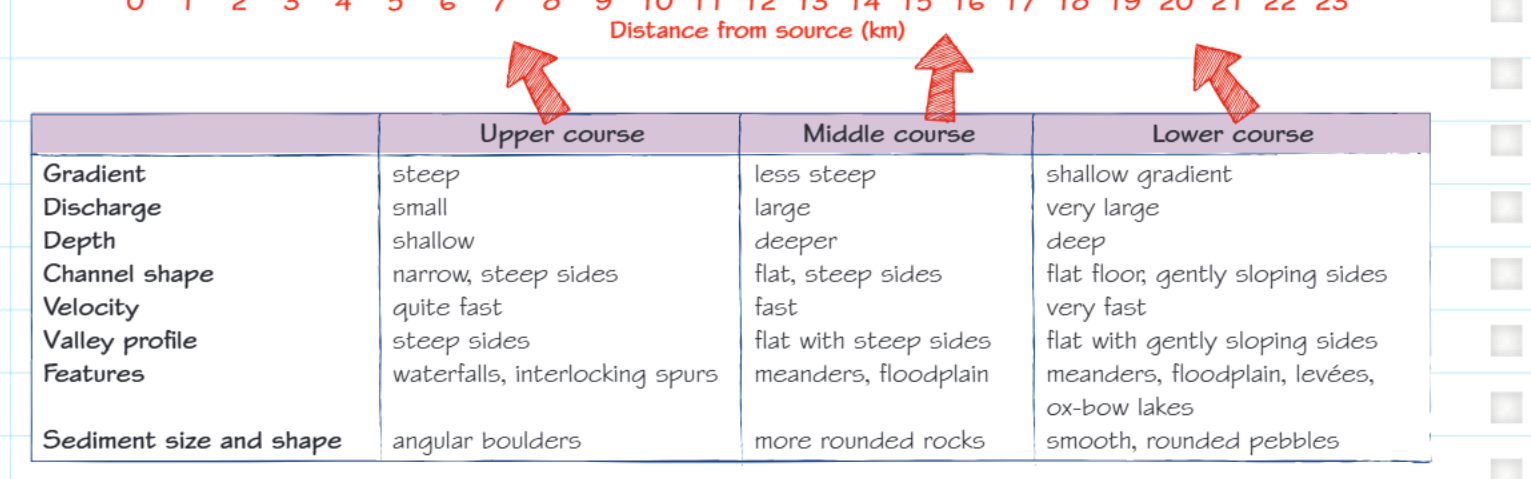
In the upper course, rivers are characterised by steep gradients that create powerful downward erosion. The discharge remains relatively small since the river is still gathering water from tributaries. Channels tend to be narrow with steep sides, and despite the steep gradient, the velocity can be quite fast due to the rough channel bed that reduces friction.
Important
The valley profile in this section features steep sides, creating dramatic V-shaped valleys. This distinctive shape is the direct result of vertical erosion cutting downwards through the landscape.
Distinctive features include spectacular waterfalls where the river plunges over resistant rock layers, and interlocking spurs where the river winds around protruding ridges of land. The sediment carried by the river consists mainly of angular boulders that have been recently broken from the valley sides.
Middle course characteristics
As rivers enter their middle course, several important changes occur. The gradient becomes less steep, allowing the river to develop different erosional patterns. Discharge increases significantly as more tributaries join the main channel, providing greater volumes of water.
The channel becomes deeper and develops a flatter bed with steep sides, while velocity increases due to the smoother channel bed and greater water volume. The valley profile begins to flatten with steep sides giving way to more gentle slopes.
Note
Lateral erosion becomes the dominant process, creating distinctive meandering patterns as the river swings from side to side. These meanders gradually broaden the valley floor, creating the first floodplains.
The sediment becomes more rounded as rocks are carried further and subjected to continued abrasion.
Lower course characteristics
In the lower course, rivers develop their most distinctive characteristics. The gradient becomes very shallow, creating ideal conditions for both erosion and deposition. Discharge reaches its maximum as the river carries water from its entire catchment area.
Channels become very deep with flat floors and gently sloping sides, maximising the river's capacity. Velocity reaches its peak due to the large volume of water and extremely smooth channel beds. The valley profile becomes completely flat with very gentle slopes extending far from the river channel.
The lower course features extensive meanders that create broad floodplains during flood events. Distinctive landforms include levées (natural embankments built up by repeated flooding) and ox-bow lakes (curved lakes formed when meanders are cut off from the main channel). Sediment consists of smooth, rounded pebbles that have been transported long distances and thoroughly worn down by constant movement.
Valley shape differences between upper and lower courses
One of the most striking differences between river courses is the dramatic change in valley shape, which directly reflects the dominant erosional processes operating in each section.
In the upper course, valleys exhibit steep sides because the river focuses its energy on cutting downwards through the landscape. This vertical erosion creates the characteristic V-shaped valleys associated with mountainous regions. The river acts like a powerful cutting tool, slicing through rock and creating narrow, deep valleys with little flat land beside the channel.
Important
In contrast, the lower course produces much flatter valleys with gently sloping sides. Here, the river's energy is directed sideways rather than downwards, causing lateral erosion that gradually widens the valley.
Over thousands of years, this sideways cutting action creates broad, flat valleys with extensive floodplains on either side of the meandering channel.
Summary
Key Points to Remember:
- Rivers have curved long profiles that are steep near the source and gentle near the mouth, reflecting changing gradients and processes
- The upper course is dominated by vertical erosion creating V-shaped valleys, waterfalls, and interlocking spurs with angular boulder sediments
- The middle course shows increased discharge and lateral erosion, developing meanders and floodplains with more rounded sediments
- The lower course features maximum discharge, extensive lateral erosion, and depositional features like levées and ox-bow lakes with smooth, rounded sediments
- Valley shapes change dramatically from steep-sided V-shapes in the upper course to flat, broad valleys in the lower course due to different erosional processes