The Declaration of Independence, 1776 (Edexcel GCSE History): Revision Notes
📚Revision Notes
The Declaration of Independence, 1776
The shift towards independence
By 1775, fighting had erupted between British forces and colonial rebels. This marked a crucial turning point in colonial attitudes. Rather than seeking to repair their relationship with Britain through reforms, the colonists began pursuing complete independence. Two major influences shaped this dramatic shift in thinking: Thomas Paine's influential pamphlet Common Sense and the formal Declaration of Independence itself.
Note
This shift from seeking reforms to demanding complete independence represents one of the most significant changes in colonial thinking during the American Revolution. It marked the point of no return in the relationship between Britain and its American colonies.
The powerful influence of Common Sense
Thomas Paine, originally from England, had relocated to Philadelphia in 1774 after encountering Benjamin Franklin. His groundbreaking pamphlet Common Sense was released on 10 January 1776 and became extraordinarily influential in transforming colonial opinions.
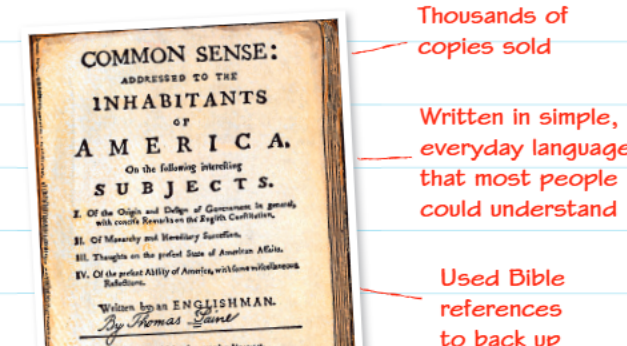
The pamphlet succeeded because Paine presented his case in accessible, everyday language that ordinary people could easily understand. He also incorporated Biblical references to strengthen his arguments, making them more persuasive to religious colonists. Most importantly, thousands of copies were distributed throughout the colonies, ensuring widespread circulation of his ideas.
Note
Paine's three main arguments for independence:
- The British monarchy restricted Parliament's ability to govern effectively
- Independent America would enjoy greater freedoms and gain support from other nations
- A republican system of government, with elected leaders including a president chosen by popular vote, represented the best form of governance
Common Sense helped ease colonists' concerns about their future and convinced many that breaking away from Britain was their only viable option, rather than attempting to modify or overturn existing British legislation.
Thomas Jefferson's crucial role
When the Second Continental Congress (now calling itself simply "Congress") decided to move forwards with independence, they established a Declaration Committee. This committee included five members, with Benjamin Franklin among them.
Thomas Jefferson, a prosperous lawyer from Virginia, received the assignment to draught the Declaration. Jefferson wrote the initial version, which the committee then reviewed and modified. Congress made additional changes before giving final approval to the document on 4 July 1776.
Important
Much of the final Declaration retained Jefferson's original language and ideas, making him the primary author of this historic document. This demonstrates Jefferson's exceptional skill as a writer and his deep understanding of Enlightenment philosophy.
Why the Declaration of Independence mattered
The Declaration of Independence proved significant for several important reasons:
A new approach to political statements: This document differed markedly from previous colonial political declarations because it explicitly demanded independence and introduced the term "United States of America" for the first time.
Enlightenment philosophy foundation: The Declaration's arguments drew heavily on Enlightenment concepts, particularly the idea that all people possess natural rights that governments must protect.
Inspiring colonial support: The Declaration provided colonists with compelling reasons to join the fight against British rule. It presented the prospect of self-governance as the reward for victory, motivating people to support the revolutionary cause.
The three parts of the Declaration
Example
Structure of the Declaration of Independence:
1. The introduction: This opening section became the most famous part of the Declaration. It established the fundamental principle that all people are created equal and possess inherent rights that governments should safeguard.
2. The list of grievances: This middle section detailed the various ways King George III and his government had failed to protect the colonists' rights, providing specific justifications for seeking independence.
3. The conclusion: The final section declared that the United States of America deserved freedom from British rule, since the British government had failed to respect the natural rights of the colonists.
Timeline of key events
Note
Key dates in the path to independence:
- 1774: Thomas Paine moves to Philadelphia and meets Benjamin Franklin
- 10 January 1776: Common Sense is published
- 1776: Congress establishes the Declaration Committee
- 4 July 1776: Congress officially approves the Declaration of Independence
Summary
Key Points to Remember:
- Common Sense was hugely influential because it was written in simple language, used Biblical references, and sold thousands of copies across the colonies
- Thomas Paine's key argument was that a republican government with elected leaders would serve America better than British rule
- Thomas Jefferson wrote the first draught of the Declaration, though it was revised by committee and Congress
- The Declaration was significant because it demanded complete independence, used Enlightenment ideas about natural rights, and motivated colonists to support the war
- The Declaration had three main parts: an introduction about equality and rights, a list of complaints against King George III, and a conclusion declaring America should be free from Britain