The development of penicillin (Edexcel GCSE History): Revision Notes
📚Revision Notes
The development of penicillin
The story of penicillin represents one of the most significant medical breakthroughs of the 20th century. As the first antibiotic to be discovered and successfully developed for widespread use, penicillin revolutionised the treatment of bacterial infections and saved countless lives, particularly during and after World War II.
Discovery of penicillin - Alexander Fleming
The journey began with a fortunate accident in 1928. Alexander Fleming, a Scottish bacteriologist working at St Mary's Hospital in London, made a remarkable observation while studying bacteria in his laboratory. He noticed that bacteria growing in one of his petri dishes were being destroyed by a mysterious mould that had somehow contaminated the dish.
Note
Fleming had worked on the battlefields during the First World War, where he witnessed soldiers dying from infected wounds despite medical efforts. This experience drove his passion for finding better treatments for bacterial infections and would later influence his recognition of penicillin's potential importance.
After the war, Fleming continued his research at St Mary's Hospital, searching for ways to combat harmful bacteria. When Fleming examined the contaminated petri dish more closely, he discovered that the mould was actually producing a substance that acted as an excellent antibiotic - he called this substance penicillin.
Important
However, Fleming faced a significant challenge. When he published his findings in 1929, many people in the medical community were sceptical. They didn't believe that penicillin would be effective in treating infections in living people, and importantly, Fleming couldn't secure the funding needed to continue developing his discovery.
Continuing the research - Howard Florey and Ernst Chain
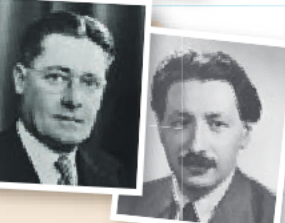
Several years passed before Fleming's work gained the attention it deserved. In 1939, two scientists at Oxford Medical School decided to revisit Fleming's research on penicillin. Howard Florey, an Australian pathologist, and Ernst Chain, a German biochemist, formed a research team dedicated to exploring ways to use penicillin to kill bacteria effectively.
Their collaboration proved incredibly fruitful. Together with their research team, they conducted systematic experiments to understand how penicillin worked and whether it could be developed into a practical medicine. Their efforts were eventually recognised when they, along with Fleming, won the Nobel Prize in Physiology or Medicine in 1945.
Important
The team's first major breakthrough came in 1940 when they successfully tested penicillin on mice. The results were promising - penicillin effectively killed the bacteria causing infections, proving it could work as a "miracle drug."
Encouraged by these results, they moved forwards to test penicillin on human patients, and once again, the antibiotic proved highly effective in treating bacterial infections.
Timeline of key developments
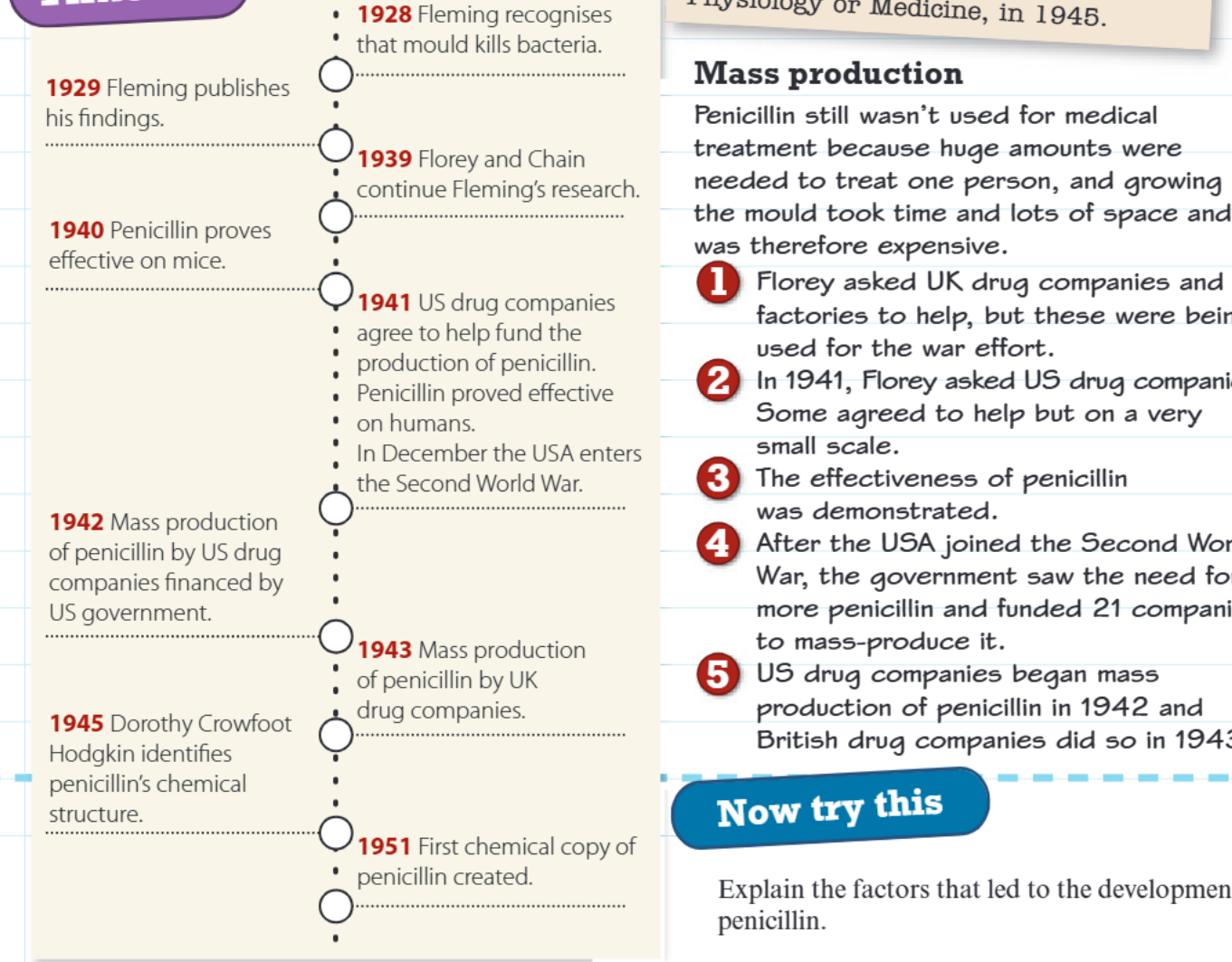
The development of penicillin followed a clear timeline of scientific progress:
- 1928 - Fleming first recognised that mould could kill bacteria in his laboratory
- 1929 - Fleming published his initial findings, though he received little support for further research
- 1939 - Florey and Chain began continuing Fleming's abandoned research
- 1940 - Successful testing on mice proved penicillin's effectiveness
- 1941 - Human trials confirmed penicillin's potential, and US drug companies agreed to fund production
- 1942 - Mass production began in the United States with government financial backing
- 1943 - British drug companies also started mass-producing penicillin
- 1945 - Dorothy Crowfoot Hodgkin identified penicillin's exact chemical structure
- 1951 - Scientists successfully created the first artificial copy of penicillin
Mass production challenges and solutions
Even after proving penicillin's effectiveness, significant obstacles remained before it could become widely available. The main challenge was that producing penicillin required enormous quantities of the mould, and the manufacturing process was extremely time-consuming and expensive.
Important
Growing enough mould to treat just one person took considerable time and laboratory space, making it impractical for widespread medical use.
Florey initially approached British drug companies and factories for help with mass production, but these were already stretched thin supporting the war effort during World War II. The breakthrough came when Florey reached out to American drug companies in 1941. Some US companies agreed to help, though initially only on a small scale.
Note
The situation changed dramatically after the United States entered World War II in December 1941. The American government recognised penicillin's potential importance for treating wounded soldiers and decided to provide substantial funding for its mass production.
By 1942, US drug companies were producing penicillin on an industrial scale with government financial support. The success of American mass production inspired British companies to follow suit. In 1943, UK drug companies also began manufacturing penicillin on a large scale.
This coordinated effort between British and American manufacturers ensured that sufficient quantities of penicillin became available to treat both military personnel and civilian patients. The timing proved crucial - penicillin became available just when it was most needed during the later stages of World War II, helping to save thousands of lives that might otherwise have been lost to bacterial infections.
Summary
Key Points to Remember:
- Fleming's accidental discovery in 1928 - A contaminated petri dish led to the recognition that mould could kill harmful bacteria
- Florey and Chain's crucial development work - Without their systematic research from 1939-1941, Fleming's discovery might have remained unused
- World War II as a catalyst - The war created urgent demand for penicillin and provided government funding for mass production
- International cooperation was essential - Both US and UK companies working together made widespread penicillin production possible
- Timeline spans over two decades - From Fleming's initial discovery to successful mass production took 14 years (1928-1942)