Collectivisation (Edexcel GCSE History): Revision Notes
📚Revision Notes
Collectivisation in the Soviet Union, 1928-1941
What was collectivisation?
Collectivisation was Stalin's radical agricultural policy that ran from 1928 to 1933. It represented Stalin's solution to the economic and ideological problems created by peasant agriculture in the Soviet Union, as well as his political problems with rival Bukharin who supported the existing New Economic Policy (NEP).
Note
This policy fundamentally transformed Soviet agriculture by replacing individual peasant farms with state-controlled collective farms, dramatically changing the lives of millions of rural workers.
Why did Stalin introduce collectivisation?
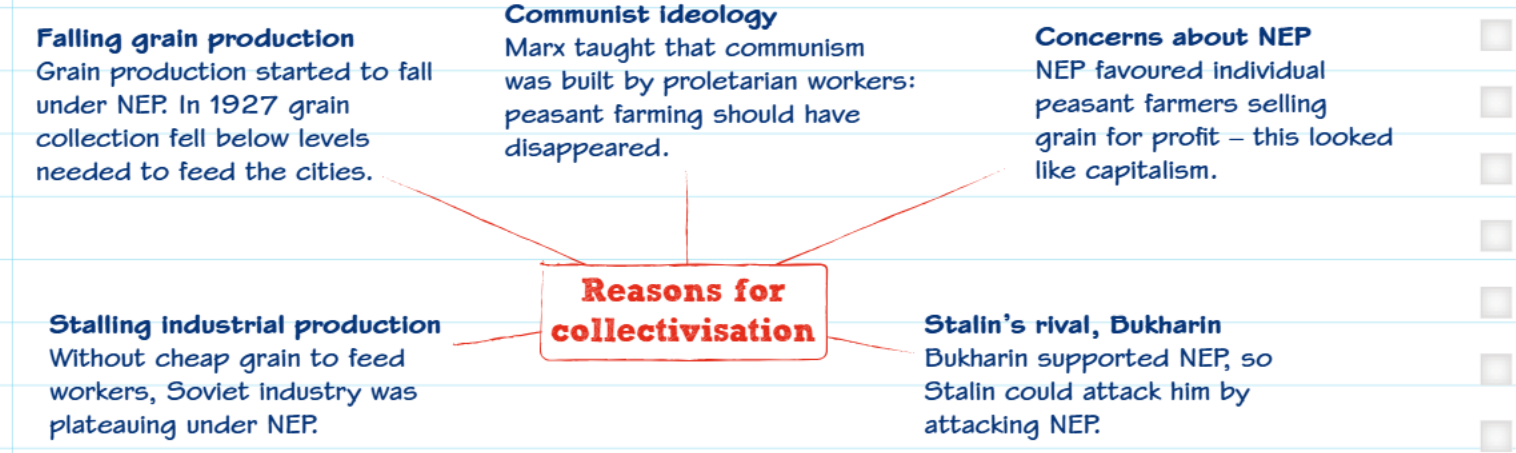
Stalin had multiple interconnected reasons for abandoning NEP and introducing collectivisation. These reasons combined economic necessity, ideological concerns, and political strategy.
Important
The economic pressures were mounting by the late 1920s. Grain production had started to fall under NEP, and by 1927 grain collection fell below the levels needed to feed the cities. This created a serious food supply crisis for urban populations.
At the same time, without cheap grain to feed workers, Soviet industry was plateauing under NEP, threatening Stalin's ambitious industrialisation plans.
From an ideological perspective, many Communist Party members were uncomfortable with NEP because it seemed to contradict core Marxist principles. Marx had taught that communism should be built by proletarian workers, but peasant farming under NEP had allowed individual farmers to prosper. This looked suspiciously like capitalism, with individual peasant farmers selling their grain for profit rather than working collectively for the state.
Finally, Stalin faced a political challenge from Bukharin, who supported continuing NEP. By attacking NEP and proposing collectivisation, Stalin could simultaneously undermine his rival while positioning himself as the defender of true communist principles.
What problems had NEP created?
Many of the reasons Communist Party members supported collectivisation were actually reactions against the negative impacts they saw from NEP in the countryside and industrial development.
The party leadership had grown frustrated with how NEP seemed to benefit the wrong people. Many party members hated the idea that kulaks (wealthy peasants) were benefiting most from NEP, while urban workers were having to pay more for their food. This created resentment and seemed to contradict the revolution's promise to help workers.
Note
More fundamentally, socialism and communism were supposed to be about collective efforts for the good of everyone, but NEP was encouraging the opposite - private peasant farms run for individual profit. This ideological contradiction troubled many committed communists who wanted to build a truly socialist society.
NEP was also failing to modernise peasant agriculture effectively. Yields were still low compared to Western countries, and instead of using modern tractors and machinery, peasants were still ploughing with horses and farming using centuries-old traditional methods. This backwards agriculture couldn't support rapid industrialisation.
Important
The situation reached crisis point in 1927-28 with a grain procurement crisis. Not enough grain was being collected to feed the urban populations of the Soviet Union, threatening both industrial workers and the broader economic development of the country.
How were collective farms organised?
Collective agriculture represented a complete transformation from individual peasant farming. The new system placed all agricultural production under direct state control.
Under collectivisation, the state owned the land, all equipment, and everything the land produced. Individual peasant farms disappeared, replaced by collective farms called kolkhoz. The state told each collective farm what to farm and set specific production targets that had to be met.
When the state purchased grain and other produce from collective farms, it paid a set price that was deliberately kept low. This ensured cheap food for urban workers while maximising state profits for industrial investment.
All collective farm workers were organised into brigades and worked set hours determined by the state rather than choosing their own working patterns. This brought industrial-style organisation to agricultural work.
Note
The mechanisation of collective farms was managed through Machine Tractor Stations (MTS). These centralised facilities provided tractors and combine harvesters that were allocated to different collective farms as needed. Importantly, the secret police kept close surveillance on each collective farm through agents stationed at the MTS, ensuring political control alongside agricultural efficiency.
Each collective farm was also set a quota of produce that it was required to keep for feeding its own workers. However, meeting state production targets always took priority over local food needs.
The attack on kulaks, 1927-1932
Stalin's campaign against the kulaks unfolded in distinct phases, each escalating the violence and disruption in the countryside.
Example
Phase 1: Forced grain collection (1927-29)
The campaign began with grain being taken by force from peasants because of the grain crisis. Peasants were forced to join kolkhozes through Red Army pressure. Many peasants refused and were labelled as 'kulaks' - a term that quickly became associated with opposition to Soviet policy rather than just wealth.
Example
Phase 2: The dekulakisation campaign (1929)
Stalin launched a systematic campaign of 'liquidation of the kulaks'. This meant that peasants identified as kulaks were either shot immediately or exiled to Siberia. The definition of 'kulak' became increasingly broad, encompassing anyone who resisted collectivisation.
Example
Phase 3: Mass deaths and resistance (1930)
Approximately 30,000 kulaks died between 1930 and 1931 as the campaign intensified. However, peasants continued to resist collectivisation through various means, including destroying livestock and equipment rather than handing them over to collective farms. Stalin was forced to halt the scheme temporarily as resistance proved more widespread than expected, and peasants began returning to their individual farms.
Example
Phase 4: Famine and policy revival (1931-32)
Stalin revitalised the collectivisation campaign despite the ongoing resistance. The result was a devastating famine that struck the USSR, particularly affecting Ukraine and other grain-producing regions. This famine was largely artificial, caused by the state's insistence on collecting grain quotas even when it meant rural populations would starve.
Timeline of major events
- 1927: Grain production crisis begins, forced collection starts
- 1928: Collectivisation policy officially launched
- 1929: Dekulakisation campaign begins, systematic persecution of kulaks
- 1930: 30,000 kulak deaths, widespread peasant resistance forces temporary halt
- 1931-32: Famine strikes USSR as collectivisation campaign revitalised
- 1933: Collectivisation largely completed despite massive human cost
Summary
Key Points to Remember:
-
Collectivisation (1928-1333) was Stalin's solution to economic, ideological, and political problems - it addressed falling grain production, communist concerns about NEP's capitalism-like features, and helped Stalin defeat his rival Bukharin
-
NEP had created serious problems by the late 1920s - kulaks benefited while workers suffered, it contradicted socialist principles, failed to modernise agriculture, and led to a grain procurement crisis in 1927-28
-
Collective farms were completely state-controlled - the state owned everything, set production targets, organised workers into brigades, and used Machine Tractor Stations to provide equipment and surveillance
-
The attack on kulaks escalated from 1927-1932 - starting with forced grain collection, moving to systematic 'dekulakisation' and mass killings, resulting in approximately 30,000 deaths and devastating famine
-
Resistance was widespread but ultimately crushed - peasants fought back by destroying property and refusing to cooperate, but Stalin's determination and use of force eventually imposed collectivisation across the USSR