Developments in weaponry (Edexcel GCSE History): Revision Notes
📚Revision Notes
Developments in weaponry c1500-c1700
Introduction
The period from around 1500 to 1700 marked a revolutionary transformation in military weaponry across Europe. During these two centuries, traditional mediaeval weapons like longbows and pikes gave way to sophisticated firearms and artillery. These technological advances didn't just change how wars were fought - they transformed entire societies, influenced military tactics, and reshaped the balance of power between nations.
Note
This period represents one of the most dramatic military technological revolutions in human history, with changes that affected not just warfare but the entire social and political structure of European societies.
The rise of the musket
From longbow to firearm
Firearms first appeared during the 1400s, but it wasn't until around 1550 that the musket began to seriously challenge the dominance of the traditional English longbow. This transition represented one of the most significant changes in military technology of the early modern period.
The musket offered several key advantages over the longbow. While longbows required years of training to master and skilled bowmen took decades to develop, muskets could be operated by soldiers with relatively basic training. This meant armies could be equipped and deployed much more quickly than before.
Scientific and technological improvements
The development of new high-carbon steel armour initially seemed to provide protection against arrows, but musket balls could pierce through even this advanced armour. This breakthrough made traditional defensive equipment largely obsolete.
Mass production techniques revolutionised ammunition supply. Unlike arrows, which were expensive and time-consuming to craft individually, bullets could be manufactured in large quantities and stored easily. A single barrel could contain thousands of bullets, making logistics much simpler for military commanders.
Important
The ability to mass-produce ammunition was just as revolutionary as the weapons themselves - it fundamentally changed military logistics and supply chains.
Historical evidence: Henry VIII's experience
Example
Historical Example: Henry VIII's Military Intelligence
During the reign of Henry VIII (1509-1547), the king received detailed battle reports describing the effectiveness of German muskets against Swiss pikemen, who had previously been considered among Europe's most formidable infantry.
The Impact:
- Swiss pikemen had been nearly unbeatable in traditional combat
- German muskets proved devastatingly effective against them
- Henry VIII immediately increased England's use of firearms
- This demonstrates how military intelligence drove technological adoption across Europe
Pistols and cavalry warfare
Development of the wheel-lock pistol
The 1540s saw the introduction of the wheel-lock pistol, a smaller firearm specifically designed for cavalry use. This weapon revolutionised mounted warfare by giving cavalry soldiers an effective ranged weapon that could be used from horseback.
The impact on mediaeval combat traditions was profound. Pistols and swords gradually replaced the traditional weapons of mediaeval knights, including lances and heavy armour. As improved firepower made mounted charges less effective, the role of heavily armoured cavalry declined significantly.
Changes in cavalry tactics
Cavalry units began operating closer to enemy lines, using complex manoeuvres to deliver volleys of pistol fire before withdrawing to reload. This represented a fundamental shift from the mediaeval cavalry charge to more tactical, firearm-based combat.
Note
Dragoons emerged as a completely new type of military unit - soldiers equipped with arquebuses or smaller muskets who specialised in harassing and threatening enemy flanks through mobile firepower rather than direct assault.
Flintlock and bayonet innovations
The flintlock revolution
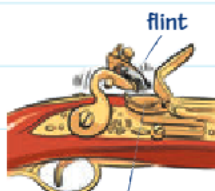
By the 1690s, the flintlock mechanism had largely replaced the older matchlock system. This change addressed several critical weaknesses of earlier firearms.
The matchlock system had proven dangerous because of its exposed flame near gunpowder, unreliable in wet weather when the match could be extinguished, and highly visible at night due to the glowing match cord. The flintlock solved all these problems by using a spring-loaded mechanism to strike flint against steel, creating sparks only when needed.
The bayonet transformation
The plug bayonet first appeared in the 1600s, but it was the development of the socket bayonet by 1705 that truly revolutionised infantry combat. The socket design allowed the bayonet to be fitted around the outside of the musket barrel, enabling soldiers to fire while the bayonet was attached.
Important
The Socket Bayonet Revolution
This innovation had enormous tactical implications. Previously, armies required separate units of pikemen to protect musketeers during close combat. The socket bayonet eliminated this need by converting every musketeer into a combination ranged and melee combatant.
Military units no longer needed to be divided into specialised roles, making army organisation more efficient and flexible.
Artillery and defensive innovations
Improvements in cannon technology
The growing power of cannon artillery prompted significant changes in both offensive and defensive military thinking. Artillery became increasingly effective at breaking down traditional castle walls and fortifications.
Defensive adaptations
From the 1530s onward, England invested enormous sums in constructing new defensive systems designed to withstand cannon fire. These new engineering methods focused on creating stronger, more resilient defensive structures.
Note
Revolutionary Defensive Design Changes
The development of low, thick, earth-filled walls represented a major departure from tall mediaeval stone fortifications. These new defensive walls were specifically designed to absorb the impact of cannon balls rather than shatter under bombardment.
Wall construction began incorporating angled designs, which caused cannon balls to bounce off harmlessly rather than penetrating the defences. Bastions provided strategic defensive positions that allowed defenders to return artillery fire effectively.
Social and tactical consequences
Changes in military thinking
The effectiveness of musket-armed pikemen in battle led to fundamental changes in military strategy and tactics. Traditional approaches to warfare, developed over centuries, became obsolete within a few decades.
Social transformations
The growth of towns and changes in farming methods meant that larger numbers of potential soldiers could be trained as archers. However, it required years of practice to develop a skilled bowman, while musket training took only days or weeks. This shift democratised military service and changed the social structure of armies.
The new weapons also reduced the effectiveness of traditional knightly combat, contributing to the decline of feudalism and the rise of professional standing armies.
Timeline of major developments
- 1400s: First firearms developed
- 1540s: Wheel-lock pistol introduced for cavalry
- 1550: Musket begins replacing longbow as primary weapon
- 1530s: England begins major investment in new fortifications
- 1600s: Plug bayonet emerges
- 1690s: Flintlock mechanism replaces matchlock
- 1705: Socket bayonet replaces pike, transforming infantry tactics
Summary
Key Points to Remember:
- Muskets democratised warfare - they required much less training than longbows, allowing armies to be equipped more quickly and cheaply
- The flintlock was more reliable - unlike matchlocks, flintlocks worked in rain and didn't reveal positions at night
- The socket bayonet revolutionised tactics - it eliminated the need for separate pike units by turning every musketeer into a combined ranged and close-combat fighter
- Artillery changed fortification design - traditional high stone walls gave way to low, thick, angled earthworks that could absorb cannon fire
- These changes transformed society - new weapons reduced the importance of traditional knightly classes and contributed to the rise of professional armies