Modern warfare and civilians (Edexcel GCSE History): Revision Notes
📚Revision Notes
Modern warfare and civilians (c1900-present)
The period from 1900 to the present marked a revolutionary change in how warfare affected ordinary people. Unlike previous conflicts, modern wars became "total wars" where entire nations and their civilian populations were drawn into the war effort. This transformation meant that the distinction between soldiers and civilians became increasingly blurred, with governments requiring unprecedented involvement from their citizens in supporting military campaigns.
The concept of total war
Important
Understanding Total War
Total war represented a fundamental shift from earlier military conflicts. In total war, success depended not just on battlefield victories, but on the complete mobilisation of a nation's resources, economy, and population. This approach required governments to take control of civilian life to an extent never seen before, coordinating everything from industrial production to food distribution to support the war effort.
The impact of active fighting on British society
Mass recruitment and conscription
The scale of modern warfare demanded enormous numbers of soldiers. During World War One, Britain experienced conscription for the first time in its modern history, forcing civilians to take up arms in what became the largest military mobilisation of the 20th century. Approximately six million British men served in the armed forces, with devastating consequences - around 700,000 died in the First World War, followed by about 450,000 deaths in the Second World War.
This massive recruitment had profound effects on British society, removing millions of men from the workforce and forcing rapid changes in who performed essential jobs. Families were separated for years, and entire communities lost significant portions of their male population.
Organisation of the home front
The Home Front became a crucial concept during both world wars. This term describes how civilian populations and domestic preparations supported military forces fighting abroad. The organisation of civilian defence became increasingly sophisticated as wars progressed.
Note
The Home Guard emerged as a part-time volunteer force in 1940, designed to defend against potential invasion. By 1941, this civilian militia had grown to 1.6 million members, demonstrating how ordinary citizens took on military responsibilities.
Meanwhile, the Civil Defence volunteers, operating from 1941 onwards, protected communities from air raids. By 1945, approximately 1.4 million wardens had served, with over 7,000 staff losing their lives while protecting their fellow citizens.
The Women's Voluntary Service (WVS) played an equally vital role, with around one million volunteers from 1941 supporting civil defence efforts. This organisation showed how women's contributions became essential to maintaining civilian morale and safety during wartime.
Living conditions on the home front
Rationing and food shortages
The impact of modern warfare on civilian food supplies was severe and long-lasting. In April 1917, Britain faced a critical shortage, with only a few weeks of wheat supplies remaining as German submarines targeted supply ships. This crisis led to the introduction of food rationing in 1918, which was reintroduced in January 1940 during World War Two.
Important
The Rationing Crisis
Rationing fundamentally changed how British families lived, requiring them to carefully manage limited food supplies and adapt their diets. This system continued well beyond the wars themselves, demonstrating how military conflicts reshaped daily life for years after fighting ended.
The blitz and civilian bombing
Modern warfare brought the battlefield directly to British homes through strategic bombing campaigns. Between 1940 and 1941, German bombing destroyed two million British homes and forced 1.5 million civilians to evacuate their communities. Major cities faced constant air raid threats, fundamentally changing urban life.
The government responded by establishing comprehensive air raid precautions. Public shelters were constructed in open spaces and family gardens, while children were evacuated from major towns and cities to safer rural areas. Blackout regulations and curfews were enforced to prevent bombers from identifying targets, showing how military strategy directly controlled civilian behaviour.
Expansion of government powers
Important
Unprecedented Government Control
The demands of total war required governments to assume unprecedented control over civilian life. The Defence of the Realm Act of 1914 allowed the government to censor information and control key industries. The Emergency Powers Act of 1940 provided even broader authority, giving the government unlimited powers to direct civilian actions.
Workers could be forced to move into jobs considered more vital to the war effort, regardless of their personal preferences or career plans. This represented a fundamental shift in the relationship between citizens and the state, with individual freedoms subordinated to military necessities.
Alternative forms of civilian contribution
Note
The Bevin Boys System
During World War Two, men could choose to work in essential mining industries rather than join the armed forces. These workers became known as "Bevin Boys", named after Ernest Bevin, the Minister of Labour. This system recognised that maintaining domestic production was as crucial as military service, acknowledging the complex nature of total war support.
Unexpected benefits of modern warfare
Note
Positive Developments from Wartime
Despite its devastating effects, modern warfare also produced some positive developments. The urgent need to treat military casualties led to significant medical advances that later benefited civilian healthcare. Additionally, the requirement for women to take on traditional male roles both on the Home Front and in the armed forces advanced gender equality, as women proved their capabilities in previously male-dominated areas.
Nuclear fears in the post-war era
The development of nuclear weapons after 1945 created new forms of civilian anxiety about warfare. By 1949, both the United States and Soviet Union possessed nuclear weapons, creating ongoing tension that affected civilian life throughout the Cold War period.
Governments issued nuclear defence guidance to the public, preparing citizens for potential atomic attacks. Air-raid sirens were regularly tested, and civil defence films were shown in schools and cinemas, keeping the threat of nuclear war present in civilian consciousness.
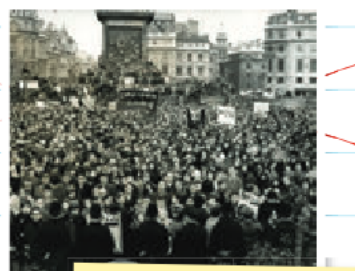
The constant tension and rivalry between superpowers lasted until the 1970s, creating increasing public concern about nuclear conflict. This fear manifested in public protests, such as the Ban the Bomb meeting in Central London's Trafalgar Square in 1964, where thousands of civilians gathered to express their opposition to nuclear weapons.
Timeline of key developments
- 1914: Defence of the Realm Act passed, expanding government powers
- 1917: Britain faces severe food shortages (April)
- 1918: Food rationing introduced
- 1940: Emergency Powers Act passed; Home Guard established; rationing reintroduced (January)
- 1940-1941: The Blitz destroys 2 million homes
- 1941: Civil Defence volunteers begin operations; Women's Voluntary Service reaches 1 million volunteers
- 1945: End of World War Two
- 1949: Both USA and USSR develop nuclear weapons
- 1964: Major anti-nuclear protest in London
- 1970s: Continued nuclear tensions affect civilian life
Summary
Key Points to Remember:
- Total war transformed civilian life: Modern warfare required complete national mobilisation, involving every aspect of society in the war effort
- The Home Front became a battlefield: Civilians faced direct attack through bombing campaigns and had to organise their own defence through groups like the Home Guard and Civil Defence
- Government powers expanded dramatically: Acts like the Defence of the Realm Act and Emergency Powers Act gave governments unprecedented control over civilian life
- Rationing reshaped daily life: Food shortages forced long-term changes in how families lived and ate, continuing well beyond the wars themselves
- Nuclear weapons created lasting civilian anxiety: The post-1945 period brought new fears about warfare that affected civilian life through ongoing civil defence preparations and public protests