The Western Front and the Somme, 1916 (Edexcel GCSE History): Revision Notes
📚Revision Notes
The Western Front and the Somme, 1916
Introduction
The Battle of the Somme in 1916 represented a major British attempt to break through the deadlock that had developed on the Western Front. This offensive revealed the devastating human cost of modern industrial warfare and demonstrated the challenges of breaking well-established defensive positions during the First World War.
The Western Front by 1915
By 1915, the war on the Western Front had transformed into a static conflict characterised by extensive defensive systems. Both Allied and German forces had constructed elaborate trench networks spanning approximately 600 kilometres, stretching from Belgium all the way to Switzerland. This created a deadly stalemate where neither side could achieve a decisive breakthrough.
Note
The trench systems were far more sophisticated than many people realise. Rather than simple ditches, they formed complex defensive networks that fundamentally changed the nature of warfare.
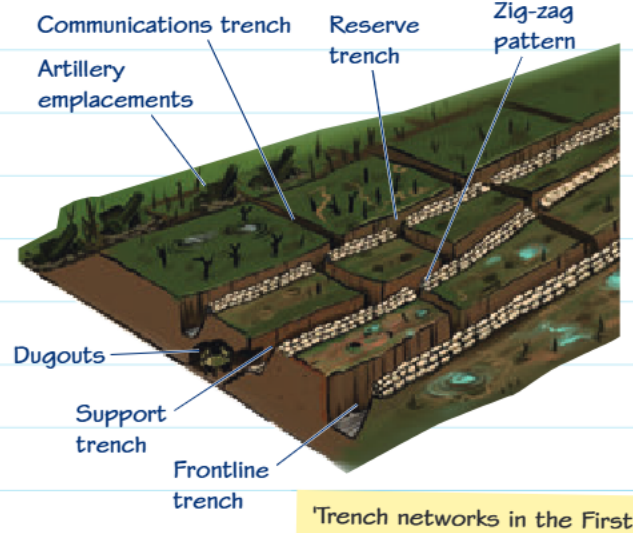
The trench systems were far more complex than simple ditches in the ground. They consisted of multiple defensive lines including frontline trenches where soldiers faced the enemy, support trenches positioned behind the front lines, and reserve trenches further back. These were all connected by communication trenches that allowed troops and supplies to move safely between positions. Underground dugouts provided shelter from artillery bombardment, while the infamous "No Man's Land" separated opposing forces.
The Somme offensive strategy
The British developed a six-stage plan to break through German defences at the Somme:
- Aerial reconnaissance: The Royal Flying Corps shot down German observation balloons to prevent enemy intelligence gathering and ensure the element of surprise
- Chemical warfare: Gas attacks were launched at 40 different locations along the front to weaken German defences
- Artillery preparation: A week-long heavy artillery bombardment was designed to destroy German fortifications and clear barbed wire
- Infantry support: A "creeping" barrage of artillery fire was planned to move ahead of advancing British troops, clearing the way for the attack
- The main assault: Approximately 120,000 infantry soldiers would go "over the top" and advance towards German trenches
- Breakthrough: The plan anticipated rapid progress through weakened German defences
Important
Despite the elaborate six-stage planning process, the reality of the offensive would prove devastatingly different from these optimistic expectations. The plan assumed that the preparatory bombardment would effectively destroy German defences - a critical miscalculation.
The reality of the offensive
The first day of the Somme, July 1, 1916, became one of the bloodiest days in British military history. Despite the elaborate planning, 20,000 British infantry were killed and 40,000 were wounded or captured on that single day. The offensive continued for five months with little strategic progress, demonstrating the difficulty of breaking through established defensive positions.
Important
The Scale of the Disaster
The casualties on the first day of the Somme - 60,000 in total - represented the worst single day in British military history. This staggering loss of life in just 24 hours highlighted the deadly effectiveness of defensive warfare.
Reasons for the limited success
Several factors contributed to the failure of the Somme offensive:
Loss of surprise: The week-long artillery barrage alerted German forces that a major attack was coming, allowing them to prepare their defences and bring up reinforcements.
Strong German defenses: The German trench system proved remarkably resilient, featuring 12 parallel lines of trenches connected by deep dugouts that provided protection from artillery. These underground shelters included comfortable tunnels where troops could wait out bombardments.
Defensive firepower: German positions were equipped with rifles, machine guns, and artillery that could cut down advancing soldiers as they crossed No Man's Land.
Inexperienced troops: Many British infantry were new volunteers who lacked proper training and combat experience, making them vulnerable to seasoned German defenders.
Artillery failures: The British artillery barrage failed to destroy German defences in No Man's Land, leaving barbed wire obstacles intact and dugouts functional.
Poor tank deployment: Although tanks were used for the first time, they were spread over such a wide area that their impact was limited and ineffective.
Note
The failure of the artillery bombardment was particularly critical. Despite firing over 1.5 million shells during the week-long preparation, much of the German defensive infrastructure remained intact. Many shells were ineffective against deep underground dugouts, and the barbed wire obstacles that were meant to be cleared often remained as formidable barriers to advancing infantry.
Life in the trenches
Trench warfare created extremely harsh living conditions for soldiers on both sides. Daily routines included mundane but essential tasks such as sentry duty and weapon maintenance. Soldiers lived in underground dugouts when not on the front lines, but these were often damp and uncomfortable.
The constant threat of enemy fire meant that movement during daylight hours was extremely dangerous. Wet conditions led to medical problems like trench foot, while contaminated water and poor sanitation caused widespread disease. Rats were a constant problem, and lice infestations were common, leading to "trench fever."
Note
The Psychological Toll
Beyond the physical hardships, the psychological impact of trench warfare was devastating. The combination of constant danger, horrific sights, and the stress of combat created lasting mental trauma that military medicine was only beginning to understand.
The psychological impact was severe, with continuous bombardment causing little sleep and contributing to what was then called "shell shock" - symptoms including uncontrollable crying, shaking, and paralysis that we now understand as post-traumatic stress disorder.
General Haig's leadership
General Douglas Haig played a controversial role in the Somme campaign. Under pressure from the government to achieve results and recapture territory lost earlier in the war, Haig was determined to pin down German troops at the Somme to prevent them from reinforcing other fronts.
Haig believed that heavy casualties would damage Germany more than the Allies, calculating that Britain could better sustain losses in a war of attrition. However, his decision to continue the offensive after the disastrous first day proved highly controversial. He persisted with similar tactics even after early infantry attacks had proven unsuccessful, and he often ignored advice from other generals who suggested changes to his approach. Haig also made poor use of new technologies and weapons that might have improved British chances of success.
Important
Haig's Controversial Legacy
General Haig's leadership during the Somme remains one of the most debated aspects of the battle. Critics argue that his persistence with failed tactics cost tens of thousands of lives unnecessarily, while supporters claim he was fighting a necessary war of attrition that ultimately contributed to Allied victory.
Timeline of key events
- 1915: Trench networks established across 600km of the Western Front
- July 1, 1916: First day of the Battle of the Somme - 20,000 British killed, 40,000 wounded
- July-November 1916: Battle continues for five months with limited territorial gains
- November 1916: Offensive officially ends with minimal strategic success
Key Points to Remember
Summary
Essential Takeaways from the Battle of the Somme:
- The Battle of the Somme was Britain's major attempt to break the stalemate on the Western Front in 1916
- The first day resulted in 60,000 British casualties, making it one of the bloodiest days in military history
- Complex trench networks with multiple defensive lines made breakthrough extremely difficult
- Poor planning, loss of surprise, and inexperienced troops contributed to the limited success
- The battle demonstrated the devastating human cost of industrial warfare and the challenges of offensive operations against well-prepared defences