London: a target city (Edexcel GCSE History): Revision Notes
📚Revision Notes
London: a target city
Why Hitler targeted London in 1939
When war began in 1939, Adolf Hitler developed plans to invade Britain. He recognised that large-scale bombing campaigns against London would severely damage Britain's ability to continue fighting and would have a devastating impact on public morale. This made London a primary target for German military strategy.
Note
Hitler's strategy was based on the belief that breaking civilian morale would be as effective as defeating military forces. By targeting the capital city, German commanders hoped to force a quick British surrender without the need for a costly ground invasion.
London's strategic importance during the Second World War
London represented the perfect target for German forces due to several critical factors. As Britain's capital city, it housed the royal family and served as the nerve centre of government operations, organisation, communication, and propaganda efforts. Beyond its political significance, London functioned as Britain's major port and primary transport hub, making it essential for moving supplies and coordinating military efforts.
The city also served as Britain's most important industrial centre, producing vital war materials and equipment. With its extremely high population density, London contained millions of civilians whose safety and morale were crucial to Britain's war effort. These factors combined to make London an obvious and accessible target that German commanders believed could cripple British resistance.
Important
The Perfect Storm of Vulnerability
London's strategic value came from the combination of multiple critical factors in one location:
- Political nerve centre (government, royal family)
- Economic hub (major port, transport centre)
- Industrial powerhouse (war materials production)
- High civilian population (morale target)
This concentration made London uniquely valuable as a single target that could potentially cripple multiple aspects of Britain's war effort simultaneously.
Geographic accessibility for German bombing campaigns
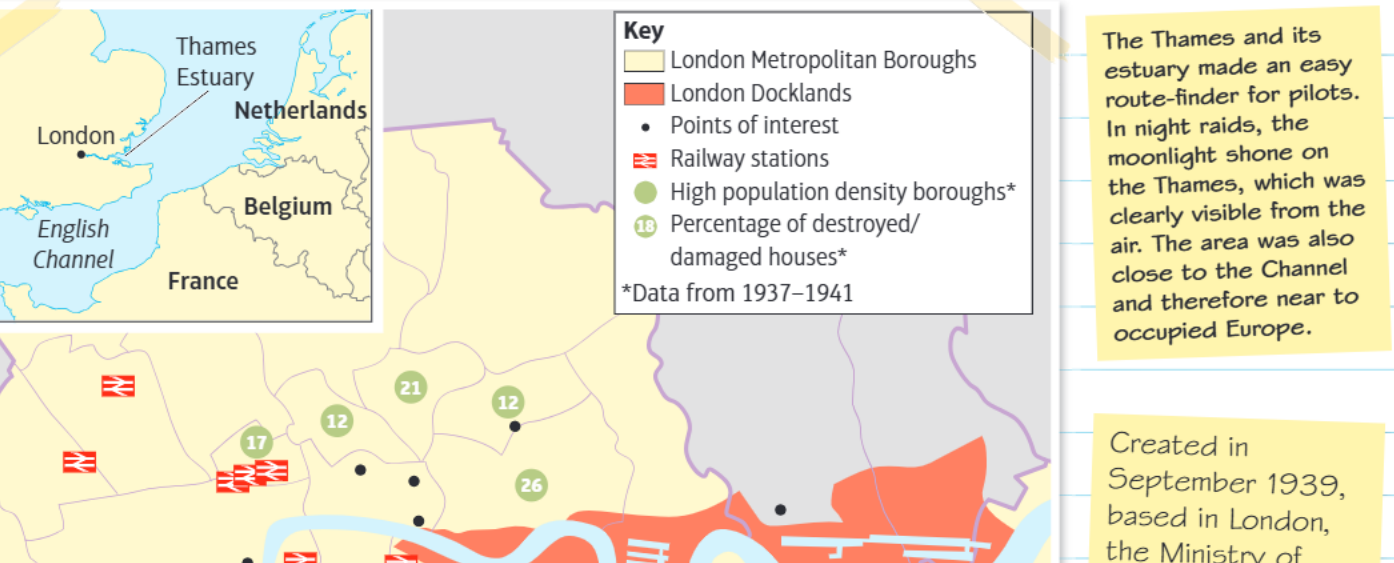
London's location made it relatively easy for German bombers to locate and attack. The Thames Estuary provided a natural navigation route that German pilots could follow, particularly during nighttime raids. The moonlight reflecting off the Thames created a distinctive silvery pathway that was clearly visible from aircraft, effectively guiding enemy planes directly towards central London.
The city's proximity to occupied Europe also worked against it. With German forces controlling areas across the English Channel in France, Belgium, and the Netherlands, London fell well within range of German bombing aircraft. This geographical disadvantage meant that German planes could reach London, carry out their attacks, and return to their bases without requiring long-range fuel capabilities.
Note
The Thames as an Unwitting Guide
The Thames River, which had been London's lifeline for centuries as a trade route, ironically became a liability during the war. Its distinctive shape and reflective surface made it an unmistakable landmark visible even on dark nights, essentially providing German bombers with a natural "runway" pointing directly to the heart of the capital.
Government preparations for war in 1939
British authorities began extensive preparations before war was officially declared. Planning responsibilities were divided between the London County Council (LCC) and 28 individual borough councils across the metropolitan area.
Civil defence measures
Following the Munich Crisis in 1938, gas masks were distributed to all London residents as authorities feared chemical weapon attacks. The Air-Raid Precautions Act required local governments to establish comprehensive air-raid precaution systems throughout their areas.
The LCC took charge of organising essential emergency services, including Fire, Ambulance, and Heavy Rescue Services, while also arranging care for those who would lose their homes during bombing raids. Individual boroughs were responsible for establishing local Air-Raid Precaution wardens who would coordinate responses during attacks.
In January 1939, a major recruitment campaign began to gather volunteers for Civil Defence roles. These civilians would provide crucial support during air raids and help coordinate evacuations and rescue efforts.
Evacuation and shelter policies
Recognising that London's children would be particularly vulnerable during bombing campaigns, authorities planned mass evacuations. Starting from 1 September, London's schoolchildren were to be moved to safer countryside locations away from potential target areas.
The government also addressed shelter needs through multiple approaches. The National Service offered financial support to rural families willing to house evacuees from the city. For families choosing to remain in London, the government implemented a dispersal policy, offering Anderson shelters for homes with gardens or providing space in communal shelters for those without private outdoor areas.
Example
Civil Defence in Action: The Warden System
Each London borough appointed local Air-Raid Precaution wardens who were responsible for:
Step 1: Monitoring their assigned areas during air raids Step 2: Guiding civilians to shelters when sirens sounded Step 3: Coordinating with emergency services during and after attacks Step 4: Assessing damage and organising immediate relief efforts
These volunteer wardens became the backbone of London's civil defence network, providing the crucial link between government planning and community-level response.
Propaganda and maintaining public morale
The government recognised that maintaining civilian morale would be just as important as military preparedness. The Ministry of Information, established in September 1939 and based in London itself, became the central government department responsible for managing propaganda and public communications.
Controlling information flow
London's civil servants developed sophisticated propaganda campaigns while ensuring that censorship effectively controlled the flow of public information. This propaganda served multiple purposes: maintaining morale, encouraging continued support for the war effort, and shaping public attitudes about the conflict.
The government worked particularly hard to create what became known as the 'Blitz spirit' - a concept representing a united British population that remained determined and defiant despite facing constant danger. This propaganda portrayed everyone from ordinary workers to members of the royal family as standing together against the threat, weathering difficulties with courage and determination.
Photographs of the royal family visiting bomb sites became powerful propaganda tools, demonstrating that even Britain's most privileged citizens shared the dangers faced by ordinary Londoners during air raids.
Important
The Power of Propaganda
The British government understood that the war would be won as much in the minds of civilians as on the battlefield. By carefully crafting the narrative of the 'Blitz spirit,' they transformed what could have been a story of victimisation into one of defiance and unity. This psychological warfare was crucial in maintaining the will to continue fighting even under constant bombardment.
Timeline of key events
- 1938: Munich Crisis leads to distribution of gas masks to London residents
- January 1939: Civil Defence recruitment drive begins
- 1 September 1939: London school evacuation programme starts
- September 1939: Ministry of Information established in London
- 3 September 1939: Britain declares war on Germany
- 1940-1941: London Blitz begins, with sustained bombing campaigns against the capital
Summary
Key Points to Remember:
-
London was a strategic target because it combined political importance (capital city, royal family, government), economic significance (major port, transport hub, industrial centre), and high population density in one location.
-
Geographic factors made London accessible to German bombers, particularly the Thames which provided a natural navigation route visible from aircraft during nighttime raids.
-
Extensive preparations began before war was declared, including gas mask distribution, Air-Raid Precaution systems, evacuation plans, and Civil Defence recruitment.
-
The government used propaganda strategically to maintain morale and create the 'Blitz spirit', while carefully controlling information through censorship.
-
Multiple government levels coordinated preparations, with the London County Council and 28 borough councils sharing responsibilities for civil defence measures.