Algebraic Fractions (Edexcel GCSE Maths): Revision Notes
📚Revision Notes
Algebraic fractions
Working with algebraic fractions follows the same principles as working with numerical fractions, but now we're dealing with expressions that contain letters (variables) as well as numbers. The good news is that all the rules you've learned for numerical fractions apply here too - you just need to be more careful with your algebra!
Note
The key principle to remember is that algebraic fractions follow exactly the same rules as numerical fractions. If you can work with and , you can work with and using the same methods.
Simplifying algebraic fractions
When simplifying algebraic fractions, your goal is to cancel out common factors that appear in both the numerator and denominator. This process makes the fraction easier to work with and often reveals its simplest form.
The key steps for simplifying are:
- Look for common factors in the numerator and denominator
- Cancel these common factors
- If needed, factorise expressions first to reveal hidden common factors
Example
Example 1 Simplify
÷7 on the top and bottom ÷x on the top and bottom to leave on the top ÷ on the top and bottom to leave on the bottom
Example 2 Simplify
Factorise the top using D.O.T.S:
Factorise the quadratic on the bottom:
Then cancel the common factor of :
Let's look at how this works in practice. For simple expressions like those involving coefficients and variables, you can cancel numerical coefficients and subtract the powers of like variables. For example, when you have the same variable in both the numerator and denominator, you can reduce the powers by subtracting the smaller power from the larger one.
For more complex expressions, you might need to factorise first. This is particularly useful when you have quadratic expressions or differences of squares. The difference of two squares pattern (often remembered as "DOTS") is especially helpful - it allows you to factor expressions like into .
Important
Common Mistake to Avoid: You can only cancel factors, not terms! For example, you cannot cancel the in because is a term in the numerator, not a factor. You must factorise first to reveal common factors.
Once you've factorised both the numerator and denominator, look for identical factors that appear in both parts. These can be cancelled out, leaving you with a much simpler expression.
Multiplying algebraic fractions
Multiplying algebraic fractions is actually the most straightforward operation. The rule is simple and direct.

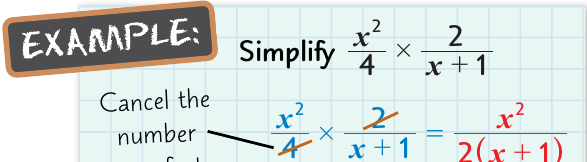
To multiply two algebraic fractions, multiply the numerators together and multiply the denominators together. However, there's a useful shortcut: you can cancel common factors before multiplying, which often makes the calculation much easier.
Note
Time-saving tip: Look for factors that appear in any numerator and any denominator - they don't have to be in the same fraction. Cancel these common factors first, then multiply what remains. This approach helps you avoid working with unnecessarily large or complex expressions.
The mathematical rule can be expressed as:
Dividing algebraic fractions
Division of algebraic fractions follows the same "flip and multiply" rule that you use with numerical fractions.
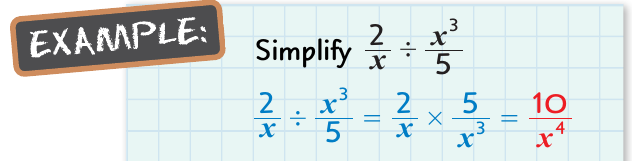
When dividing by a fraction, you multiply by its reciprocal instead. This means you flip the second fraction (swap its numerator and denominator) and then multiply. After flipping, you can treat the problem as a multiplication and apply all the same techniques, including cancelling common factors before multiplying.
Important
Essential Rule for Division: Division by a fraction is the same as multiplication by its reciprocal, so
Remember that division by a fraction is the same as multiplication by its reciprocal, so .
Adding and subtracting algebraic fractions
Adding and subtracting algebraic fractions is more challenging because you need to work with common denominators. Unlike multiplication and division, you can't simply combine numerators and denominators directly.
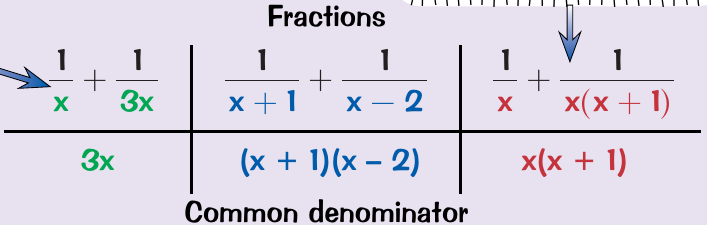
The process involves several steps:
- Find a common denominator for all fractions
- Rewrite each fraction with this common denominator
- Add or subtract the numerators
- Keep the common denominator
The common denominator is typically the product of all the different denominators, though sometimes you can use a simpler expression if the denominators share common factors.
When working with more complex denominators, you'll need to multiply each fraction by appropriate factors to achieve the common denominator. For instance, if you're adding fractions with denominators and , your common denominator will be .
Example
Worked Example: Adding Fractions with Different Denominators
To add :
Step 1: Identify the common denominator Common denominator =
Step 2: Rewrite each fraction
Step 3: Add the numerators
Each fraction must be multiplied by the factors it's missing from the common denominator. The first fraction gets multiplied by , and the second by . Once both fractions have the same denominator, you can add the numerators and simplify if possible.
Summary
Key Points to Remember:
- Always look for common factors to cancel when simplifying - this makes your work much easier
- For multiplication, multiply straight across but cancel common factors first where possible
- For division, flip the second fraction and multiply instead
- For addition and subtraction, you must find a common denominator before combining fractions
- Factorising expressions first often reveals opportunities for simplification that weren't immediately obvious